

What you can do today, with no permit and no risk
Start here, because most of the useful ground needs no authorization at all and it is the part properties most often skip while waiting for a vendor.
New York DEC states plainly that no federal or state permit is needed to scare, herd or chase geese, including with dogs or noisemakers, provided no bird is physically harmed. That single sentence is the legal floor the whole non-lethal field stands on. Everything below it is either free or a matter of grounds work.
Six things you can do without anyone's permission
01
Stop the feeding, and post it
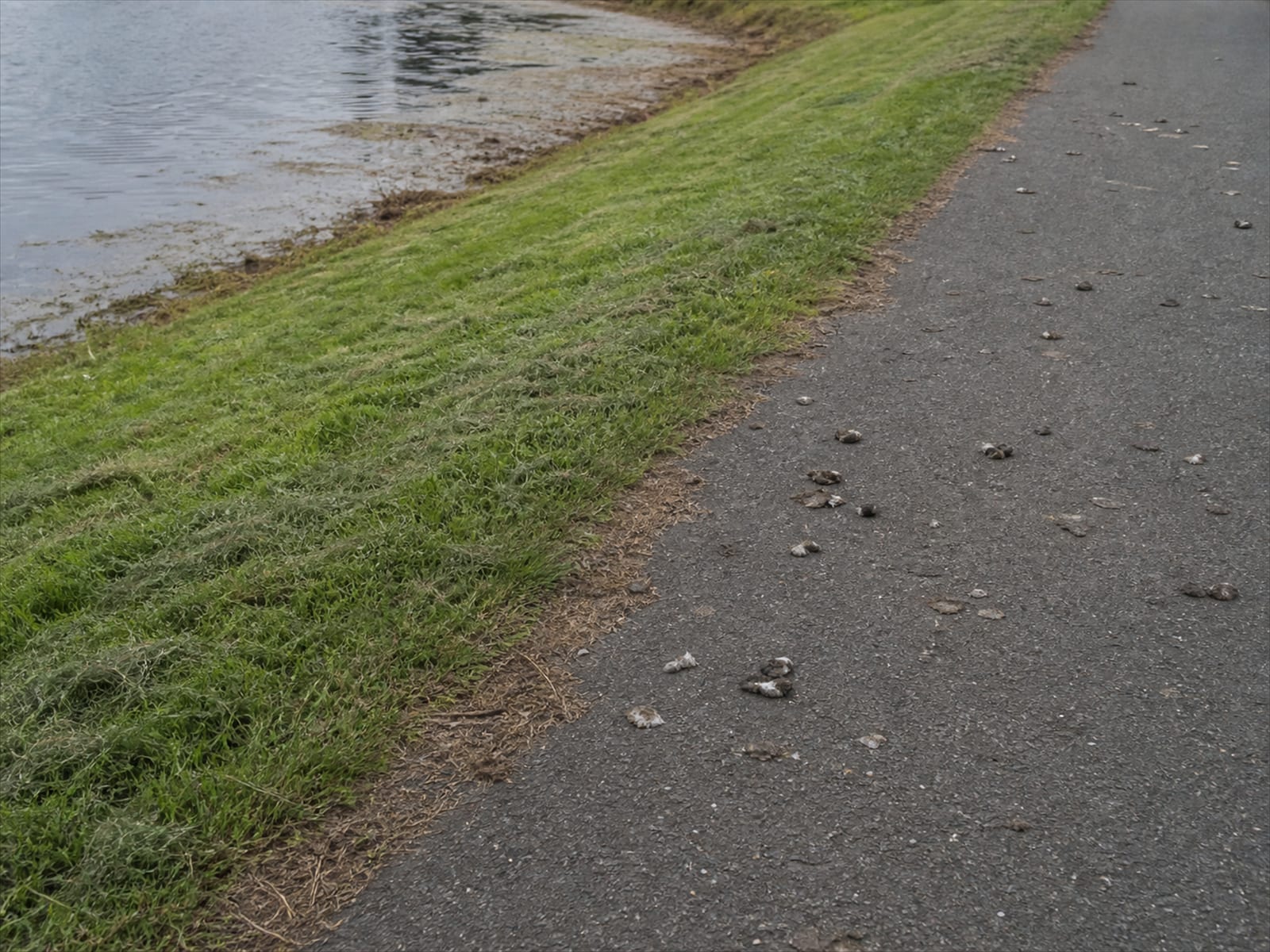
USDA APHIS says feeding encourages wildlife to congregate, reduces their fear of people and can increase both aggression and disease spread. One person with a bag of bread will hold a flock against everything else on this list.
02
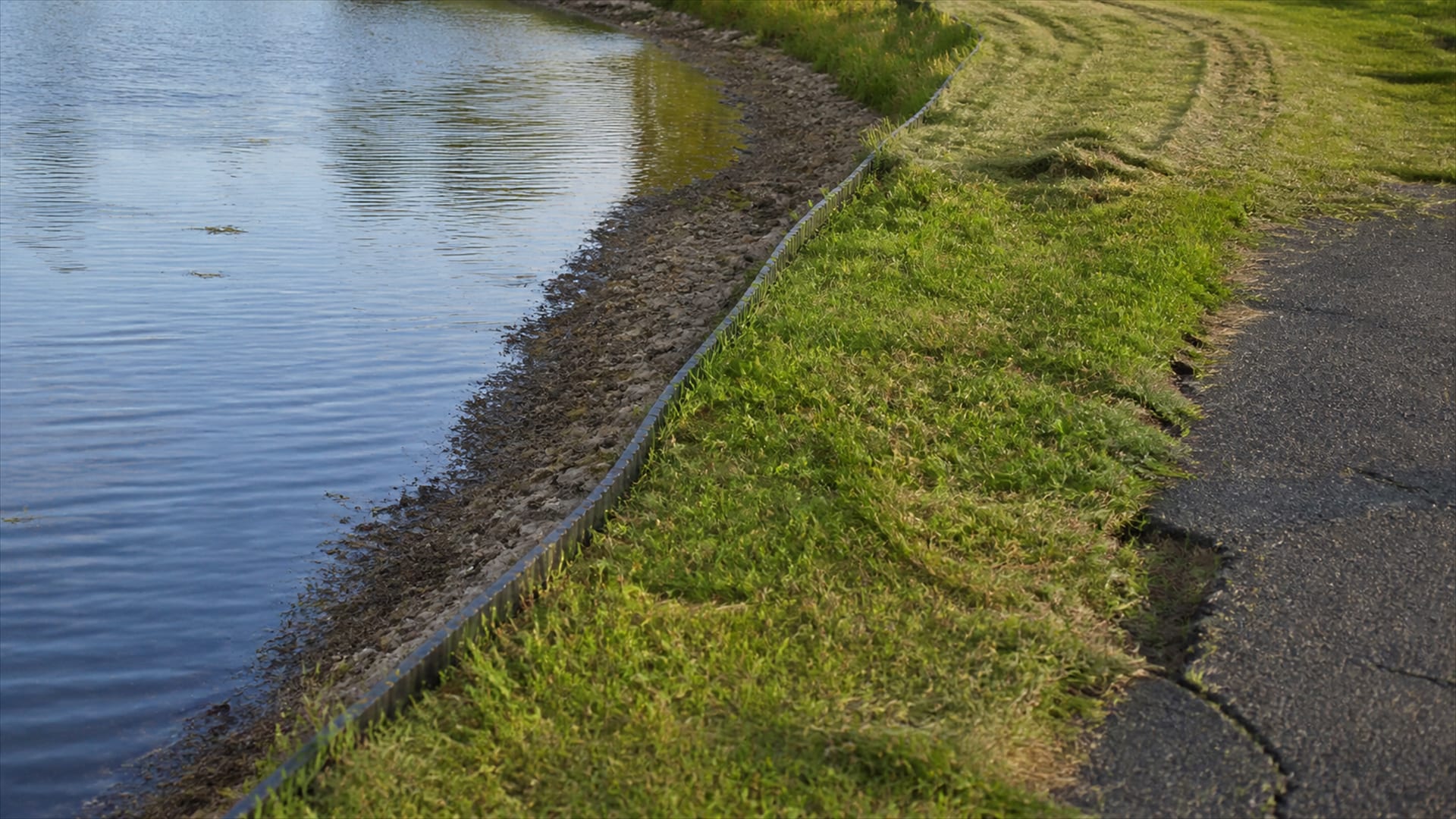
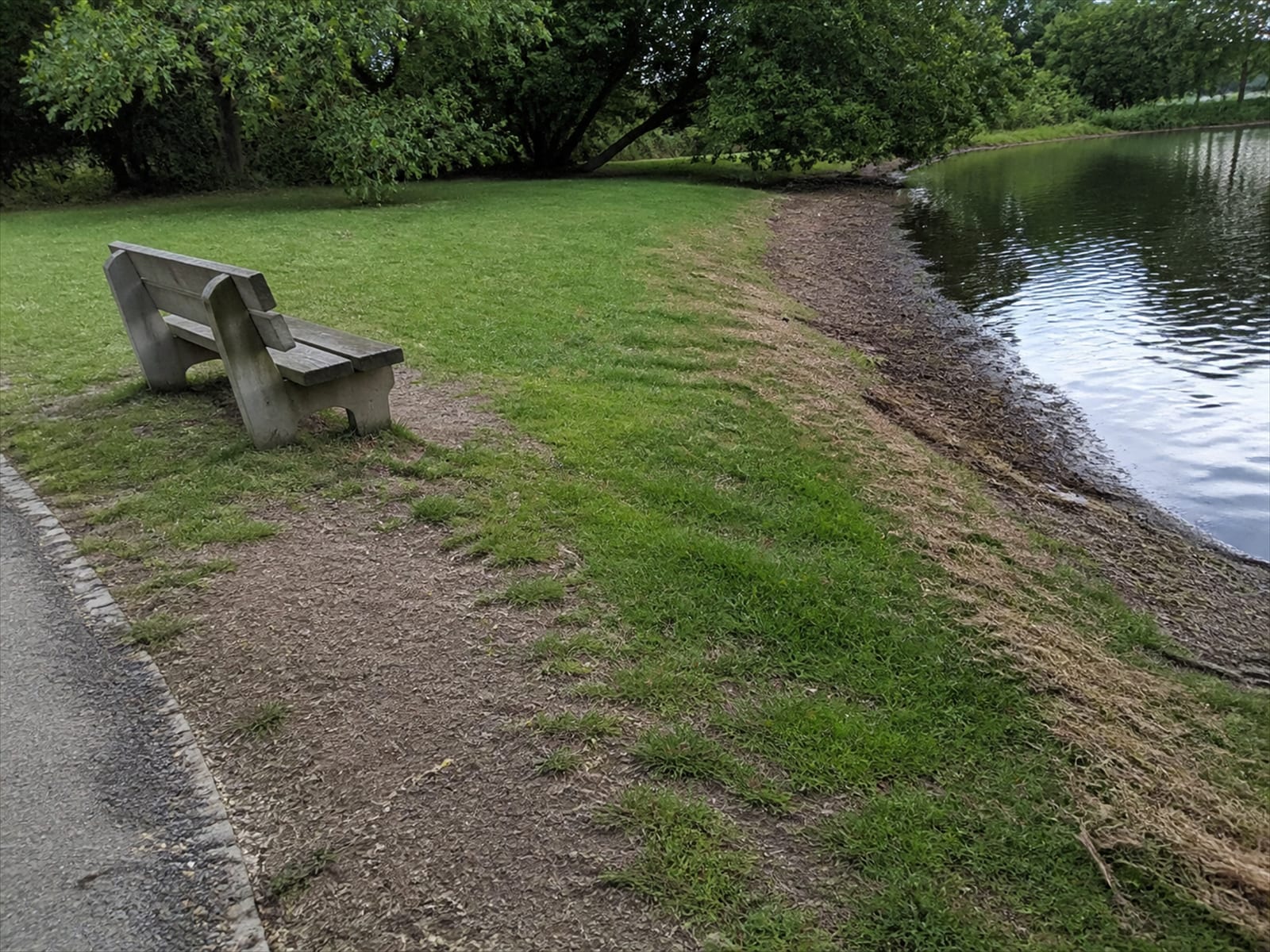
Stop mowing to the water
Connecticut's guidance names waterfront lawn created by development as the thing that makes a site attractive in the first place. The mower is doing half the work of keeping the birds there.
03
Put something in the walking route
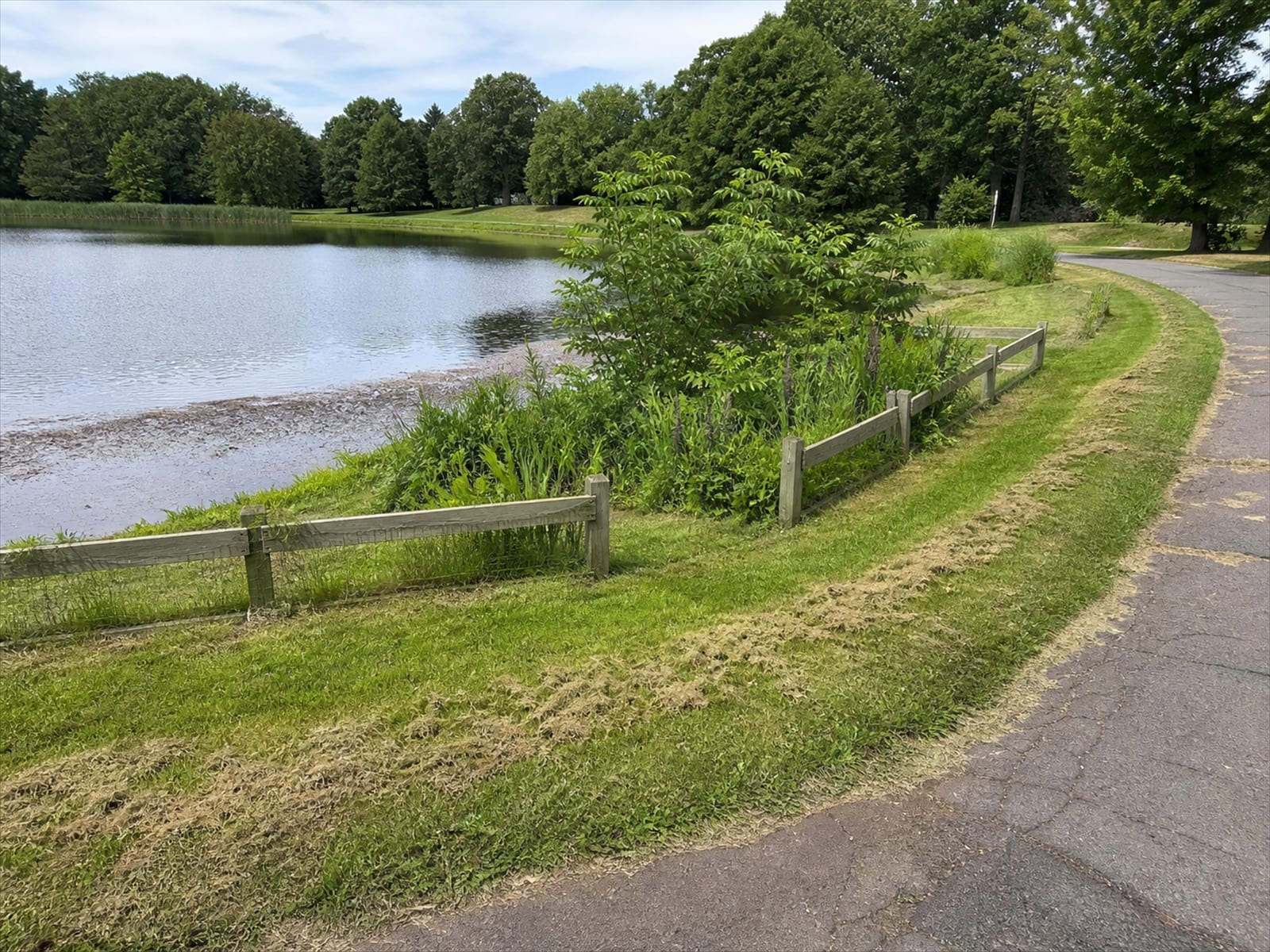
Connecticut's stormwater manual gives a minimum 3 foot barrier, and a dense shoreline buffer of 20 to 100 feet, as exclusion options. MassWildlife gives the same 3 foot figure for chicken wire and counts a hedge or uncut strip as a barrier too.
04
Start dispersal before the pattern sets
Connecticut's manual says frightening methods work best before birds establish a feeding pattern, and around sunrise and sunset. Waiting until the flock is settled makes the same effort worth less.
05
Write down what you are seeing
Numbers, locations, times, complaints. Without it you cannot tell slow progress from none, and you cannot answer the board in six months.
06
Talk to whoever owns the water
Cornell says a resident population is rarely confined to one property and that community collaboration is necessary for management that lasts.
Not one of those requires a permit, a license or a contractor. They are also the items that keep working when nobody is on site.
The numbers the agencies actually publish
Most goose advice is adjectives. These are the figures with a public source behind them, which matters when you are specifying work or checking a quote.
Published figures worth knowing before you specify anything
Two of those get misused constantly. The phosphorus figure is from two specific lakes with large winter flocks and should never be quoted as what geese do to any pond. And the 1.5 pound figure is a per-bird technical estimate; multiplying it by a flock count gives you an order of magnitude, not a cleanup budget. The arithmetic that actually matters is on our page about droppings and turf damage.
Safe for people, which is a separate question
A deterrent that works on birds can still be the wrong thing to put on ground the public uses.
Anything installed at a shoreline sits where people walk, where children go and where somebody may need to get out of the water. Connecticut's own guidance treats barrier design as a site question rather than a product choice, and that is the right instinct: the fence that solves the goose problem and blocks an accessible route has not solved anything. On school ground, park and beach sites, the design has to answer to public access, visibility, drainage, accessibility and safety codes before it answers to the birds.
The other people-safety issue is the one that arrives on its own schedule. Nesting pairs defend, and they do it beside doors and paths rather than out of the way. That is a spring problem with a spring answer, covered on our page about nesting season aggression, and the thing not to do is improvise near a nest.
Airfield property is its own category and should not be handled with ordinary grounds practice. The FAA maintains the wildlife strike database and its own hazard mitigation process, and on or beside an airfield that process comes first. We treat it that way too, on our page about bird strike risk.
Where a permit starts, and who has to hold it
This is the part that decides whether a vendor is offering you something legitimate.
Canada geese are protected migratory birds. The Migratory Bird Treaty Act is codified at 16 U.S.C. 703 through 712 and the federal permit rules sit in 50 CFR Part 21. Non-injurious dispersal sits outside all of that. Handling a bird, a nest or an egg sits inside it.
For nests and eggs specifically, the resident Canada goose nest and egg order lets eligible landowners, public land managers, homeowner associations and local governments in the lower 48 register annually for that authority on land under their own jurisdiction. Three details in the FWS guidance matter more than the rest: registration is annual and must precede activity, reporting is required afterwards, and registrants are expected to use appropriate non-lethal measures to reduce the need for that work at all.
Read that last one again, because it is the sequence the whole field is supposed to follow, and it is the reason a serious provider will talk to you about mowing lines and feeding before they talk to you about anything regulated.
The states then layer on:
- Connecticut. State law requires migratory game bird rules at least as stringent as the federal ones and says no person may take a nest or egg of a wild bird except under lawful authority. There is a separate agricultural depredation permit route for qualifying producers, which is not the route an office park or a town green is on.
- Massachusetts. MassWildlife says it is illegal to interfere with Canada goose eggs without authorization, publishes an egg addling permit application, and is explicit that the presence of geese alone is not a sufficient basis. There has to be a real reason, such as property damage.
- New York. DEC points nest and egg work at the federal registration and says it does not require additional state authorization for that limited activity. It also says relocation is generally not allowed even with a permit, so moving the flock elsewhere is not an option somebody is withholding from you.
The permit belongs to the property, not to the contractor. If a company offers to take care of a nest, the first question is who is registered for this site, and the right answer names you.
Anything beyond nests and eggs runs through a different door again. The federal migratory bird depredation permit application is its own form with its own processing fee, listed by FWS at 50 dollars for a homeowner and 100 dollars for a business. Those are federal administrative figures and nothing else: they are not the cost of a program, and they cover none of the state requirements, labor or materials.
Repellents: a real technique, and licensed work
Turf repellents come up in every conversation about safe deterrents, so it is worth being precise about what they are and who may use them.
Cornell identifies methyl anthranilate and anthraquinone as the active ingredients in registered goose repellents, and makes two points that get skipped. These products are pesticides, so state registration and certified applicator requirements apply. And they need repeated application, which Cornell notes can add considerable expense on any real acreage.
We do not apply repellents. Applying a product like that to commercial turf is licensed pesticide work in Connecticut, Massachusetts and New York, we hold no such certification, and we will not imply otherwise to win a job. If a repellent is right for a defined area on your property, such as a small high-traffic surface that has to stay clean, the person to talk to is a licensed applicator, and the questions to ask them are the product's registration in your state, the reapplication interval and what rain does to it.
Egg addling sits in the same category for us and for the same reason. It is real, it is regulated, and it is not ours.
Massachusetts egg addling under permit, 2014
- Permits issued statewide43
- Nests treated by permittees327
- Nests treated under the statewide agency permit91
Those permittees treated 1,580 eggs across those 327 nests, with a further 467 eggs under the statewide permit. The reason to show you a regulated technique's actual scale is that it is small, specific and documented, which is what regulated work looks like. Anything offered casually is a different thing wearing its name.
What fails, and why it fails
Most properties have already tried two or three of these. That history is genuinely useful, because what the flock has learned to ignore changes what to do next.
The first failure is habituation. Connecticut's manual says geese become accustomed to repeated frightening methods, and Cornell puts it precisely: habituation can be reduced but not eliminated. A device that never becomes a real threat eventually becomes scenery. That is the whole difference between a decoy and a dog, and it is why Border Collie goose abatement works on a schedule the flock cannot learn rather than on a fixed one.
The second failure is scale. Cornell's urban goose guidance says short-term scare techniques and barriers can relocate a flock rather than resolve it. Connecticut has this documented locally: the DEEP watershed plan for Baker Cove in Groton records a regional flock being handled independently by Shennecossett Golf Course, Birch Plain Golf Course, Groton-New London Airport and Groton Utilities, and found that disjointed efforts rotated the birds between locations rather than reducing them. Up at Roseland Lake in Woodstock, the state records roosting flocks reaching several thousand in spring, autumn and ice-free winters, feeding out onto nearby farmland and golf courses.
The third failure is the shortcut. MassWildlife says breaking eggs is often ineffective because geese will lay replacement eggs, which means the unlawful version of the technique does not even work.
The fourth is doing the fieldwork and none of the grounds work. That is the one that produces a program which stops the day it is paused, and it is why habitat modification belongs in the same contract rather than in next year's budget.
The year, and what it changes
Timing decides which of these is worth doing, and the same property needs a different plan in March and in August.
A regional planning year for Connecticut, Massachusetts and the Hudson Valley
Late February through mid-May
FWS puts resident goose nesting in this window, with most eggs hatching in early May, and Connecticut DEEP reports pairs beginning to nest between March and May. Anything you want to change at a shoreline is easiest before a nest exists.
March 1 through June 30
The federal window for regulated nest and egg activity by registered parties, with registration open from January 1. A legal calendar, not a recommendation that any site should use it.
Mid-June through early July
FWS describes the adult flightless molt in this period. Birds cannot fly out, so a barrier is doing more work than at any other time, and dispersal has to be planned around the fact that flightless young may be present.
August onward
Flight returns and the flock ranges widely across developed and agricultural ground. FWS describes resident birds as nesting in the lower 48 March through June or residing there April through August.
Autumn and winter
Abundance rises through the region as migratory birds arrive. Connecticut records migration through November and a mid-December arrival peak. Resident birds commonly stay wherever open water and food hold out, so a winter inspection beats an assumption.
New York's own guidance describes the same pattern from the other side of the region. DEC says resident geese are present year round in New York parks, waterways, residential areas and golf courses, and names short grass, ponds and lakes, few predators and supplemental feeding as what turns presence into conflict. It even records a specific origin story near Albany: the nesting geese at the Five Rivers Environmental Education Center are thought to descend from birds once raised on the site. Resident flocks are usually somebody's history rather than a new arrival.
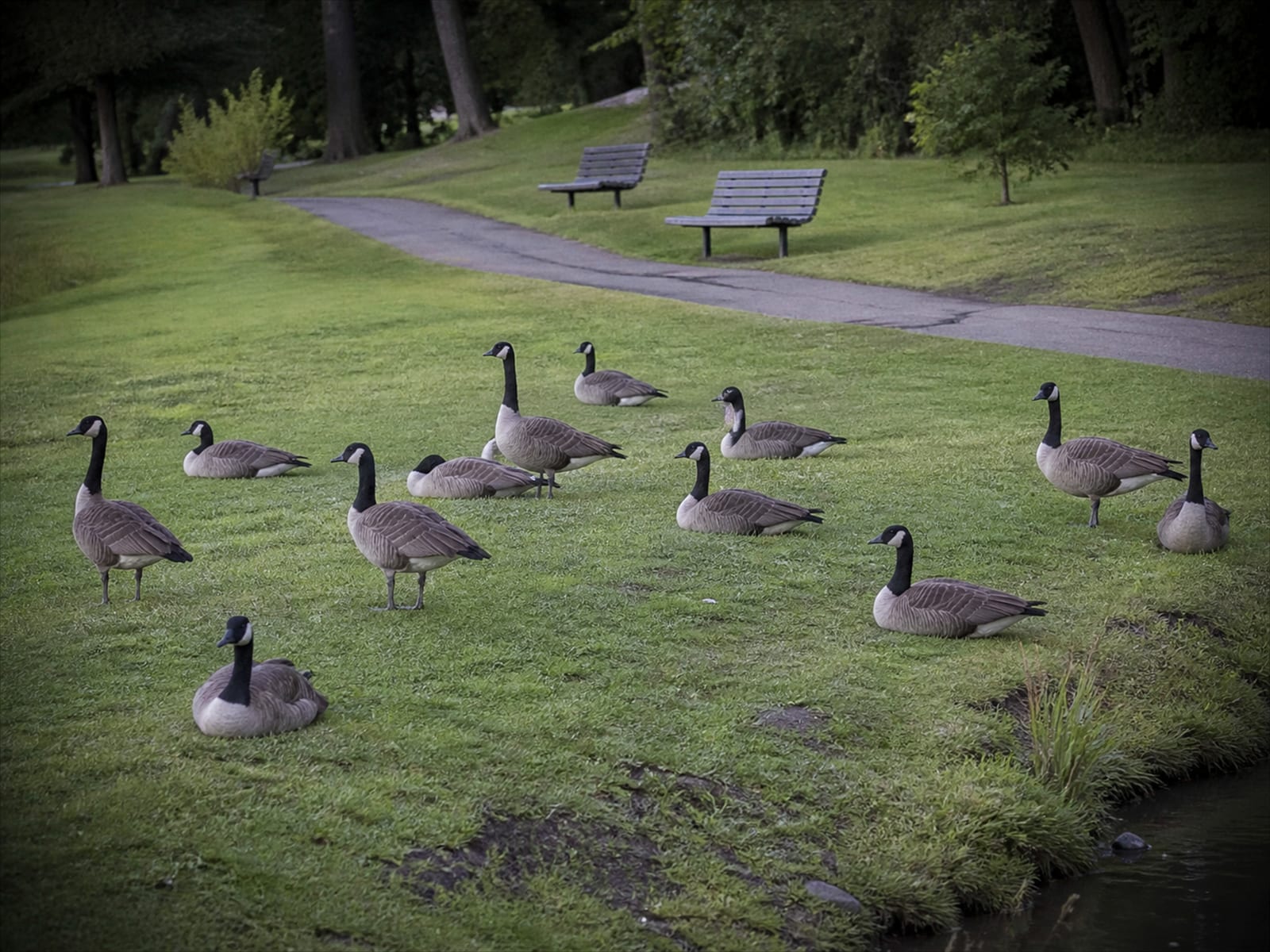
One note on identification that saves arguments. Connecticut DEEP says migratory and resident birds overlap in autumn and winter and cannot be told apart by appearance, so a November flock tells you very little about where those birds nested. What the bird actually is, and why the resident population behaves differently, is on our page about the Canada goose.
Whether it is working, and how you would know
Counting birds is the measure everyone reaches for and the one most likely to make a working program look like a failure.
Watch the surfaces people use rather than the property as a whole. Watch how long it takes the flock to come back after each visit, because that interval stretching is the earliest honest signal you get. Watch complaints, which your organization already tracks. Watch whether anybody is still feeding them. And treat the water separately: goose presence is a reason to test, not a test result, and Connecticut's statewide bacteria plan lists wildlife alongside pets, human sewage and agricultural runoff precisely because attributing a reading to one source needs evidence. That distinction is the whole of our page on water quality in ponds.
Would your property pass a wildlife-law spot check?
Pick an answer to see how you did
1. A flock is on the main lawn this morning. What can your own staff legally do about it today?
2. A contractor offers to treat a nest on your property. What is the first thing to establish?
3. You are quoted for a turf repellent across the main lawn. What has to be true?
4. Geese are on the grass in December. What does that tell you about your resident flock?
Nothing answered yet.
Questions we get from facilities and parks managers
Is a dog safe around the public, and around the birds? It is the method the state guidance names first for exactly that reason. New York DEC's position is that scaring, herding and chasing, dogs included, needs no permit as long as no bird is physically harmed. The dog herds and makes no contact, which is what keeps it lawful rather than what makes it gentle. Visits are scheduled around how the site is used, which on public ground usually means before or after the people arrive.
Will the geese just move to the property next door? They can, and it is better raised now than discovered later. Cornell says short-term techniques can relocate a flock, and Baker Cove is the local record of exactly that happening between neighboring landowners. Where a pond, a path or a field is shared, the sensible boundary for a program is sometimes bigger than one parcel, and that conversation is part of consultation and program design.
Can we just put up a fence? Sometimes, and it does the most work during the summer flightless weeks. Once the birds are flying again, a barrier at the water edge stops being the whole answer, because it only interrupts the walk in. It stays worth having; it stops being sufficient.
We are a water supply property. Is this different? Yes. Massachusetts DCR runs long-term bird dispersal programs at the Wachusett and Quabbin reservoirs specifically to limit what birds contribute to the water. On agency-controlled water supply land, that agency's rules and authority come first and no private contractor should suggest otherwise.
What does it cost? There is no published price range for this work in Connecticut, Massachusetts or the Hudson Valley, and any number quoted before somebody has walked your site is invented. The drivers are acreage, how much water edge and how reachable it is, flock pressure, how often visits happen and in which seasons, constraints from public use, how much habitat or barrier work is in scope, and whether anything regulated is involved.
Does any of this apply to a golf course? The same law and the same figures, with tighter constraints on where habitat work can go and when anyone can be on the ground. We wrote that up in goose control for golf courses. If your problem is that a previous program stopped holding, the companion piece is long-term goose control in Connecticut and New York.
Where this leaves your property
Safe, on ground the public uses, is three tests rather than one. A method has to stay inside the law that protects the bird, has to be something you would be comfortable defending to whoever walks past it, and has to not make the pond worse. Very little passes all three on its own, which is why the guidance keeps describing combinations rather than products.
The encouraging part is where the useful work sits. The items that need no permit, no license and no contractor, ending the feeding, moving the mowing line back, interrupting the walk up from the water, are the ones that keep working while nobody is watching. Fieldwork then does the part grounds work cannot, which is changing what the birds believe about the property today.
If you are deciding what to put in front of a board, tell us what you are dealing with: how many birds, which surfaces, how close the water is and who else owns a piece of it. Tri-State Geese Patrol runs humane Canada goose abatement with trained Border Collies across Connecticut, Massachusetts and New York, working out from West Hartford, and you can see where we cover on our service areas page. Call us on (203) 856-4889 or send us a message and it goes to Bill. If the honest answer for your site is a fence and a no-feeding sign rather than a contract, we will say so.
The words that decide what is allowed
Tap a term to see what it means
Hazing. Moving birds without physically harming them, using dogs, noisemakers or people. New York DEC says this needs no federal or state permit provided no bird is hurt, which is the legal basis for dog-based work rather than a softer word for something else.