

Why golf courses in particular
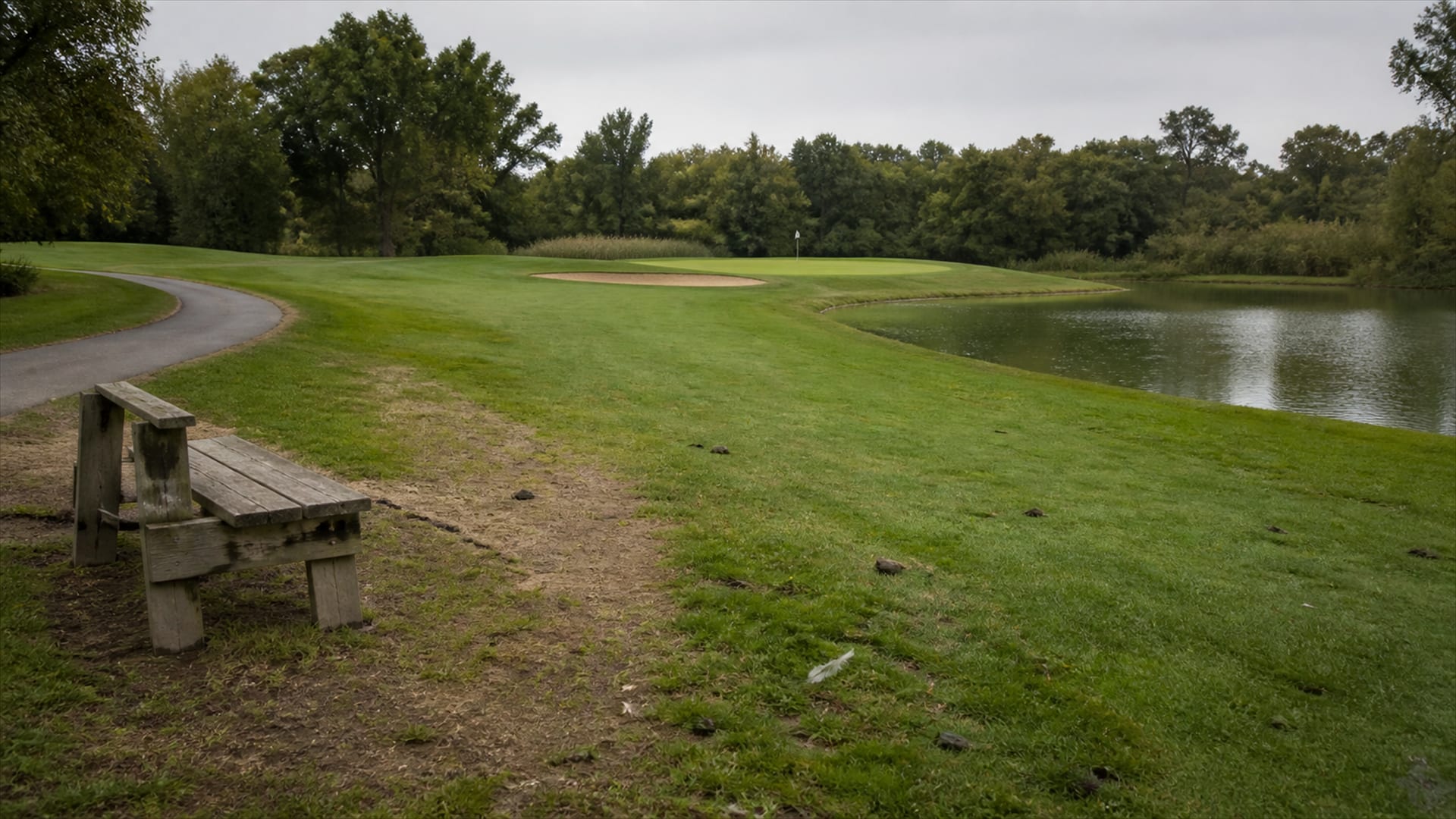
Because a course supplies everything a Canada goose is looking for, arranged next to each other, and it does so by design.
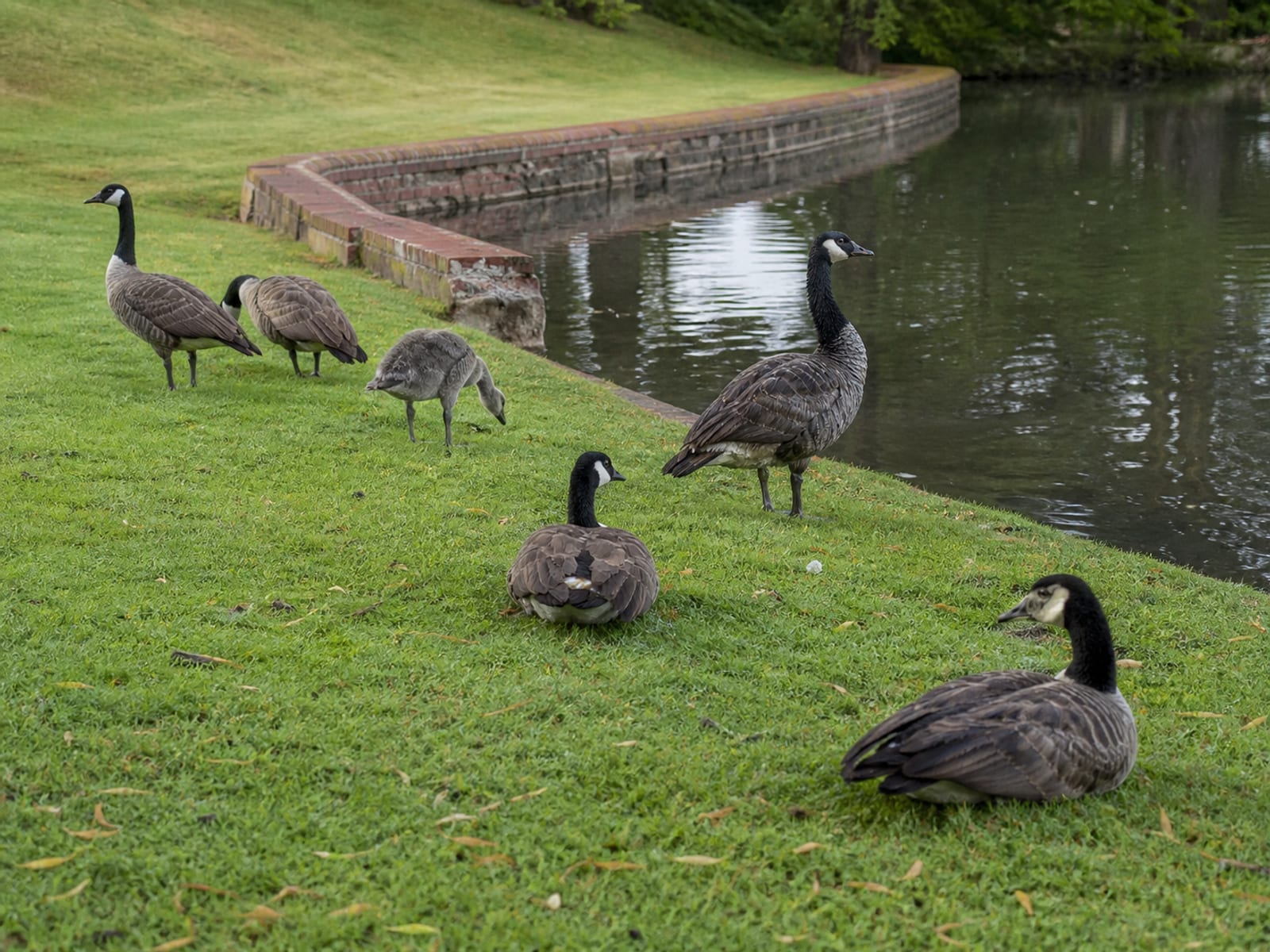
Connecticut DEEP lists golf courses directly among the habitats that hold resident geese, alongside lawns, parks, athletic fields, ponds and reservoirs. Its nuisance guidance is more specific about why: geese need room to land and take off, and they are uncomfortable feeding where their view of a predator is poor. Cornell's guidance on urban geese arrives at the same three ingredients from a different direction, naming open view, grazing turf and nearby water.
Now read that back as a description of your property. Short, fertilized, irrigated turf is better forage than anything in the rough. Water hazards are an escape route a few steps away. The sightlines are open because golf needs them open. Nothing on that list is a mistake somebody made.
That is genuinely the useful reframe here. The work is not about undoing the course. It is about changing the parts of it the birds are reading, in the places the course can afford to change.
What eleven superintendents actually reported
- Identified droppings as a concern8
- Identified grazing as a concern7
- Ranked grazing the most serious7
- Reported spring and summer problems7
- Reported fall and winter problems8
- Flocks that arrived within five years3
What the birds are doing to the turf
The fouling is what members complain about. The grazing is what shows up in your budget.
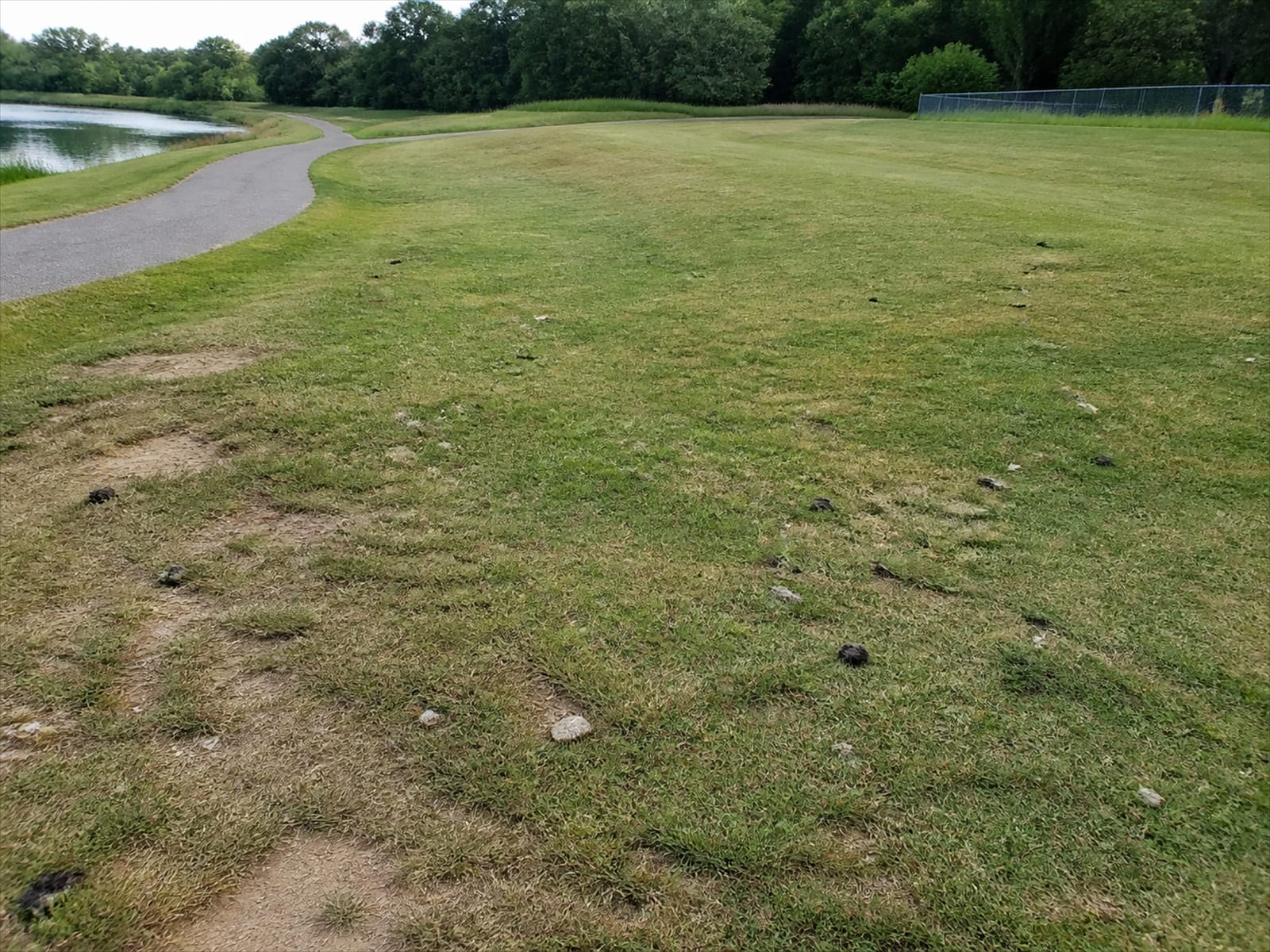
Canada geese are grazers, and they return to the same ground repeatedly, so the same square yards get cropped, trampled and fouled across a season. A 1991 Connecticut study of twenty sites found less Kentucky bluegrass in heavily grazed areas than in lightly grazed portions of the same lawns. At six sites where several hundred geese gathered daily to be fed, 46 percent of the ground was bare except for moss.
Two cautions on that number, because it gets quoted badly. Those six were severe, food-conditioned sites, and it is not a prediction for a green. And droppings and grazing should not be treated as the diagnosis for every thin or wet patch on the course; you still need to look at each surface on its own.
What is fair to say is the shape of it. USDA APHIS reports that a single Canada goose can defecate every twenty minutes and produce up to 1.5 pounds of feces a day. Multiply that by a resident flock spending most of daylight on your ground and the cleanup does not scale down, because clearing a surface resets the count without changing the rate.
The measure that actually moves the problem is bird-hours on the course: the number of birds multiplied by the hours they spend on it. Everything below is a way of reducing it, and the same arithmetic is set out in more detail on our page about droppings and turf damage.
What does not work, and why
Most courses have already tried two or three of these. That history is useful rather than embarrassing, because what the flock has already learned to ignore genuinely changes what to do next.
Six approaches the agencies say will disappoint you
01
A static scare device on its own
Connecticut DEEP says geese habituate to visual deterrents, particularly when used alone. It also has to be maintained, and on a course it has to look acceptable from the tee.
02
One-time chasing by cart or boat
DEEP is blunt that the birds come back once the vehicle is gone, and describes the approach as having limited long-term use.
03
Treating a course like a lawn
Topical repellents must be reapplied after rain and are not well suited to large expanses of turf. They protect a defined priority area, not eighteen holes.
04
A pond barrier while the birds can fly
Fencing at the water edge is effective during the flightless molt and loses much of its effect once the flock can simply fly in over it.
05
A night-only pond tool for a daytime problem
Connecticut DEEP says lasers may deter geese roosting on a pond, and they do nothing about feces, feathers or grazing on turf during play.
06
Letting the feeding continue
New York DEC says feeding concentrates birds at unnatural sites, can delay migration, and contributes nutrients that lead to water quality problems.
The pattern behind all six is the same. Each is a single tool asked to be the whole program, and both state agencies say that does not work. New York DEC states that no single method is universally effective and that persistent use of a combination is usually necessary. Connecticut DEEP puts it as long-term solutions being complex, with no panacea, and several non-lethal techniques used together at the right time doing better than any one alone.
What a program looks like on a course that has to stay open
The constraint nobody outside golf appreciates is that the answer has to fit inside play, mowing and irrigation rather than interrupt them. A recommendation that closes a hole is not a recommendation.
Trained dogs, on a schedule the flock cannot predict
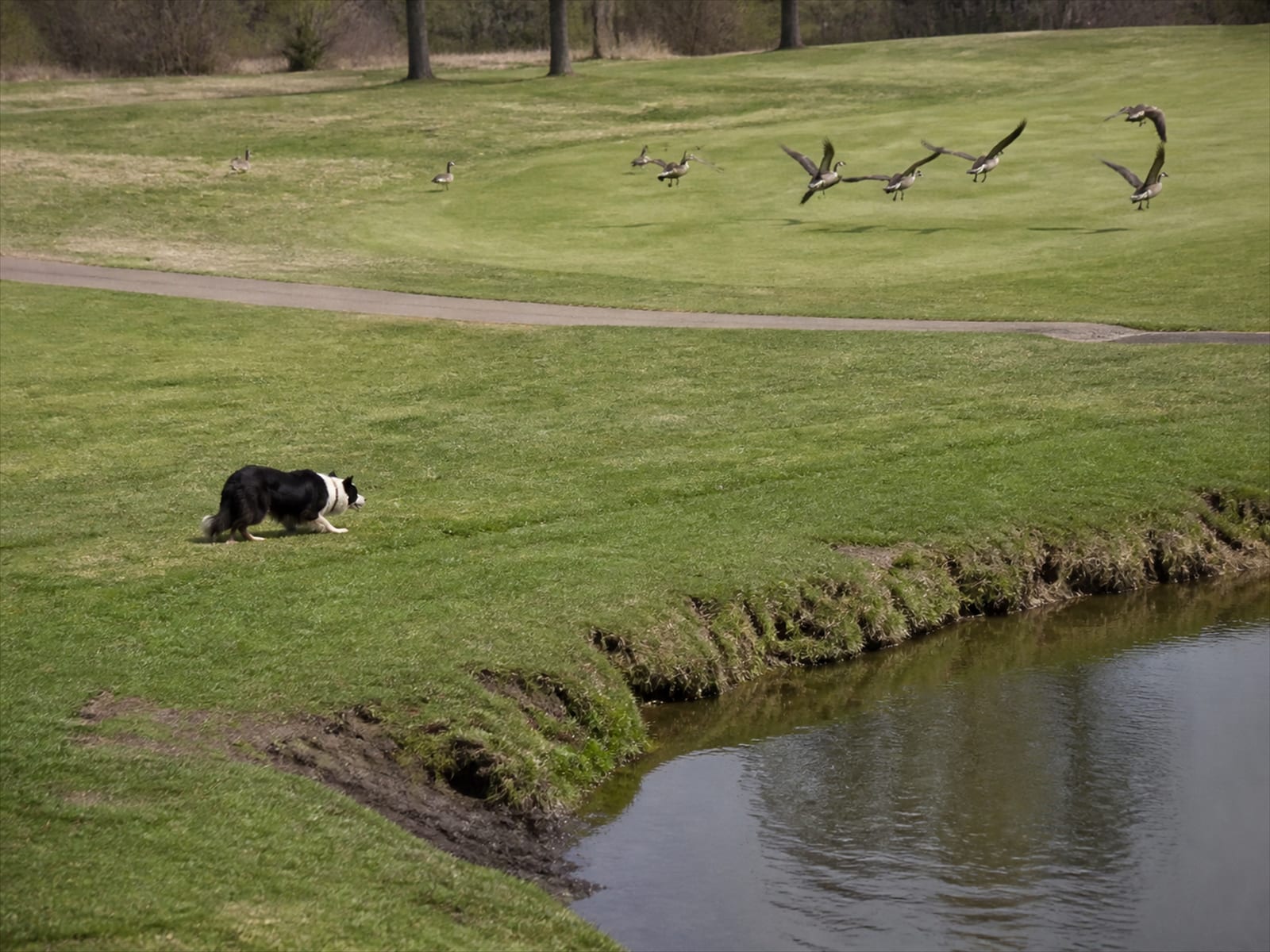
A Border Collie works a low stalking posture, and a goose reads that as a predator instinctively rather than learning it. No contact, no noise, no bird harmed. New York DEC states that no federal or state permit is needed to scare, herd or chase geese with dogs or noisemakers as long as the birds are not physically harmed, and MassWildlife names trained dogs as especially effective among the non-lethal options. That is what our Border Collie goose abatement program does.
The part worth being straight about is why one visit is not the program. USDA research on hazing found that geese left sites more often when hazed but returned more quickly than on unhazed days, and did not avoid a site for longer than 48 hours after a single event. Repetition on an unpredictable pattern is the mechanism. A flock that can time the arrival will simply wait it out, which on a course means moving to the far nine for an hour.
Habitat work, in the places play allows
This is the durable half, and on a golf course it is also the constrained half. Connecticut DEEP calls habitat modification the most effective non-lethal way to reduce conflicts, while being clear that many of the useful changes are not practical on recreational ground.
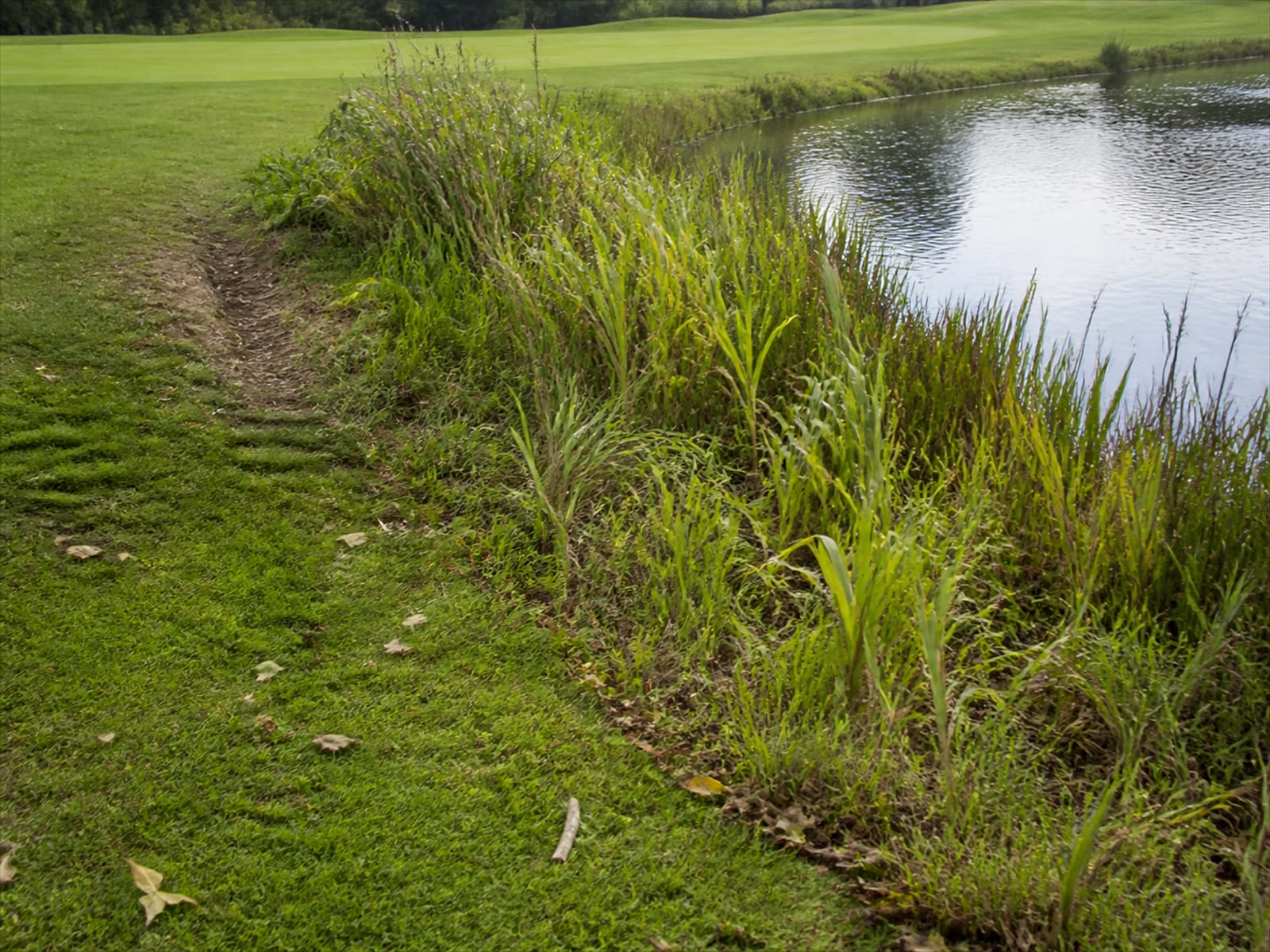
So the design question is never what would deter a goose most. It is which pond edges are far enough from play to carry a buffer. Massachusetts DCR tells its own site managers not to mow to the water edge and to keep a vegetated buffer instead, and MassWildlife recommends a hedge or a wide swath of uncut growth between water and mowed grass. This is the habitat modification half of a program. On a course, the ground behind a green, a far bank and out-of-play shoreline are usually where that fits without changing how the hole plays.
There is a second argument for it that plays well with a green committee. Connecticut's nonpoint source plan says vegetated buffers reduce both goose attraction and pollution, so the same planting can be justified against water quality as well as birds.
Repellent on the surfaces that must stay clean, and who may apply it
An EPA-registered turf repellent makes treated grass less appetizing to grazing birds. It suits a defined priority area rather than wide expanses, it needs reapplying after rain or mowing, and on a course the mowing point matters more than the rain: treating on Tuesday and mowing Wednesday wastes the application, and the crew doing the mowing is rarely the crew doing the treatment.
One thing to be clear about, because it decides who you can even ask. Applying a repellent to commercial turf is licensed pesticide work in all three states, with its own certification categories and record-keeping. We do not offer it, and if a provider proposes it, ask which certification covers the work before anything is sprayed. Your own turf contractor may already hold it.
The season decides what is worth doing when
A program written in February and one written in August are not the same program, even on the same course.
The Canada goose year on a New England course
Late February and March
New York DEC says pairs return to nesting areas as the water opens, and Connecticut DEEP says territorial defense can begin in March. Walk the shoreline, the islands, any structures and the crew and golfer access routes before nests are established. This is the month of the year when acting costs least.
Early April into May
Connecticut guidance describes nesting by early April, with New York putting laying and incubation through April and peak hatch in late April or early May. Nests, eggs, adults and goslings all become a regulatory and safety checkpoint, and nesting season aggression starts generating incident reports. Nothing gets disturbed without verified authority.
Mid-June to late July
New York DEC gives a four to five week flightless molt in this window. The flock cannot leave, so concentration, droppings and grazing are at their most visible, and a pond-to-turf barrier is doing more work than at any other point in the year.
August
Birds resume flight. Do not let a barrier that worked in July become the whole plan; reassess fly-in access and get back to repeated hazing.
Fall and winter
The superintendent survey reported fall and winter problems at eight of eleven courses, more than reported them in spring and summer. A course with a winter flock should not wait for nesting season to map its high-use turf and water edges.
Massachusetts sits in the same latitude band, but no state page gives exact statewide nesting and molt dates, so those Connecticut and New York windows are a planning guide for a Massachusetts course rather than a promise.
Where the law stops everyone, including your contractor
This is the section worth reading twice, because the legal responsibility does not sit where most courses assume. The terms that decide what is allowed are defined at the end of this article.
Canada geese are protected under the Migratory Bird Treaty Act, which makes it unlawful, except as regulation permits, to pursue, take, capture, possess or transport protected migratory birds, their nests or their eggs. Non-injurious hazing sits on one side of that line and needs no permit. Handling a bird, a nest or an egg sits on the other.
The registration point deserves emphasis because it is where courses get caught out. 50 CFR 21.162 requires the eligible landowner or registrant to register the employees or agents acting on its behalf. A contractor's marketing claim does not substitute for the course's own legal responsibility. If somebody offers to take care of a nest for you, the question to ask is who is registered, and the answer needs to be your club.
Connecticut DEEP says a permit is required to addle eggs and points to its Migratory Game Bird Program. MassWildlife publishes an egg addling permit application and says there must be a reasonable basis, such as property damage. New York DEC says nest or egg treatment requires federal registration.
How to tell whether it is working
Are the geese gone is the wrong measure, and any provider who accepts it is setting a course up to be disappointed the first week a migrating flock drops in.
Measures that track a flock changing its mind
Keep the record through the months nobody is thinking about the pond. The survey found more courses reporting fall and winter problems than spring and summer ones, and a flock that establishes over winter is the one you meet again in March.
Would your course pass a wildlife-law spot check?
Pick an answer to see how you did
1. A resident flock is on the eighteenth fairway. Which of these can your crew do today with no permit?
2. When is a low fence between the pond and the turf doing the most work?
3. A contractor offers to handle a nest near the sixth tee. What should you ask first?
Nothing answered yet.
Common questions from superintendents
Will the dogs bother golfers or damage turf? The dogs work under handler control on a scheduled visit, and the work is timed around play rather than through it. That scheduling is part of the scope, and on most courses it settles into early morning before the first tee time.
How many geese is too many? There is no published number that fits every course, and any provider quoting one has not seen your property. What matters more than the count is where the birds are and how long they stay away between visits.
Can a repellent be used across the whole course? Not sensibly, and not by us. Connecticut DEEP describes topical repellents as practical for small lawns and poorly suited to large expanses of turf, so even where one is used it protects defined priority areas only. Application to commercial turf is licensed pesticide work, which we do not do; the dogs and the site work are what we bring.
Do the geese move to the course next door? They can, and it is worth raising early. Cornell notes that scare techniques and barriers can give relief at one property while moving a flock to another site. Where two courses or a course and a neighboring campus share a corridor, the sensible boundary for a program is sometimes larger than one property.
What does it cost? Pricing is per site, because the drivers are per site: how much ground is worked, how many birds, how much water, how often we visit and what the ground is used for. No credible published range exists for a course program in this region, and a number produced before anyone has walked the property is a guess.
We have a reservoir or drinking-water pond on the property. Does that change things? Yes, materially. New York DEC identifies nutrient loading and water supply public-health concerns among goose impacts, and any shoreline work near regulated water brings a wetlands or conservation review into the sequence. It does not stop a project; it sets the order of operations.
Where this leaves your course
A resident flock on a golf course is not a visitor problem, it is a habitat problem with a behavior problem sitting on top of it. The habitat half is slow, partial and constrained by play. The behavior half works quickly and stops working the moment it stops being repeated. Run one without the other and you get the result most courses have already paid for once.
What a properly built program buys you is not an empty property. It is playable surfaces on the holes that matter, a cleanup burden your crew can absorb, a spring that does not generate incident reports, and a record that tells you honestly whether any of it is working. Those are things a green committee can be shown, which is usually what a superintendent actually needs.
If your course is dealing with a flock that will not move on, tell us what you are seeing: which holes, how close the water is, and what has already been tried. Tri-State Geese Patrol runs humane Canada goose abatement with trained Border Collies across Connecticut, Massachusetts and New York, working out from West Hartford, and we run more than one crew, so a course ninety minutes out gets the same recurring program as one down the road. Call us on (203) 856-4889, or send us a message and it goes straight to Bill. If a goose program is the wrong answer for your property, we will tell you that on the first call rather than after the site visit.
The terms that decide what is allowed
Six words carry most of the weight in this subject, and three of them are the ones a provider can hide behind. Worth having straight before any conversation about scope.
Tap a term to see what it means
Hazing. Moving birds without physically harming them, using dogs, noisemakers or people. New York DEC states this needs no federal or state permit. It is the legal basis for dog-based abatement.