Tri-State Geese Patrol

Goose Control in Chicopee, MA

Humane Canada goose abatement for Chicopee properties, using trained Border Collies that move birds without touching them. In Chicopee the birds already show up in the city's water-quality data.

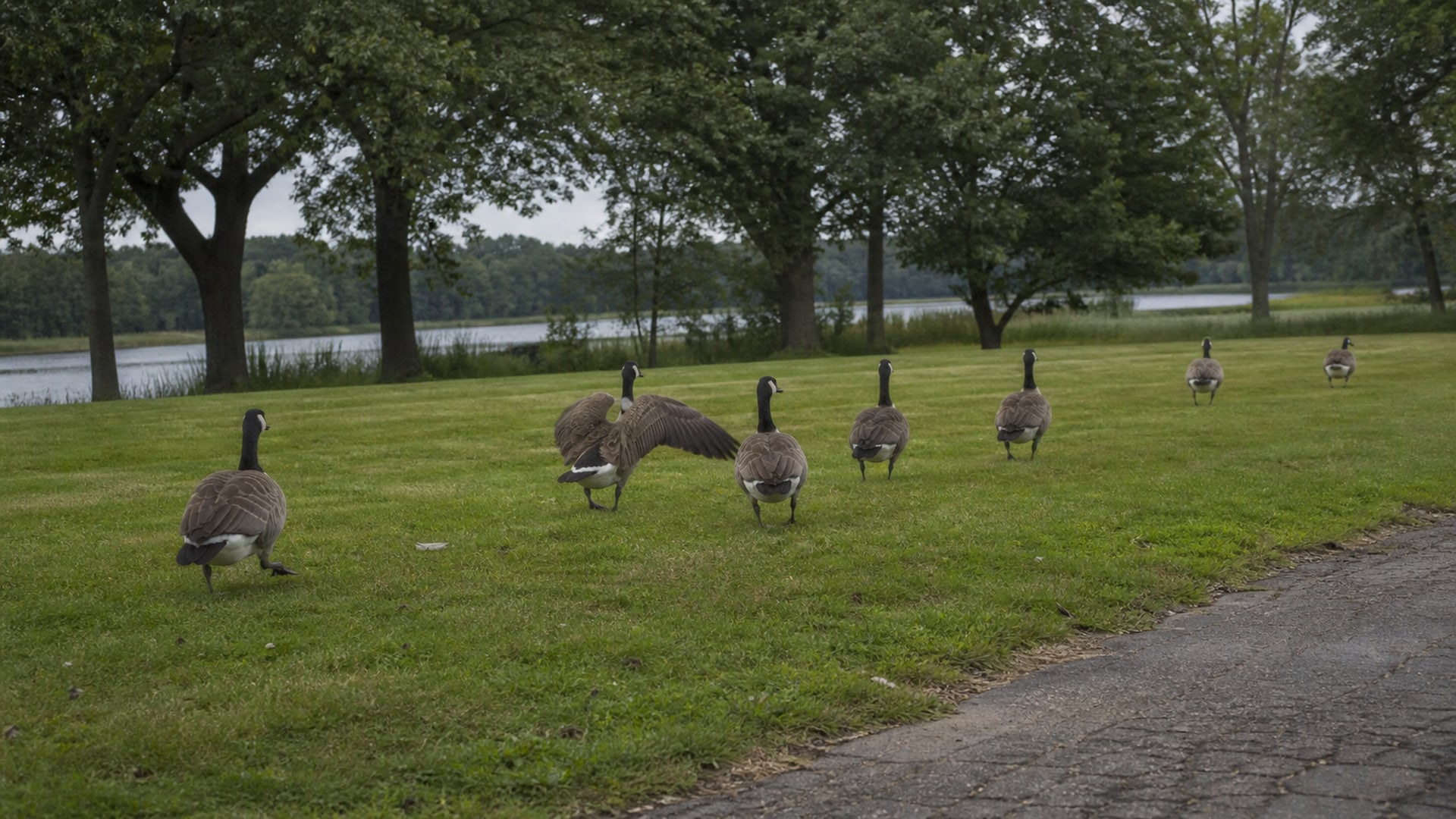
Open mown grass beside water of the kind Canada geese settle on in Chicopee, MA

At a glance

City

Chicopee, Massachusetts

Method

Non-lethal herding by trained Border Collies, no contact with any bird

Wetlands authority here

Chicopee Conservation Commission, under the Massachusetts Wetlands Protection Act

On the record locally

Goose waste was tied to elevated E. coli in Abbey Brook by source tracking

In Chicopee, the geese are already in the water data

Most goose arguments are about how the grass looks. In Chicopee there is a stronger version of the argument, and the city already has it written down.

The 2019 watershed plan for Abbey Brook and the lower Chicopee River says the grassed slopes beside the ponds at Szot Park are frequently habituated by geese. During field investigation, the plan records many geese and clear evidence of goose waste immediately next to Upper and Lower Bemis Pond. Then it goes one step further than almost any municipal document does: it reports that 2016 source tracking concluded goose waste contributed to elevated E. coli in Abbey Brook.

That is a measured link between birds on a specific lawn and a bacteria result in a specific brook. It is not a regional statistic borrowed from somewhere else, and it is not a vendor's claim. It means that on the Chicopee side of the river, a goose conversation can be a water-quality conversation with numbers behind it.

The city's own stormwater page follows that where it leads and asks residents plainly not to feed Canada geese. Worth knowing, if you are the one enforcing something: that is municipal guidance rather than an ordinance. We could not find a Chicopee code section prohibiting the feeding of waterfowl, and Massachusetts does not make wildlife feeding illegal statewide, though the state discourages it because it teaches animals to rely on people.

So on public ground the no-feeding message is persuasion. On your own ground it is a rule you can actually set, and it is usually the single highest-value thing on the list.

What the Abbey Brook design says about fixing it

The interesting part of that plan is not the diagnosis, it is the prescription, because the engineers reached for habitat rather than for a device.

To discourage year-round goose use, the plan proposes an upland sediment forebay, serpentine bioswales and a vegetated berm. Read past the engineering vocabulary and those are all the same idea: interrupt the open walk between water and mown grass, and make the sightlines worse from a goose's point of view.

That is exactly what Connecticut and Massachusetts wildlife guidance says about barriers, and it is the half of the work that keeps going when nobody is on site. MassWildlife's own advice for a property runs along the same lines, describing a three foot fence, or a hedge or uncut strip between water and mown grass, as an effective barrier.

It also tells you what the plan did not reach for. There is no proposal there for lights, decoys, tape or noise devices, because those fade. Geese habituate to a warning that repeats and never turns out to be real.

The gap the plan leaves is the immediate one. Berms and bioswales take design, permitting, funding and construction seasons, and the Lower Bemis Pond dam removal alone carries a city-listed five million dollar allocation. Meanwhile the birds are on the grass this month. That is the space a dog program occupies: it changes behavior now, while the ground work changes the site later, and the two belong in the same plan rather than in different decades.

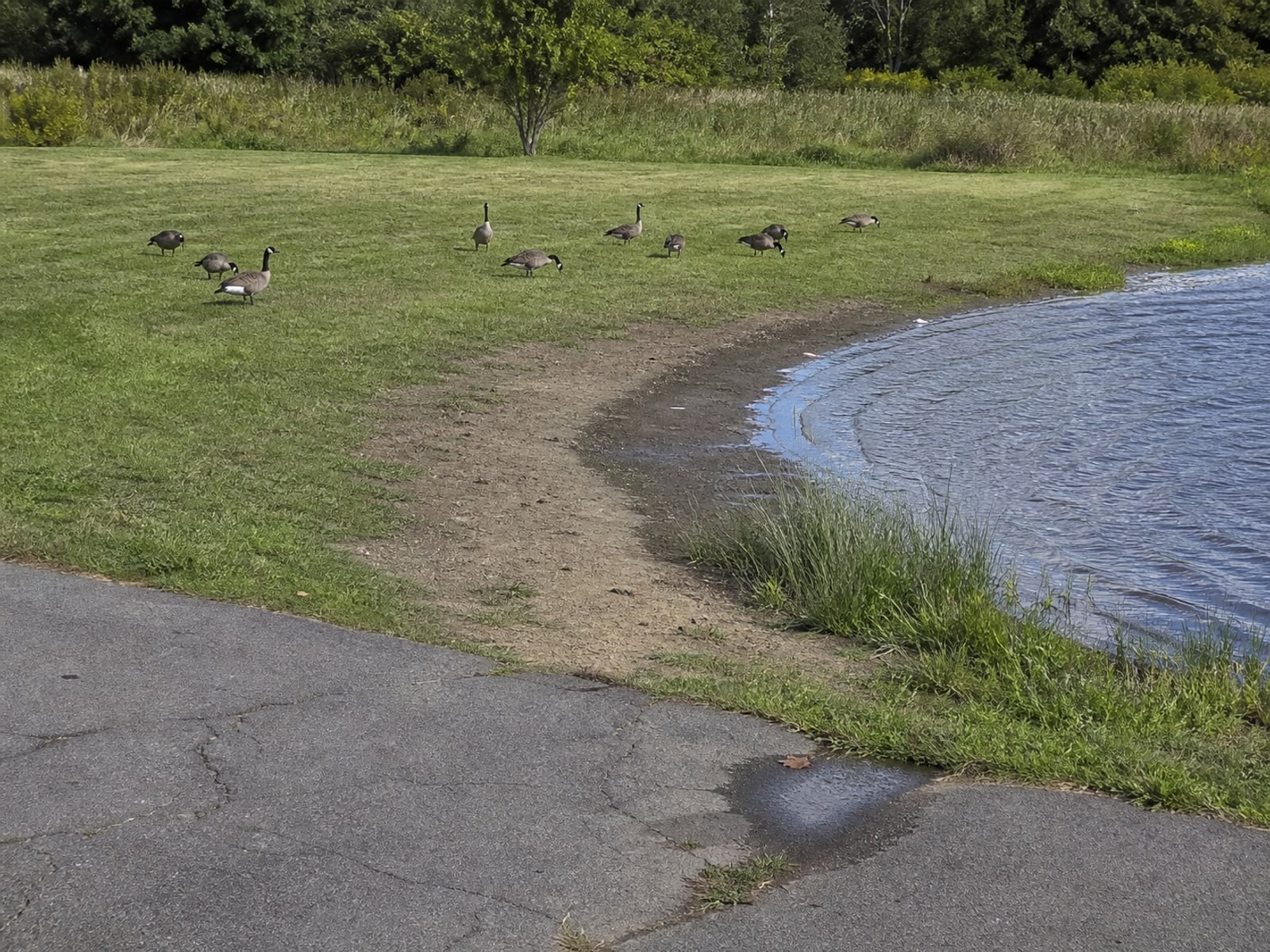
Canada goose droppings and grazed turf on maintained ground in Chicopee, MA

Where does lawn meet water in Chicopee?

Chicopee's water is a mix of city, state and federal ground, which matters more here than in most places. Where the record does not establish a water feature, this says so rather than inventing one.

Szot Park and the Bemis ponds

The clearest open-turf-and-water site in the city, with Upper Bemis Pond and the former Lower Bemis Pond fed by Abbey Brook before it reaches the Chicopee River. The park carries ball fields, football, soccer, picnic areas and a pavilion, and it is home field for Chicopee High School athletics. Parks and Recreation maintains it. It is also an active restoration site, so any proposal there has to work alongside stream work rather than across it.

A municipally owned golf course

Chicopee Country Club, recorded in city material as the municipal golf course, is an 18 hole course at 1290 Burnett Road with a city-named golf superintendent. Municipal ownership changes the buying route compared with a private club. An independent golf listing records four water hazards there; that is secondary data rather than a city fact, so it is worth confirming with the superintendent before anyone treats it as the site inventory.

The reservoir that is now a state park

Chicopee Reservoir is a 24 acre impoundment on Cooley Brook inside Chicopee Memorial State Park off Burnett Road, with a beach and picnic ground, managed by Massachusetts DCR. It was the city's historic water supply, but Chicopee's drinking water now comes from the Quabbin through the Chicopee Valley Aqueduct. So the local reservoir is a recreation and waterbody question rather than a drinking water one, and it is state ground rather than city ground.

Westover, and what is actually established

Westover Air Reserve Base and the co-located Westover Metropolitan Airport are the large institutional airfield campus in the city, sharing what the city describes as the longest runway in Massachusetts, with more than 1,600 base personnel. Airfields are a serious wildlife hazard setting and they are handled through the airport's own hazard process with its own partners. Nothing here should be read as implying we have access to the base or the airport, because we do not.

Massachusetts rules are not Connecticut rules

We work in three states, and Chicopee sits under a different structure from most of our service area. That is worth spelling out, because a provider who quotes you Connecticut process here has not noticed which side of the river you are on.

Wetlands are administered by the Chicopee Conservation Commission under the Massachusetts Wetlands Protection Act and 310 CMR 10.00, with local rules layered on top. Work that would remove, fill, dredge or alter a wetland or its buffer zone goes through that commission. The city's filing requirements are specific: nine complete sets, a 200 dollar advertising fee, the applicable state fee, an electronic copy, and certified mail notice to abutters within 300 feet. A project that will alter a protected resource area files a Notice of Intent.

As always, that applies to changing ground rather than to moving birds. A dog working across maintained turf is a different activity from building a berm at a pond edge. The city publishes no typical approval duration, so plan around the commission's meeting cadence and confirm filing deadlines with Planning staff instead of trusting anybody's promised date.

On the wildlife side, MassWildlife is the state authority and says Canada geese are present in Massachusetts year round. Egg addling is regulated here through a MassWildlife permit, which is a different route from Connecticut's, and it is not something we perform in either state.

Procurement is different too. A recurring municipal service in Massachusetts runs under M.G.L. c. 30B: sound business practices below 10,000 dollars, at least three written quotations from 10,000 to 50,000, and the formal process above 50,000 with notice at least two weeks before bids are received. Chicopee's Purchasing Department manages that for city and school departments and publishes solicitations through its bid portal.


What are the rules about working dogs in Chicopee?

Get it in writing, and expect to be responsible for the obvious things.

Chicopee's Chapter 144 covers dogs and other animals. We could not find a park-specific leash section or any working-dog or commercial-dog exemption in the published code. What Chapter 144 does clearly require is that a dog owner remove waste on public walks, recreation areas and private property, and that anyone appearing with a dog in those places carries the means to do it. That is a straightforward operating requirement for any dog team on shared ground, and it is one we would follow anyway.

The honest position is the same one we take across the service area: an absence in the code is not permission. On municipal ground we ask Parks and Recreation and the property owner in writing, and we set out how the dog stays under handler control.

On hours, Chapter 200 prohibits unreasonable, loud and unnecessary noise and specifically names construction or demolition before 7 a.m. or after 9 p.m. on weekdays, with a 50 dollar first-violation fine. That is a construction provision and it would be wrong to transpose it onto quiet animal-handling work as though it were a categorical ban. It is still the right ballpark to schedule inside, and we would rather agree the window with the site than argue about it later.

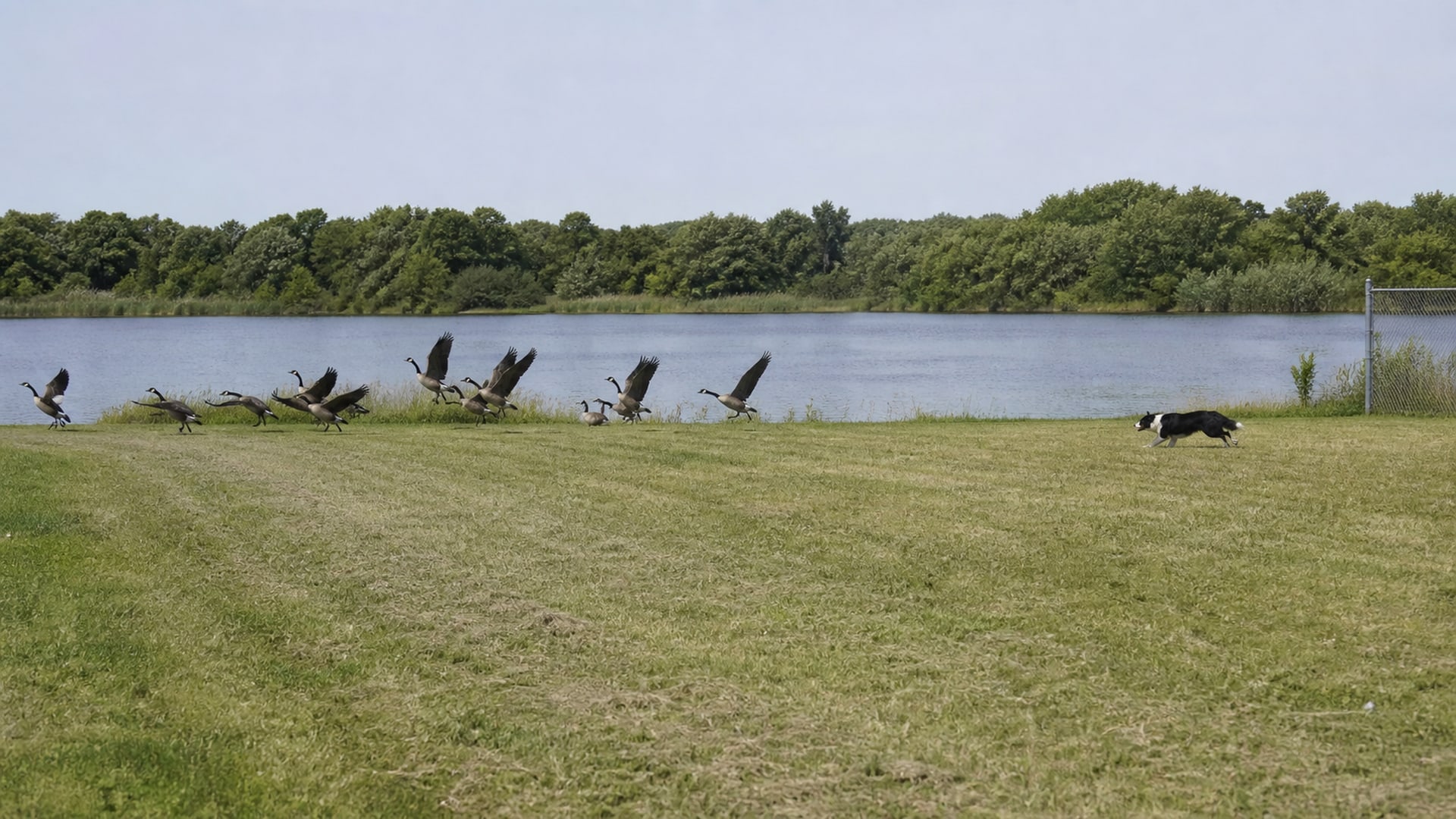
A Border Collie working a flock of Canada geese off maintained ground in Chicopee, MA

What happens after you call about a Chicopee property?

The fieldwork is the same at Szot Park as on a company lawn. What changes is whose ground you are on, and in this city that includes state and federal answers.

  1. 01

    We establish whose ground it is

    City park, school field, the municipal golf course, DCR state park land, private property or airfield-controlled ground. Chicopee has all of those inside one city line, and the answer decides everything that follows.

  2. 02

    We ask what you are seeing, and what has been tried

    How many birds, on which surfaces, at what times, and how close the water is. What a flock has already learned to ignore genuinely changes what is worth doing next.

  3. 03

    We walk the ground and map the way up from the water

    Geese travel between water and turf on foot, so the useful map is where they come up, which grass they graze, where they loaf, and which of that you control.

  4. 04

    We settle permissions before scheduling

    Written site permission on municipal ground with waste-removal and handler control set out, and a conversation with the Conservation Commission before anything that would alter a wetland or its buffer.

  5. 05

    The dogs work at times the flock cannot anticipate

    A handler works the ground with a trained Border Collie holding a stalking posture. A goose responds to that as it would to a predator, by leaving, with no contact and no capture. The visits repeat unpredictably, which is precisely what a berm cannot do and what a static device stops doing after a few weeks.

  6. 06

    We say what should change about the ground, and we measure

    Where mowing stops, whether an unmown strip or a barrier can sit between water and turf, and whether feeding is still happening. Then counts, locations, complaints and the gap between a visit and the birds returning. In a city where goose waste has already been tied to a bacteria result, that record has an audience beyond your own file.

What we handle, and who handles the rest

We do not apply turf repellents. They are registered pesticides and applying one to commercial turf is licensed work in Massachusetts as in Connecticut and New York. We hold no such certification. If a repellent suits a defined surface, a licensed applicator is the right call.

We do not addle eggs or work on nests. In Massachusetts that runs through a MassWildlife permit, and the authorization belongs to the landowner or the municipality rather than to a contractor. If somebody offers to handle a nest on your Chicopee property, ask who holds the permit for that site.

We do not work airfield ground on our own initiative, and nothing on this page should be read as implying access to Westover.

This is a maintained program rather than a one-time fix. The city's own watershed plan proposes reshaping the ground at Szot Park precisely because the birds keep coming back to what is there now. A vendor promising permanence from visits alone is contradicting the engineering.

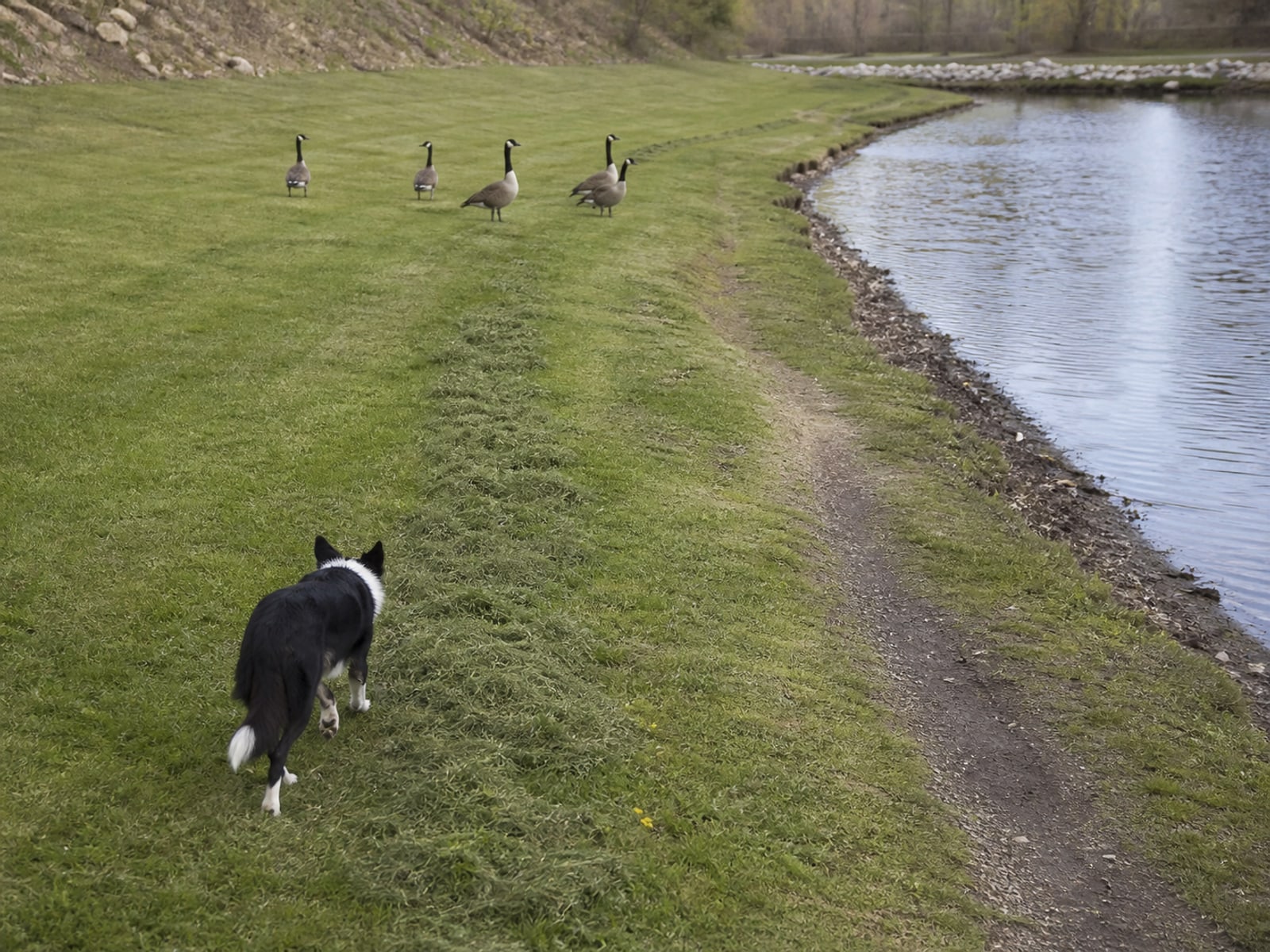
Maintained ground in Chicopee, MA holding clear of Canada geese after repeat visits

Chicopee goose control questions

Is there really a documented goose problem in Chicopee?

Yes, and it is unusually specific. The 2019 Abbey Brook watershed plan records geese and goose waste immediately beside Upper and Lower Bemis Pond, describes the grassed slopes there as frequently used by geese, and reports that 2016 source tracking tied goose waste to elevated E. coli in Abbey Brook.

Is it against the rules to feed geese in Chicopee?

Not as an ordinance that we could find. The city's stormwater page asks people not to feed Canada geese, and Massachusetts discourages wildlife feeding while not making it illegal statewide. On your own property you can set and enforce the rule yourself, which is where most of the value is anyway.

Do we need a Conservation Commission filing?

For physical work in or near a wetland or its buffer, yes. Chicopee requires nine complete sets, a 200 dollar advertising fee, the state fee, an electronic copy and certified mail notice to abutters within 300 feet, with a Notice of Intent where a protected resource area would be altered. Moving birds off maintained turf with a dog is a different activity.

Can a trained dog work on a Chicopee park?

Only with written permission. Chapter 144 has no working-dog exemption that we could find, and it does require waste removal and the means to do it on public recreation areas. We ask Parks and Recreation and the owner in writing and set out how the dog stays under handler control.

How much does goose control cost in Chicopee?

It is quoted per site, on ground worked, bird numbers, water edge, visit frequency and what the surface is used for. For city or school work the route is set by state law: sound business practices below 10,000 dollars, three written quotations from 10,000 to 50,000, and a formal solicitation above 50,000 through the Purchasing Department.

We are near Westover. Does that change the approach?

On your own property, no. Around an airfield, wildlife management is handled through the airport's own hazard process with its own partners, and we would not represent ourselves as having any role on base or airport ground. If your site is genuinely airfield-adjacent, that coordination should be part of the conversation from the start.

How quickly will we see a difference?

Behavior on the site starts changing from the first visits, because a predator response is instinctive rather than learned. Whether it holds depends on what changes about the ground, which is the whole argument of the city's own watershed plan. We will not give you a date, because no source supports one.

Local detail

Canada geese in Chicopee, Hampden County

Chicopee is a Hampden County city of about 55,600 residents at the confluence of the Chicopee and Connecticut rivers, and it holds the most specific goose evidence anywhere in this service area. The 2019 Abbey Brook watershed plan records geese and goose waste beside Upper and Lower Bemis Pond at Szot Park, and reports that 2016 source tracking tied goose waste to elevated E. coli in Abbey Brook.

Massachusetts law applies here rather than Connecticut's, so wetlands run through the Chicopee Conservation Commission under the state Wetlands Protection Act, and egg work is a MassWildlife permit matter. The city also holds a municipal golf course on Burnett Road, a state park built around the former city reservoir, and the Westover Air Reserve Base and airport campus, which is handled through its own aviation wildlife process.

Neighborhoods we cover in Chicopee

Parts of Chicopee where we work. Each one opens in Google Maps.

Bordering towns: Springfield, Holyoke, West Springfield, Ludlow, Granby, South Hadley. A flock does not recognize a town line, so a program sometimes has to be scoped wider than one parcel.

Getting there: Interstate 90, Interstate 391, Burnett Road, Memorial Drive, Route 33, Route 116.

We cover all of Chicopee and the ground around it. If your neighborhood is not listed, or you are not sure which one you are in, it is very likely we work there. Ask and we will confirm.

Talk to us about your Chicopee property

Tell us what you are dealing with: roughly how many birds, which surfaces they are fouling, how close the water is, and whether the parcel is city, school, state or private.

Tri-State Geese Patrol runs humane Canada goose abatement with trained Border Collies across Connecticut, Massachusetts and New York, and we are reachable 24 hours. Call (203) 856-4889 and it goes to Bill.

And if the honest answer for your site is an unmown strip and a no-feeding sign rather than a contract, we will say so.