

What humane means here, precisely
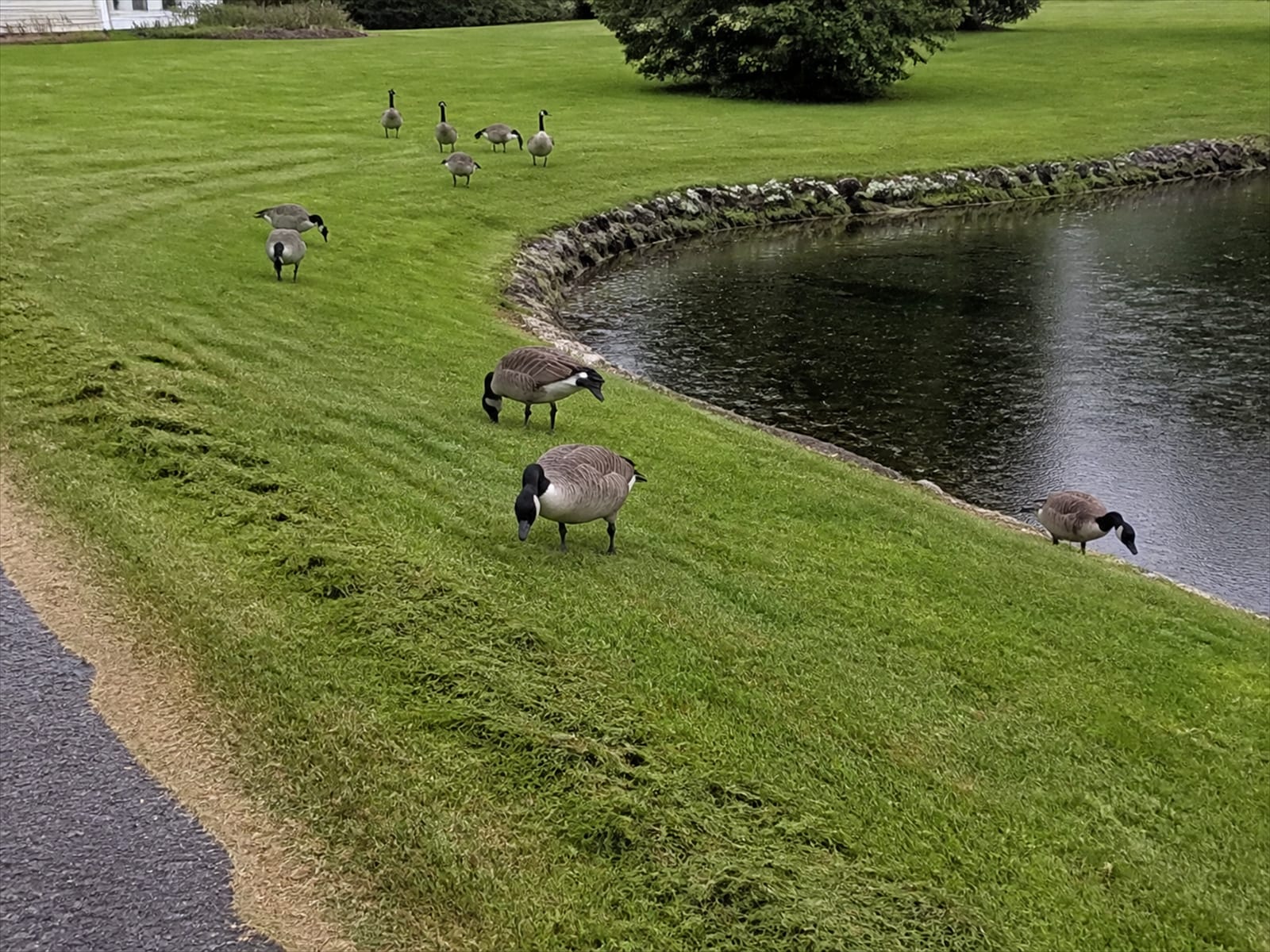
It has a working definition rather than a marketing one. US Fish and Wildlife Service guidance lists the non-lethal techniques as habitat modification, hazing with dogs or lasers, and repellents. In every one of those, the bird is not caught, not handled and not hurt. It decides the ground is no longer worth using and it flies off.
That is a genuinely different thing from any technique that involves taking, handling or interfering with birds, nests or eggs, all of which is regulated. Canada geese are protected migratory birds, and the basic rule is that you may not take, possess or transport a migratory bird, its nest or its eggs except as federal law allows. Non-injurious scaring, herding and chasing sits outside that. Everything else sits inside it.
Both halves of that sentence matter when you are choosing who to call.
The options, side by side
Every non-lethal option, and what each actually does
Read the last two rows again if a company has offered you either one casually. Those are the two places where a provider's answer tells you most about them.
Trained dogs, and what they do not do
This is the option most people mean when they search, so it deserves a plain description.
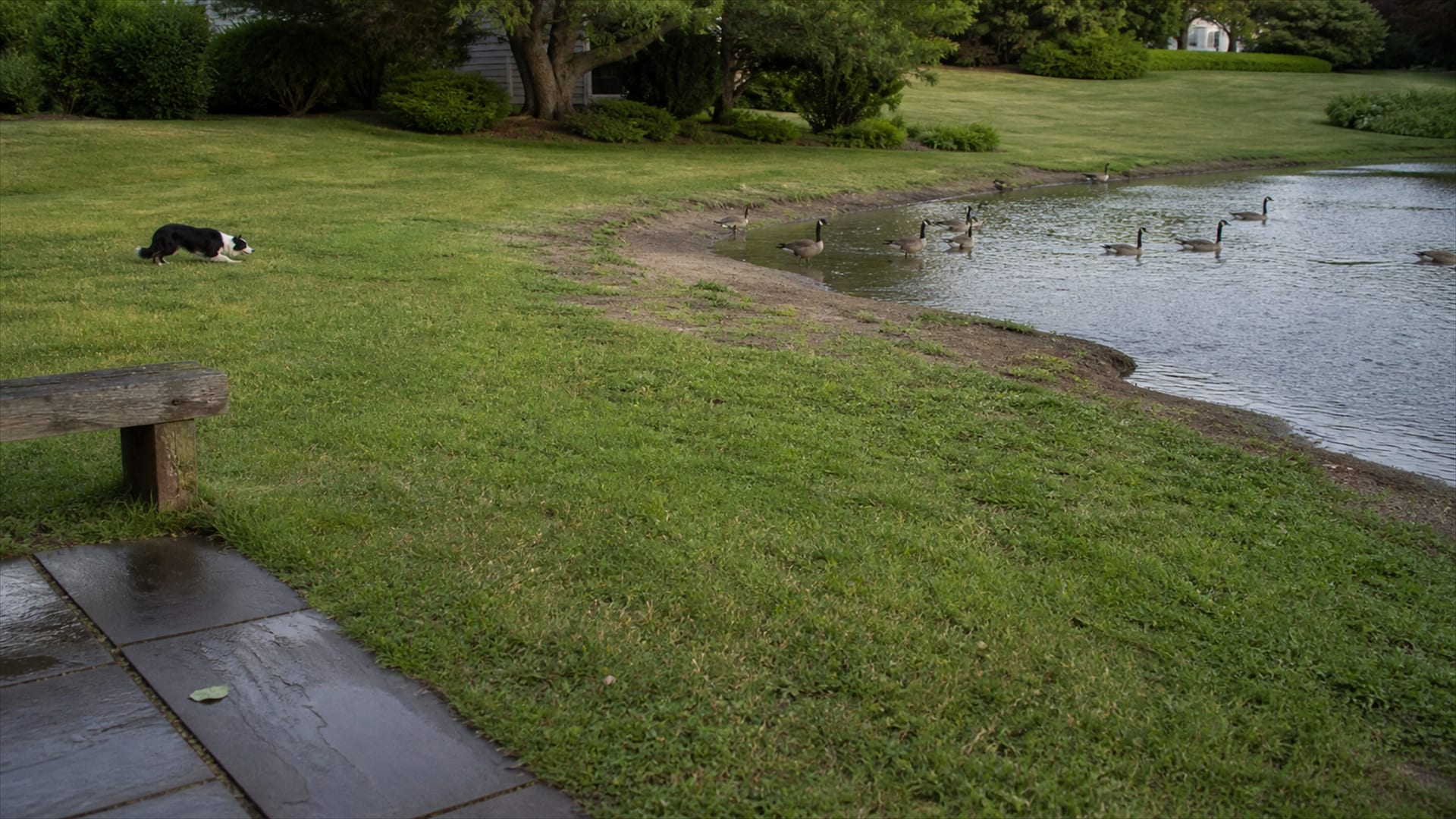
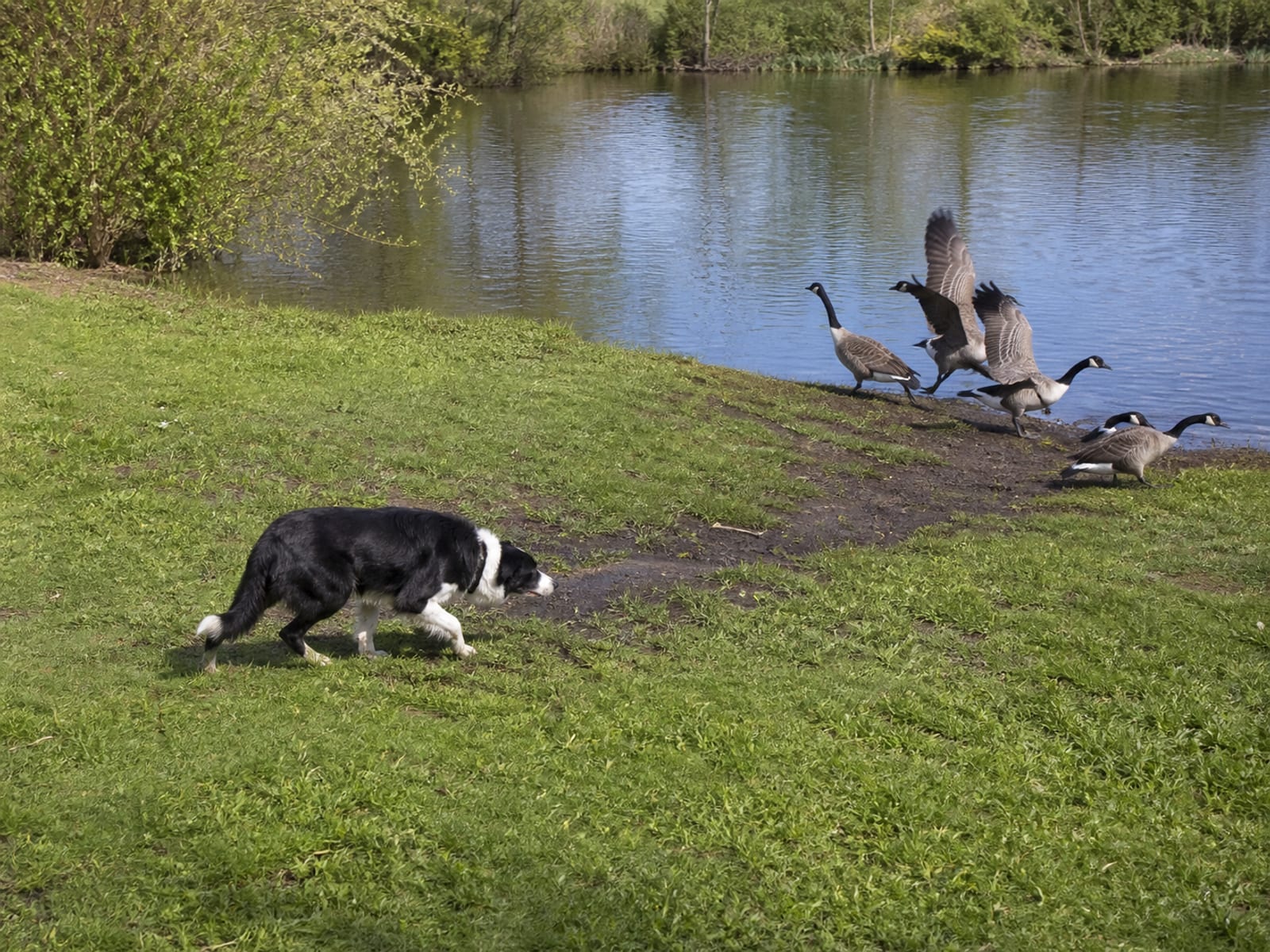
A handler brings a trained Border Collie onto the property on a repeating schedule and works the ground the birds are using. The dog moves like a predator, which is what a goose reads it as, and the flock leaves. The dog does not catch anything, touch anything or make contact, and that is not a courtesy: it is the legal basis of the whole method. New York DEC says no federal or state permit is needed to scare, herd or chase geese, including with dogs or noisemakers, provided no bird is physically harmed.
Now the honest limitation, from the same agencies that recommend it. Connecticut DEEP says trained Border Collies can move geese off an area but that the birds tend to come back once the dog is gone, and it names displacement to another site as a limitation of the approach. That is not a reason to skip it. It is the reason it is a recurring program rather than a visit, and the reason a provider who promises a permanent result from fieldwork alone is telling you something the state guidance contradicts. What the work involves week to week is on our page about Border Collie goose abatement.
Timing is part of it too. Connecticut's stormwater manual says frightening methods work best when they coincide with the birds' feeding times, around sunrise and sunset, and before a feeding pattern is established. Early is worth more than often.
Habitat work, the part that keeps working
This is the option that persists when nobody is on site, and the agencies are unusually specific about it.
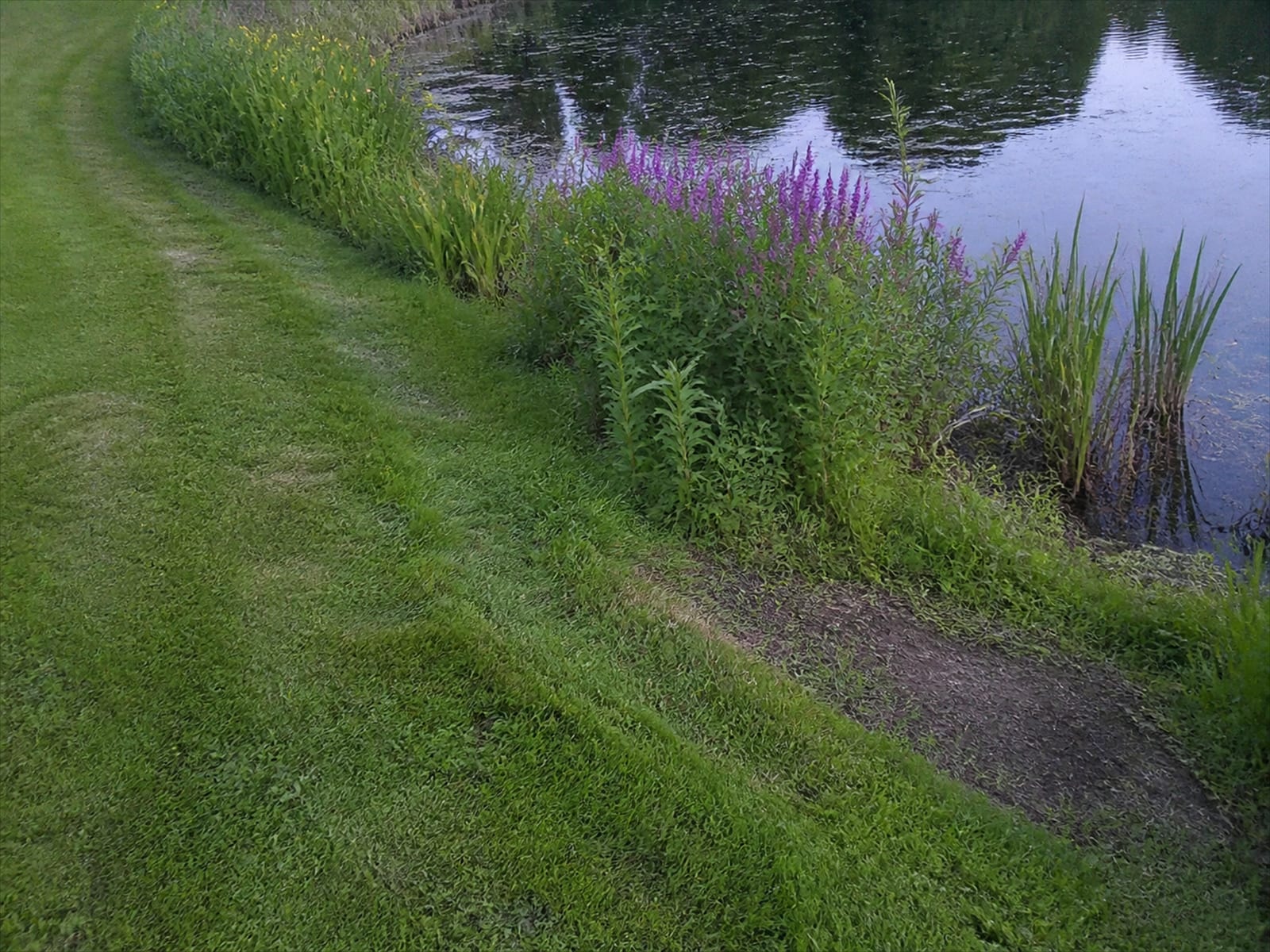
Connecticut's stormwater manual describes barriers as either vegetation or structure, gives 3 feet as a standard barrier height, and describes dense shrub or mixed vegetation buffers 20 to 100 feet wide. MassWildlife says geese rarely fly over a 3 foot chicken-wire fence, especially while flightless during the summer molt, and counts a hedge or a broad strip of uncut growth between water and mown grass as a low-maintenance barrier in its own right.
Connecticut's Broad Brook watershed plan goes further and gives grass heights: a minimum 15 foot buffer with 30 to 50 feet preferred, grass at six to eight inches to reduce feeding interest, and 18 to 24 inches to reduce use of the water body itself. That is one watershed plan's recommendation rather than a rule, and shoreline vegetation can carry local requirements of its own, so it is a starting point for a conversation rather than an instruction.
The catch is the obvious one. DEEP notes that letting grass grow can conflict with how a recreation field is used, and a buffer has to fit around access, sightlines and what the ground is for. That trade-off is the substance of habitat modification work, and it is the reason two properties with the same flock get different plans.
Repellents and nest work: real, regulated, and not ours
Two options come up constantly and neither is something we perform. Being straight about that is more useful to you than being vague.
Turf repellents. These are registered pesticides. Connecticut DEEP says they must be reapplied after rain and are better suited to a small lawn than a large expanse of turf. Applying one to commercial turf in Connecticut, Massachusetts or New York is licensed work, we hold no such certification, and we will not imply otherwise. If a repellent suits a defined high-traffic surface on your property, the person to call is a licensed applicator, and the questions worth asking are which product is registered in your state, how often it needs redoing and what happens when it rains.
Nest and egg work. This is a regulated technique with an annual federal registration behind it. FWS says eligible landowners, public land managers, homeowner associations and local governments must register annually before any nest or egg activity, must name their agents, must use non-lethal methods to reduce the need for it, and must report afterwards. The state contact table, updated in March 2026, records all three states as accepting that federal registration. Connecticut is the one that adds something on top: the table notes a further state requirement for commercial control firms specifically, with CT DEEP's Wildlife Division as the contact. Massachusetts carries a MassWildlife permit requirement of its own, and New York lists no comparable extra restriction. MassWildlife adds that a special permit is needed and that the presence of geese alone is not a sufficient basis.
The registration belongs to the property, not to the contractor. So if somebody offers to handle a nest for you, the question is who is registered for this site, and the answer needs to be you.
It is also worth knowing how small and documented this activity actually is. MassWildlife's FY2023 annual report records 68 individual resident goose egg addling permits issued, with permittees reporting 1,596 eggs treated. That is what a regulated technique looks like on paper. Anything offered casually over the phone is a different thing borrowing its name.
What is not on the menu at all
Relocation. New York DEC says it generally does not allow goose relocation, with or without a permit, and FWS says nest or egg relocation is not authorized under the resident goose nest and egg order either. Nobody is holding this option back from you; it does not exist.
And the line is enforced. A 2025 DEC enforcement account describes tickets issued after a Haverstraw homeowner threw rocks at geese and interfered with a nest. That is what happens when a frustrated property owner improvises, and it is the outcome the whole permitting structure exists to prevent.
How to tell a legitimate provider from a problem
You are hiring in a field with real legal exposure and no obvious credential to check. These are the questions that sort it out fast.
Six questions worth asking whoever you call
01
What exactly will happen on my property?
A straight answer describes moving birds without contact. If the description involves catching, holding or taking anything anywhere, stop there.
02
Will you promise the geese will be gone?
The right answer is no. Connecticut DEEP says birds tend to return once the dog leaves, so a promise of permanence contradicts the state's own guidance.
03
Who holds the registration if a nest is involved?
It has to be your organization, annually, before any activity. A provider who says they hold it for you has the structure backwards.
04
Are you applying anything to the turf?
If yes, that is a registered pesticide and state licensing applies. Ask who holds it.
05
What do you want me to change about the property?
A provider who asks nothing about mowing lines, feeding or the water edge is selling visits rather than a result.
06
How will we know it is working?
There should be a measure that is not just a headcount, and somebody should be writing it down.
The one question that separates a serious answer from a sales answer is the second. Connecticut DEEP is direct that no single method is a cure-all and that success takes time, and New York DEC says persistent combinations produce the best results. Anybody selling you one method as the whole answer is arguing with both states.
The year, and what it changes
Which options are worth doing, and what they will cost you in effort, moves with the season.
The Canada goose year in Connecticut, Massachusetts and the Hudson Valley
March into early April
The territorial and early nesting period in Connecticut. USDA APHIS puts the broader resident nesting window as early as late February through mid-May. This is when changing anything at a shoreline is easiest, because nothing is established there yet.
April through June
Connecticut DEEP describes about 28 days of incubation with hatching across these months, peaking in the first week of May. A defending pair can close off a path, a doorway or a playground on its own initiative, which is where nesting season aggression starts producing incident reports.
Mid-June into early July
The flightless molt in the same APHIS guidance. A water-to-turf fence is at its most useful here because the birds cannot fly over it, and DEEP notes it loses much of that effect once they can.
Late summer
Flight returns and the flock ranges more widely. A barrier that carried the summer stops being the whole plan.
October through January
DEEP says migrants arrive in early October, migration continues through November, there is another peak in mid-December and most leave by mid-January, although mild winters hold birds. A winter flock is the flock you meet again in March.
Connecticut also publishes where this concentrates: DEEP reports the highest goose populations in Fairfield, Hartford and New Haven counties, which is most of the ground we cover from West Hartford. The same fact sheet gives the ordinary biology behind the calendar above: an adult bird at six to 13 pounds, four to seven eggs in a typical clutch, and about 28 days of incubation.
What it costs, honestly
There is no published price range for this work in Connecticut, Massachusetts or the Hudson Valley from any agency or university source, so anybody quoting you one off the phone has invented it.
What is documented is what moves the number. DEEP says planning has to weigh the problem location, the time of year, which options the site actually allows, effectiveness, acceptability, cost and community support. In practice that means acreage and access, how much water edge there is, how many birds and in which seasons, how often anybody needs to be on site, how much habitat work is in scope, and whether the property's use restricts when work can happen. DEEP names the ongoing cost of a dog service as a real drawback, and it is right to: this is a maintenance line rather than a one-time repair, and any provider who hides that is setting up an unhappy renewal.
Why the scale of this is not your fault
It helps to know the population you are dealing with is a regional situation rather than a failure of your grounds staff.
New York's resident Canada goose population against its own target
- Estimated resident geese, spring 2024228000
- New York's long-term management goal85000
DEC publishes both of those figures on its own nuisance Canada geese page: a spring 2024 resident estimate of 228,000 birds against a long-term statewide goal of 85,000. The gap is the reason a property that solves its own problem can still see birds arrive from somewhere else, and it is why Cornell's guidance says a resident population is rarely confined to one property and that community collaboration is what makes management last.
Do you know what you can actually hire?
Pick an answer to see how you did
1. A company offers to catch the geese and release them at a lake nearby. What is that?
2. Which of these needs no permit of any kind?
3. A provider guarantees the geese will be gone and will not come back. What does that tell you?
4. When does a 3 foot fence between the water and the lawn do the most work?
Nothing answered yet.
Questions people ask before they call anyone
Do the dogs hurt the geese? No, and if they did the method would be unlawful rather than merely unpleasant. The dog herds and makes no contact. New York DEC's permission for scaring, herding and chasing is conditioned exactly on no bird being physically harmed.
How long until they are gone? No agency or university source gives a number of days or weeks for a property. What is established is that the birds move during the work from the start. Whether they stay away depends on what else changes on the property, which is the point the state guidance keeps making.
Can I just do this myself? Some of it, yes, and you should. Stopping feeding, moving the mowing line back from the water, letting a shoreline strip grow, and moving birds along without touching them are all things a property owner can do lawfully. The moment anything involves a bird, a nest or an egg, it stops being a do-it-yourself matter.
Is this a pond problem or a lawn problem? Usually both, and the pond half is the one people underestimate. Penn State Extension estimates an adult goose produces two to four pounds of manure a day, around 1,000 pounds a year, and links goose waste to phosphorus enrichment, algae and reduced water quality. That is a general biological estimate rather than a measurement of your pond, and presence of birds is a reason to test rather than a test result, which we go into on our page about water quality in ponds.
We are next to an airport. Is that different? Yes, and it should be handled through the airport's own wildlife hazard process. The FAA's national wildlife strike reporting records 2,301 Canada goose strikes with US civil aircraft between 1990 and 2025, averaging 71 a year across the last decade of that period. Those are national figures across 35 years and not a local risk estimate, which is exactly why an airfield gets a site-specific process rather than a general one. More on that on our page about bird strike risk.
What if my neighbor does nothing? It matters, and it is worth raising early. Where a pond or a field is shared, the sensible boundary for a program is sometimes larger than one property, which is a conversation that belongs in consultation and program design rather than in the first invoice. If your problem is specifically that an earlier program stopped holding, we went through that in detail in long-term goose control in Connecticut and New York.
Where this leaves you
The honest summary of the whole field is short. There are four things that work, they work in combination rather than alone, two of the most talked-about options are licensed work that most providers cannot legally do, and one popular idea is not available to anyone. Anybody who tells you otherwise is either mistaken or selling.
The good news is that the part that does the most costs nothing and needs no permit: stop the feeding, move the mowing line back from the water, and put something in the walking route between the two. Fieldwork then does the part grounds work cannot, which is changing what the birds believe about your property this week.
If you want a straight read on your own site, tell us what you are looking at: roughly how many birds, which surfaces they are fouling, how close the water is and what has already been tried. Tri-State Geese Patrol runs humane Canada goose abatement with trained Border Collies across Connecticut, Massachusetts and New York, working out from West Hartford, and you can check where we cover on our service areas page. Call us on (203) 856-4889 or send us a message and it goes to Bill. If what your property needs is a fence and a no-feeding sign rather than a contract, that is what we will tell you.
The words you will hear
Tap a term to see what it means
Hazing. Moving birds without physically harming them, using dogs, noisemakers or people. New York DEC says this needs no federal or state permit provided no bird is hurt. It is the legal category almost all humane goose work sits in.