

Why the last program stopped working the day it stopped
There is a straight answer in the state guidance, and it is worth reading before anyone quotes you again.
Connecticut DEEP says that most non-lethal methods other than habitat modification are transitory in their effect when used alone. Virginia Cooperative Extension puts the same point in operational terms: geese monitor the sites they prefer and can come back to favored feeding and loafing ground once the dogs leave.
The most specific evidence comes from a GPS study of winter goose dispersal in Illinois, which tracked what the birds actually did rather than what observers assumed. Geese left a worked area 3.5 times more often on days the work happened, and they also returned quickly 1.9 times more often. Repetition alone showed diminishing returns. That is a study from a different state and a different season, so it does not set a visit schedule for a property in Hartford or the Hudson Valley. What it does establish is the shape of the thing: dispersal moves birds reliably, and on its own it moves them back.
None of that makes dispersal the wrong tool. It makes dispersal the half of the job that has to be paired with the other half.
Five reasons a single-method program gives the ground back
01
The reward never changed
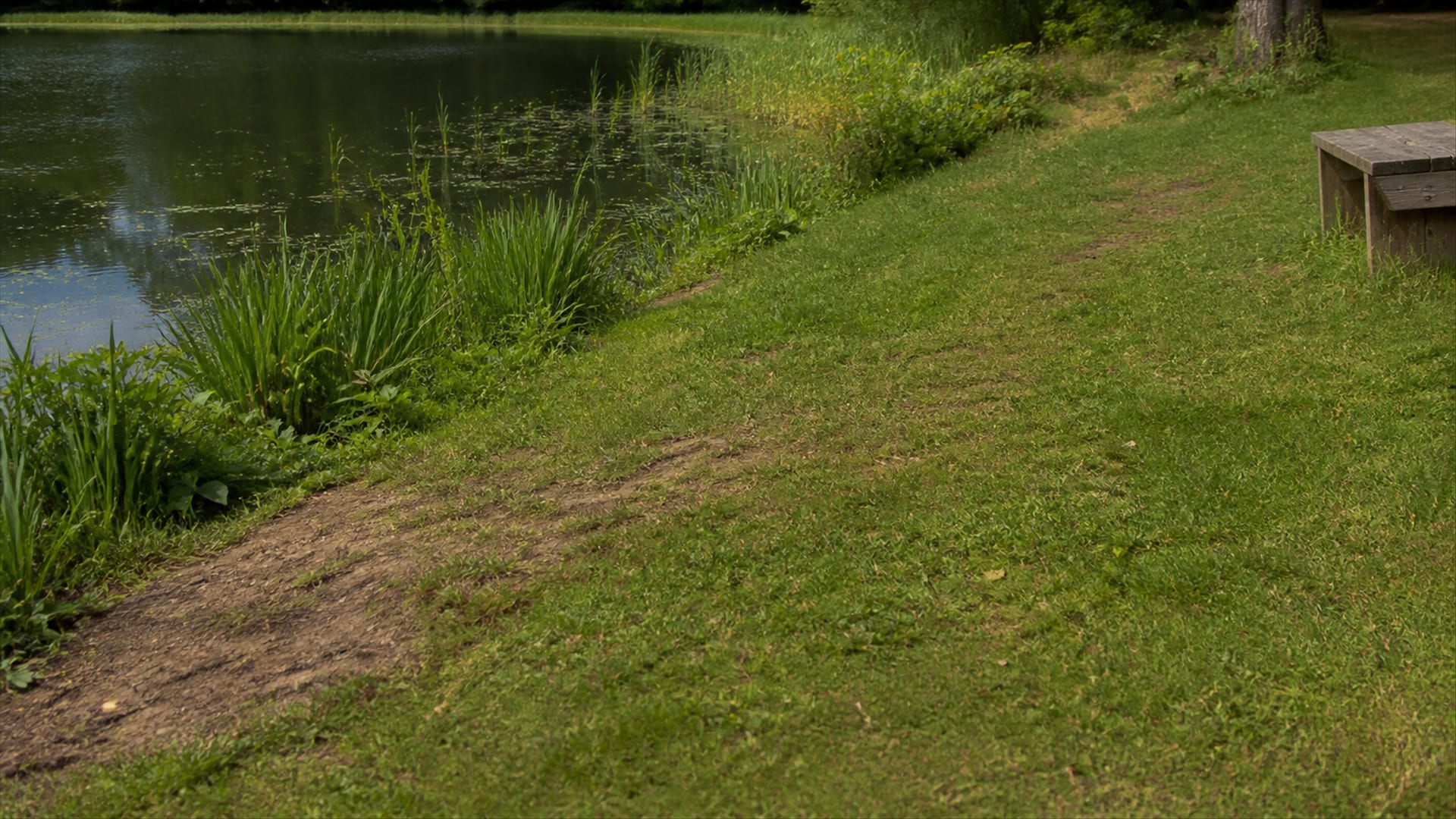
Connecticut DEEP describes the attraction as open grass next to water. If the grass and the water are still arranged the same way, the site is still worth returning to.
02
The route never changed
Geese walk between water and turf. Where nothing interrupts that walk, the property stays as convenient as it was before anyone was hired.
03
The feeding never stopped
DEEP warns that public feeding creates unsanitary conditions and public-safety problems. One person with a bag of bread can hold a flock against everything else you are doing.
04
The work stopped
Virginia Extension is explicit that birds may return to preferred sites when dogs leave. A program is a maintenance line, not a project with a completion date.
05
Nobody was counting
Without a record of counts, locations and complaints across seasons, there is no way to tell a program that is working slowly from one that is not working at all.
What long term actually means here, in numbers
It does not mean zero geese, and any provider who lets you believe otherwise is setting up the conversation you will have with them in March.
The strongest local evidence in this region comes from an integrated program at eight sites in Orange County, New York, run each year from March through November across three years. It combined monitoring, public education, dispersal and regulated egg treatment carried out under authorization. Mean observed goose counts at the treated sites fell from 77 in 2004 to 19 in 2005 and 11 in 2006. Standardized dropping counts fell from 0.16 to 0.12 to 0.05 per foot per day. Unmanaged comparison sites did not show the same change.
Three things about that result matter more than the numbers themselves.
It took three years, not three visits. It combined several methods at once rather than testing one. And it included regulated nest and egg work performed under federal authorization held by the landowners, which is a separate legal track from dispersal and is not something we do. The lesson to carry across is the structure, not a promised percentage for your site.
Eight New York sites, three years of coordinated work
- Mean geese observed, 200477
- Mean geese observed, 200519
- Mean geese observed, 200611
- Droppings per foot per day, 2004 (x100)16
- Droppings per foot per day, 2005 (x100)12
- Droppings per foot per day, 2006 (x100)5
No published source gives a number of days or weeks after which a given property stops holding geese, and there is no authority behind any guaranteed duration of benefit. Site size, flock behavior, how much open water is nearby, what the neighbors do and whether birds are nesting all move that answer. Anyone quoting you a timeline is quoting you a hope.
What a program that holds is actually made of
Four parts, in this order. The order is the part most often skipped.
A written map before anything moves
The Orange County researchers used standardized dropping counts, movement and population surveys, and managed against unmanaged comparison sites. You do not need a research protocol, but you do need the same idea written down: how many birds, at what times, on which ground, where they enter from the water, where the nests are if any, where people walk, and which parts of the property you actually control.
That last item decides more than people expect. A pond shared with an abutter, or a municipal parcel next door, changes what is possible before any method is chosen. It is the first thing we look at during consultation and program design, because a plan drawn on the wrong boundary fails for reasons no amount of fieldwork can fix.
Taking away the reward and the route
This is the half that persists when nobody is on site, and it is why habitat modification is the one method the state guidance does not describe as transitory.
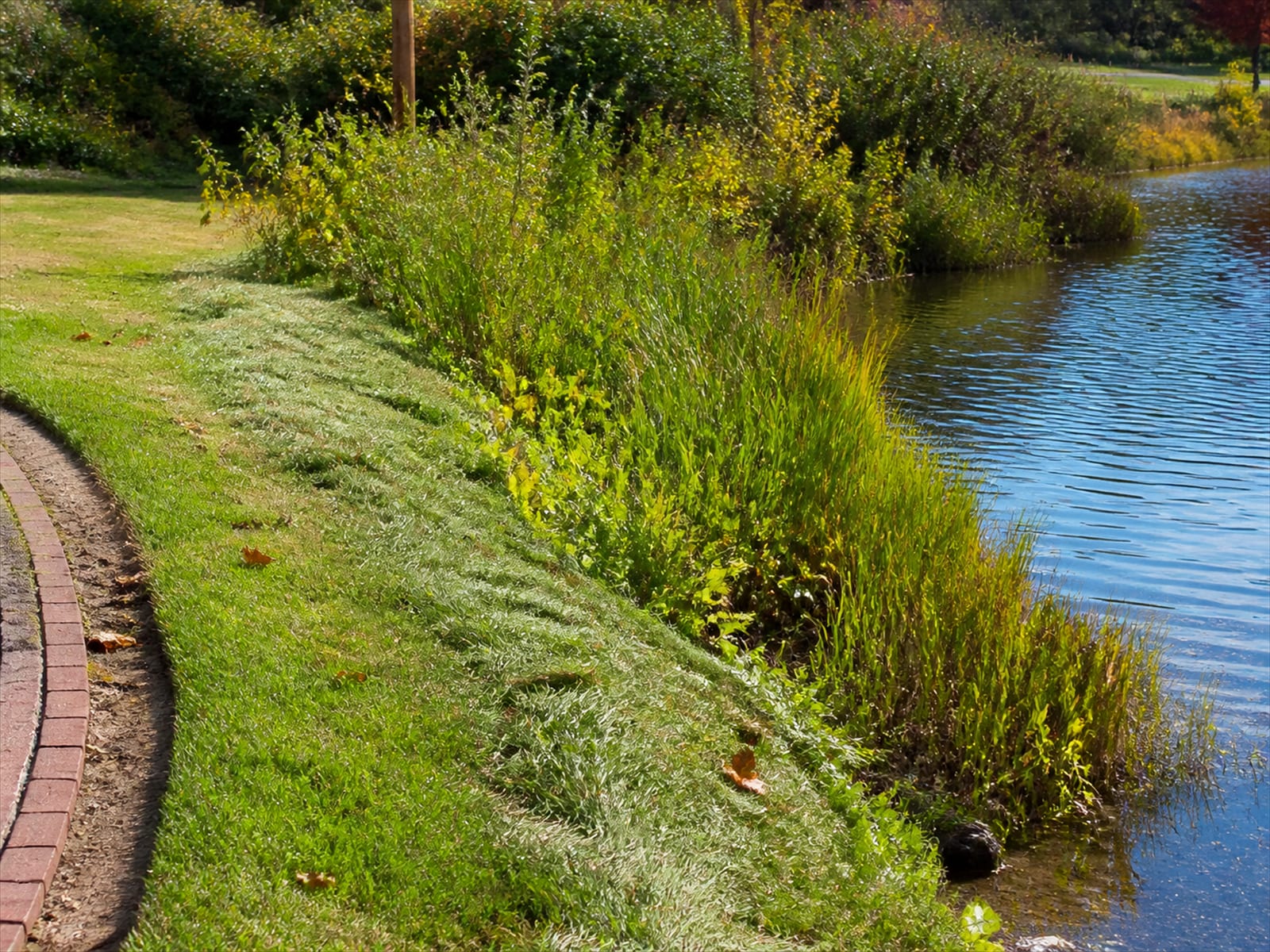
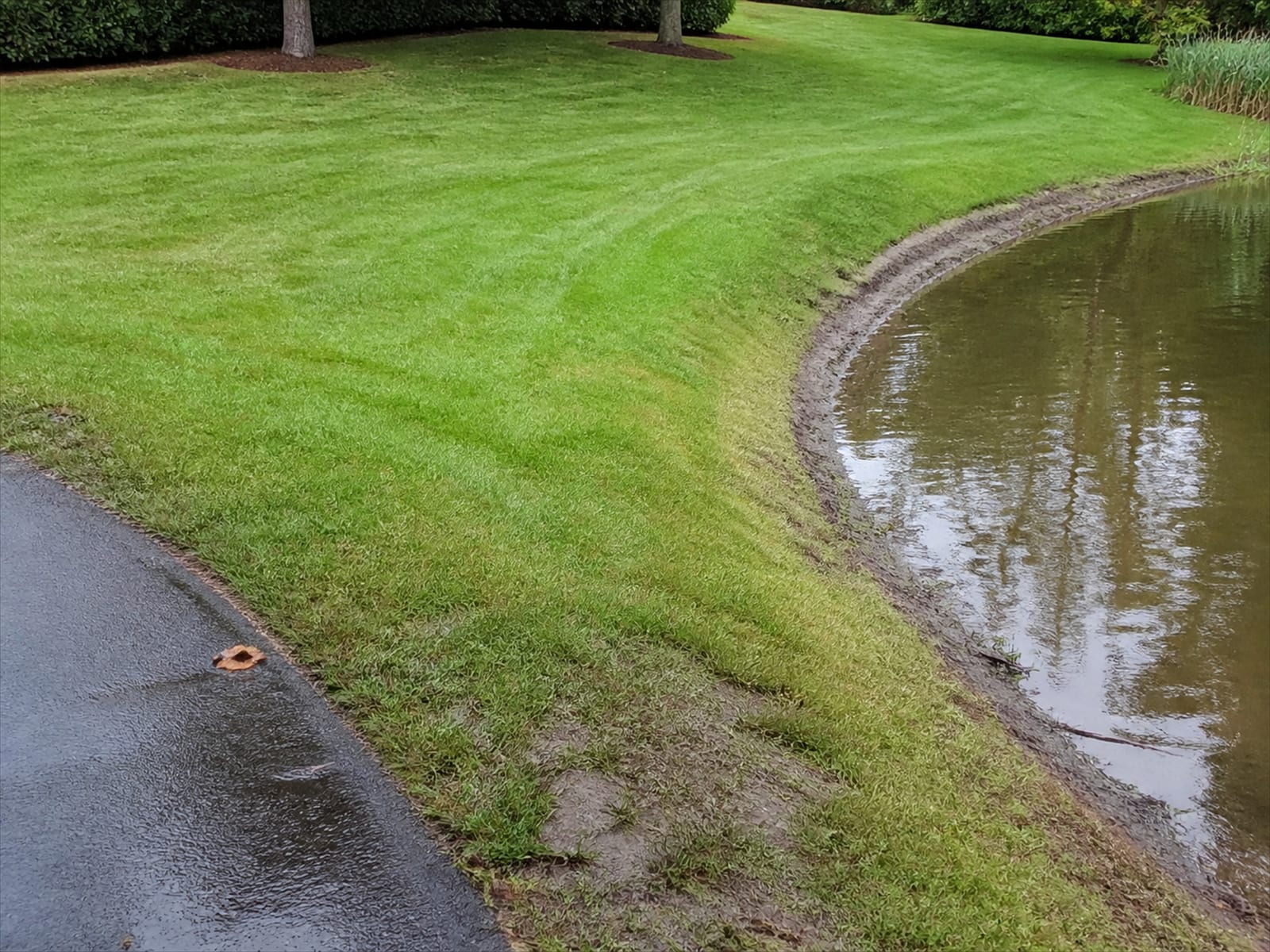
Connecticut's stormwater manual specifies that a continuous vegetated shoreline buffer of 20 to 100 feet, or a 3 foot barrier, can impede movement between water and grass. MassWildlife agrees on the dimension, calling a 3 foot chicken-wire fence effective and describing hedges or an uncut strip of vegetation as a barrier in their own right. Both are describing the same idea: the birds walk in, so interrupt the walk.
Stopping feeding belongs in this category too, and it usually costs the least of anything on the list and is the hardest to enforce.
Repeated lawful dispersal, on a schedule the flock cannot predict
New York DEC states plainly that no federal or state permit is needed to scare, herd or chase geese, including with dogs or noisemakers, as long as no bird is physically harmed. The US Fish and Wildlife Service lists habitat modification, hazing with dogs or lasers, and repellents among the non-lethal techniques expected to be used before any regulated nest and egg activity is considered.
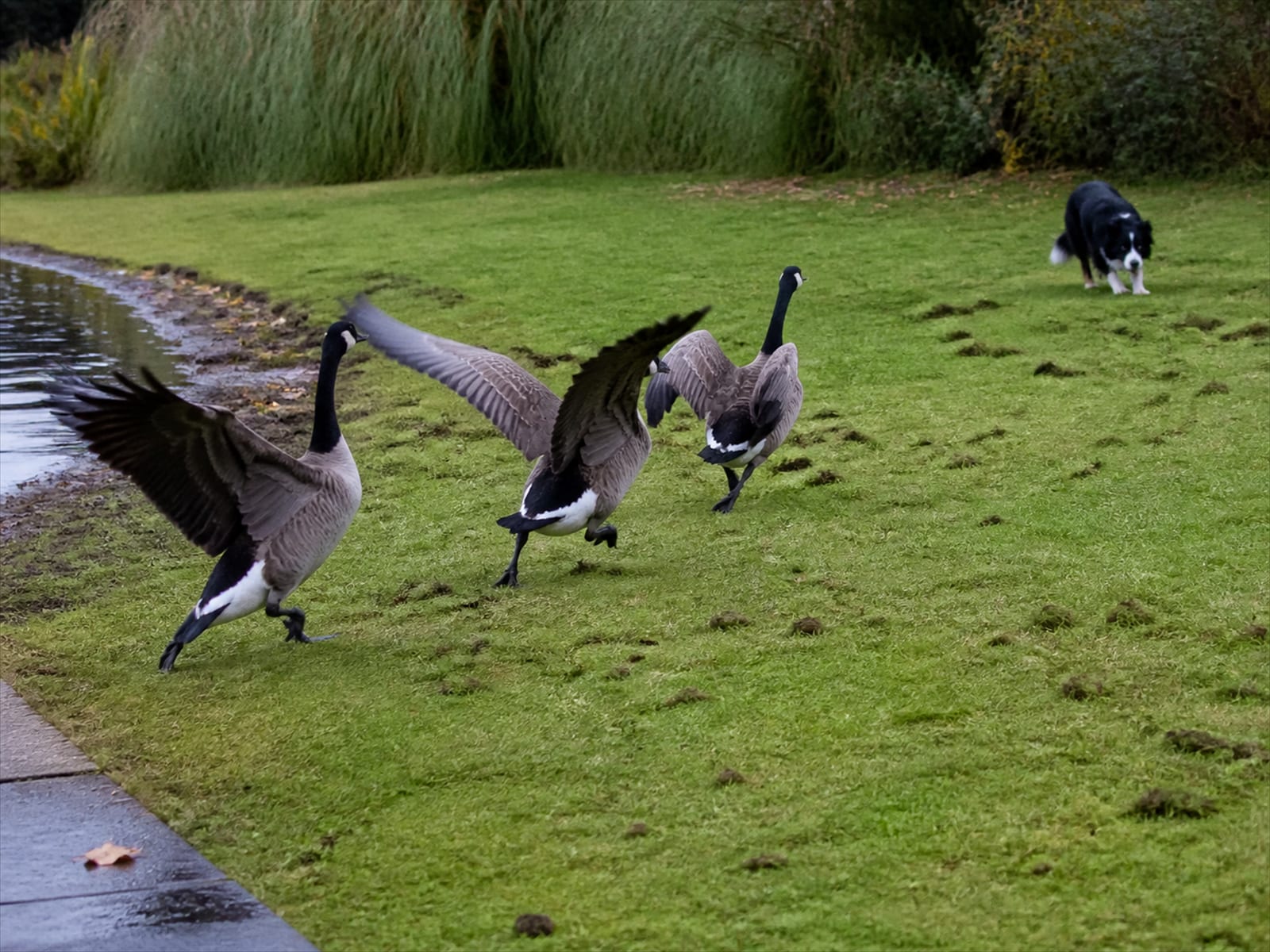
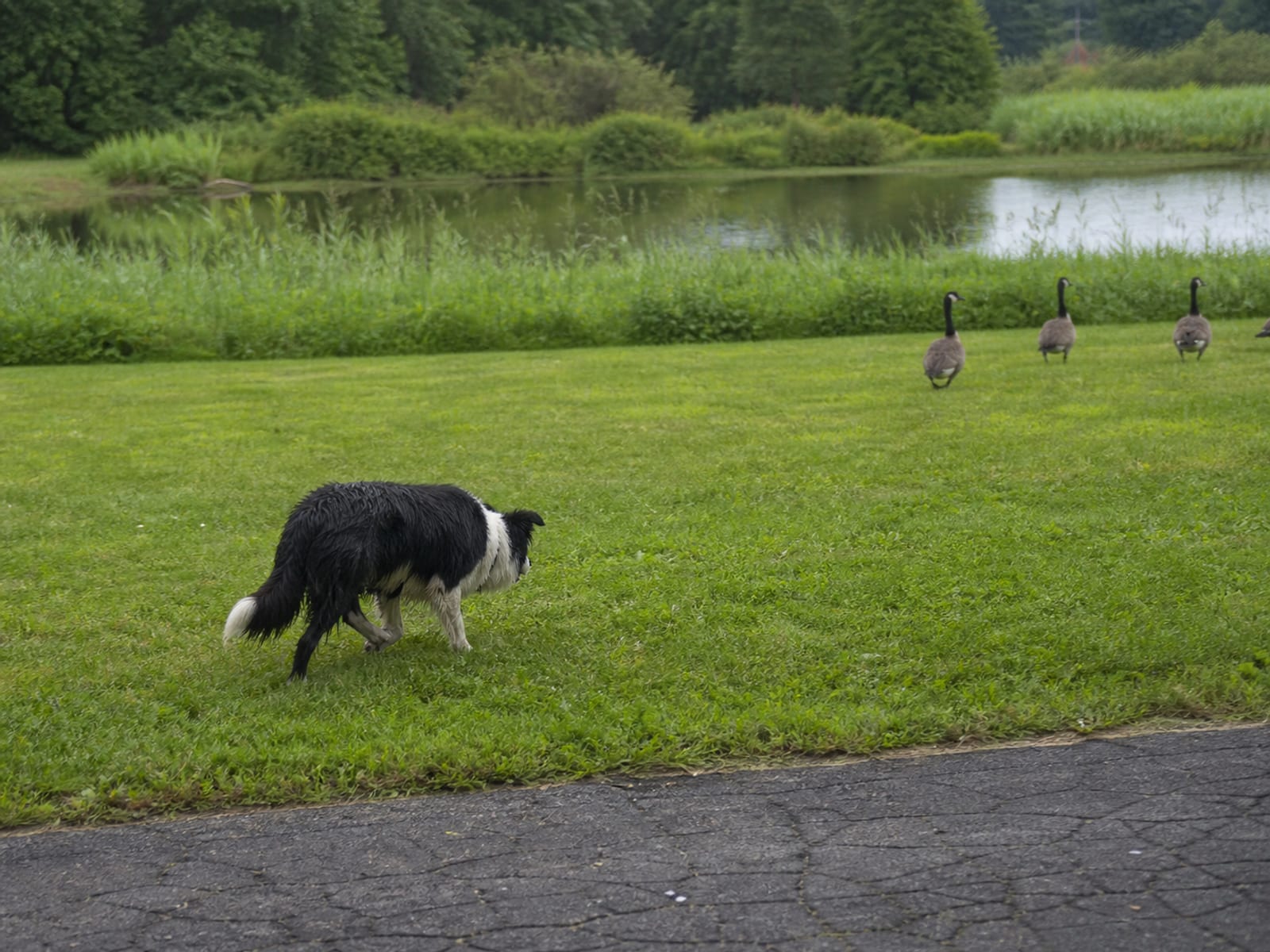
This is the part Border Collie goose abatement does, and the reason it works is that a dog reads to a goose as a predator rather than as a nuisance. The reason it has to be repeated is everything in the section above.
Monitoring that survives a change of staff
If the only record of the program lives in the head of the grounds supervisor who leaves in September, the program restarts from zero. Write it down somewhere the next person will find it.
The year decides what is worth doing when
A plan written in February and a plan written in August are not the same plan, even on the same property.
The Canada goose year across Connecticut, Massachusetts and New York
March
Connecticut DEEP says territorial defense can begin this month. This is when walking the shoreline, the islands and any structures costs least, because nothing has been established yet and nothing is protected in place.
Early April into June
DEEP describes nesting by early April. FWS identifies March 1 through June 30 as the window for regulated resident goose nest and egg activity, subject to state rules. From here on, nesting season aggression starts producing incident reports rather than complaints.
Summer
The flightless molt falls in this period, and no state page publishes an exact statewide start and end date valid across Connecticut, Massachusetts and the Hudson Valley at once. During it the birds cannot leave, so a water-to-turf barrier is doing more work than at any other point in the year.
Autumn
Connecticut says migration continues through November, with abundance rising through the region as birds move south.
Winter
Connecticut records a migrant arrival peak in mid-December, with most migrants gone by mid-January, though mild years hold substantial numbers. The Atlantic Flyway management plan notes that resident geese often stay put in developed areas wherever open water and food remain, and identifies the Hudson River Valley among the inland areas where winter concentrations form near large unfrozen water. Inspect in winter rather than assuming the property is empty.
Where this lands hardest in Connecticut is not evenly spread. DEEP reports that geese nest statewide but that the highest populations sit in Fairfield, Hartford and New Haven counties, which is most of the ground we cover. Municipalities here already treat it as a standing line item rather than an incident: Coventry's official 2024 State of the Lake page carries a resident Canada goose management item for Lake Wangumbaug. That is a habitat signal and a sign of how these are handled locally, not evidence that any particular town has a problem today.
One caution that gets ignored every autumn. Connecticut DEEP says migratory and resident birds overlap in fall and winter and cannot be told apart by appearance. A flock on your grass in November is not evidence of anything about where those birds nested, so do not let a seasonal sighting turn into a claim about your resident population. What the birds are is covered in more detail on our page about the Canada goose.
Where the law stops everyone, including your contractor
This section is worth reading twice, because the legal exposure usually sits with the property owner rather than with the company they hired.
Canada geese, their nests and their eggs are protected under the Migratory Bird Treaty Act and federal regulations, and FWS is direct that handling birds, nests or eggs requires legal authority. Non-injurious dispersal sits on one side of that line and needs no permit. Everything involving a bird, a nest or an egg sits on the other.
For nest and egg work, authorization is annual and it belongs to the land, not to a contractor. FWS says landowners, homeowners' associations, public land managers and local governments in the lower 48 may register for that authority on property under their jurisdiction, must renew before each year's activity, and must report afterwards. Its guidance also says non-lethal techniques are to be used to minimize the need for nest and egg work in the first place. The FWS state contact table, updated in March 2026, records Connecticut, Massachusetts and New York as all accepting that federal registration, and flags a further Connecticut requirement for commercial control firms specifically. That last detail is worth holding onto: the paperwork sits with you, and hiring a firm can add a requirement rather than removing one.
Three state details are worth carrying into any conversation with a vendor:
- MassWildlife requires a special permit for egg addling or nest work, and says presence alone is not enough. There has to be a reasonable basis, such as property damage.
- New York DEC says relocation is generally not allowed, even with a permit. Moving the flock somewhere else is not a legal option being withheld from you; it is not an option.
- The same DEC guidance says online federal registration is sufficient for nest and egg work in that state, and that all Canada geese, resident flocks included, are protected by federal and state law. The federal rules it points to are listed by section, with 50 CFR 21.162 covering resident goose nests and eggs and separate sections covering airfields, agricultural facilities and public health.
The enforcement side is not theoretical. A 2025 DEC enforcement account describes throwing rocks at Canada geese in a potentially injurious way as unlawful, with action taken. That is the boundary a frustrated employee crosses without meaning to.
How to tell whether it is holding
Are the geese gone is the wrong question, and a property that accepts it as the measure will conclude the program failed the first week a migrating flock drops in.
What to record, and why it beats a bird count
Keep the record through the months nobody is thinking about the pond. A flock that settles in over winter is the flock you meet again in March, and by then it has an opinion about the property.
Water is its own measure and it is not a visual one. The Atlantic Flyway plan states that goose droppings contain fecal coliform bacteria, links waterfowl E. coli to elevated counts at beaches and drinking water supplies, and notes that large numbers at a small, poorly flushed water body can preclude swimming, drinking or other direct-contact uses. Connecticut's stormwater manual calls waterfowl a significant source of nutrient and pathogen loading to surface waters. Seeing birds on a pond is a reason to test, not a test result, which is the distinction we draw on our page about water quality in ponds.
What actually drives the cost
No authoritative public source gives current commercial price ranges for humane long-term goose work in Connecticut, Massachusetts or the Hudson Valley and Capital District, so nobody should be publishing one, us included. What can be stated honestly is what moves the number.
Acreage and access. How many water bodies, and how big. How much open maintained turf. How many active use zones with people in them. Flock counts and how they change by season. Safety restrictions on when work can happen. Whether monitoring and reporting are wanted. Whether physical site changes such as fencing or planting are in scope. And whether any part of the work touches a regulated technique, which changes who has to hold what.
One number that circulates and should not: FWS charges no fee for the resident goose nest and egg registration. True, and irrelevant to program cost. It is a paperwork estimate, not a quote.
Would your property pass a wildlife-law spot check?
Pick an answer to see how you did
1. A resident flock is on the main lawn. Which of these can your staff do today with no permit at all?
2. When is a low fence between water and turf doing the most work?
3. A vendor offers to take care of a nest near your entrance. What is the first question?
4. You have geese on the grass in December. What does that tell you?
Nothing answered yet.
Questions from managers who have been through this once
We already tried a dog service and the geese came back. Why would this be different? Because of what sits alongside it. Virginia Extension says birds may return to preferred sites when dogs leave, and Connecticut DEEP says non-lethal methods other than habitat work are transitory on their own. If the previous program was dog visits with no change to the shoreline, no end to feeding and no record kept, then it produced exactly the result the guidance predicts. The fix is not usually a different dog.
How long before we see something? Behavior at the site starts changing from the first visits. A durable change in how the property is used is measured across seasons, and the one regional study with three years of data behind it ran March to November each year. We will not give you a date, because no source supports one and the number would be invented.
Do the geese just move to the property next door? They can. Where a pond, a lawn or a public path is shared between owners, the sensible boundary for a program is sometimes larger than one parcel. The Orange County researchers made the same point from the other direction, noting that wider adoption would need coordination between local projects, public involvement and a long-term commitment of resources.
Is any of this different because we are a water supply property? Yes, materially. Massachusetts DCR runs an annual goose population control program at the Quabbin, Wachusett and Sudbury reservoirs, precisely because resident birds can affect water quality, and its Quabbin material describes locating active nest areas, particularly on islands, and using barriers, decoys and active dispersal. On agency-controlled water supply land, access rules and the agency's own authority come first, and no private contractor should imply otherwise.
What about grazing? Is the turf damage real or is it just the mess? Both, and they scale differently. Penn State Extension estimates an adult goose eats about 4 pounds of grass a day and produces 2 to 4 pounds of manure a day. That is a general biological estimate rather than a measurement of your lawn, and it should not be converted into an annual cleanup figure without counts from your own site. We work through that arithmetic on our page about droppings and turf damage.
We are near an airfield. Does that change the urgency? It changes who else has a say. The Atlantic Flyway plan reports waterfowl involvement in 31 percent of bird strikes that damaged civil aircraft in its 1991 to 1997 dataset and 59 percent of the reported monetary losses, which are historic national figures rather than a current rate for any airport near you. The FAA notes that 95 percent of bird strikes happen during takeoff and landing. On or beside an airfield the starting point is the airport's own wildlife hazard planning rather than a general regional claim, which is the ground we cover on bird strike risk.
Our property is a golf course. Is this the same advice? Mostly, with different constraints on where habitat work can go and when anyone can be on the ground. We wrote that up separately in goose control for golf courses.
Where this leaves your property
A resident flock is a habitat problem with a behavior problem sitting on top of it. The behavior half works quickly and stops working when it stops. The habitat half is slow, partial, and the only part the guidance does not call transitory. Fund one without the other and you buy the same result you already paid for once.
What a program built properly gives you is not an empty property. It is ground people can use, a cleanup load your staff can absorb, a spring that does not generate incident reports, and a written record that tells you honestly whether it is working. Those are things you can put in front of a board, which is usually what the person asking about last year's spend actually needs.
If your flock came back, tell us what you are seeing: how many birds, where the water is, what was tried before and what changed on the property afterwards. Tri-State Geese Patrol runs humane Canada goose abatement with trained Border Collies across Connecticut, Massachusetts and New York, working out from West Hartford, and we run more than one crew, so a site an hour out gets the same recurring program as one down the road. You can see where we work on our service areas page. Call us on (203) 856-4889 or send us a message and it goes straight to Bill. If a goose program is the wrong answer for your property, we would rather say so on the first call than after the site visit.
The words that decide what is allowed
Six terms carry most of the weight in this subject, and three of them are the ones a vendor can hide behind.
Tap a term to see what it means
Hazing. Moving birds without physically harming them, using dogs, noisemakers or people. New York DEC states this needs no federal or state permit, provided no bird is hurt. It is the legal basis for dog-based abatement rather than a softer word for something else.