Tri-State Geese Patrol

Goose Control in Simsbury, CT

Humane Canada goose abatement for Simsbury properties, using trained Border Collies that move birds without touching them. The town already runs permitted waterfowl management at its own golf course.

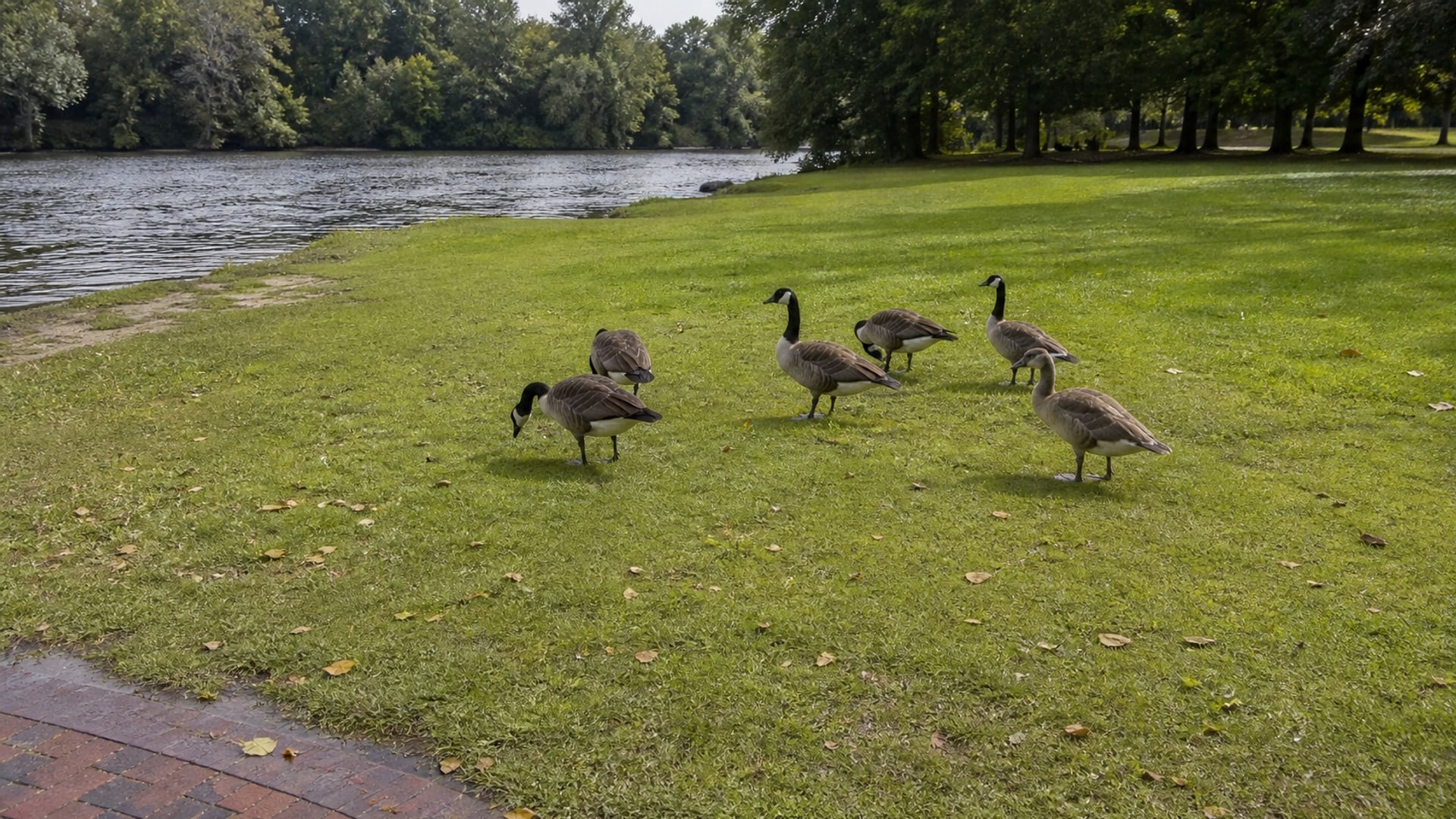
Open mown grass beside water of the kind Canada geese settle on in Simsbury, CT

At a glance

Town

Simsbury, Connecticut, including Weatogue, West Simsbury and Tariffville

Method

Non-lethal herding by trained Border Collies, no contact with any bird

Permit needed to move geese this way

None, provided no bird is harmed

Local rule worth knowing

Intentional feeding of wildlife carries a 250 dollar fine per offense

Simsbury already does this, at its own golf course, under a permit

There is a sentence in Simsbury's draft stormwater management plan that no other town in this service area matches. It says waterfowl management at Simsbury Farms Golf Course will continue to operate under an existing permit with the USDA.

Continue is the operative word. That is not a plan to look into something. It is a town describing an arrangement already running at its own municipal course, with a federal agency permit behind it.

The same plan sets out the wider approach: Simsbury will identify lands where waterfowl congregate and where public feeding occurs, use signage and other methods to educate people about the effects of feeding including waste deposition, and either discourage congregation or isolate direct drainage from those areas.

For a property owner here, two things follow. The first is that you are not going to have to convince anyone locally that this is a real issue; the town has already taken a position and is spending against it. The second is a useful calibration on expectations. A municipal course with a federal permit arrangement is running a maintained program, not a one-time fix, and that is what serious goose management looks like at a site that keeps offering birds what they came for.

To be clear about our own position: that permit is the town's arrangement with a federal agency, not ours, and nothing here should be read as us operating under it or being able to.

The strongest feeding fine in the region, and a hard limit on dogs

Simsbury's code pulls in two directions at once, and an honest provider should tell you about both rather than only the helpful one.

The helpful one first. Chapter 65, Article I, section 65-3 prohibits the intentional feeding of wildlife, defined broadly to include feeding, giving, placing, exposing, depositing, distributing or scattering edible material or an attractant with intent to feed, attract or entice wildlife, and the code's definition of wildlife takes in wild birds. Section 65-5 authorizes a 250 dollar fine for each offense.

Two hundred and fifty dollars is the stiffest figure we have found in this service area, and feeding is the single thing most likely to hold a flock in place against everything else a property does. If somebody is reliably feeding birds on ground you control, Simsbury gives you real weight behind asking them to stop.

Now the harder one. Chapter 65, Article II governs dogs at town recreational facilities, athletic fields and trails. It defines restrained as physically controlled by leash or lead, and it prohibits both restrained and unrestrained dogs from specified team-use areas, naming the Memorial Park fields, the Curtiss Park athletic fields, the Weatogue Park athletic fields and playscape, and the Simsbury High School track, artificial turf, courts and fields. The stated exemption is for service dogs. No working-dog or commercial exemption appears in the text.

So on those named surfaces a dog is out regardless of whether it is on a lead, and those are exactly the kind of surfaces a flock will choose. Work on public ground in Simsbury therefore needs written, location-specific approval rather than an assumption, and where a named field is involved the honest answer may be that the fieldwork is not the available tool there. Habitat work and monitoring still are.

On private ground, a private club, an association, a company campus, the owner authorizes it and none of the Article II field list applies.


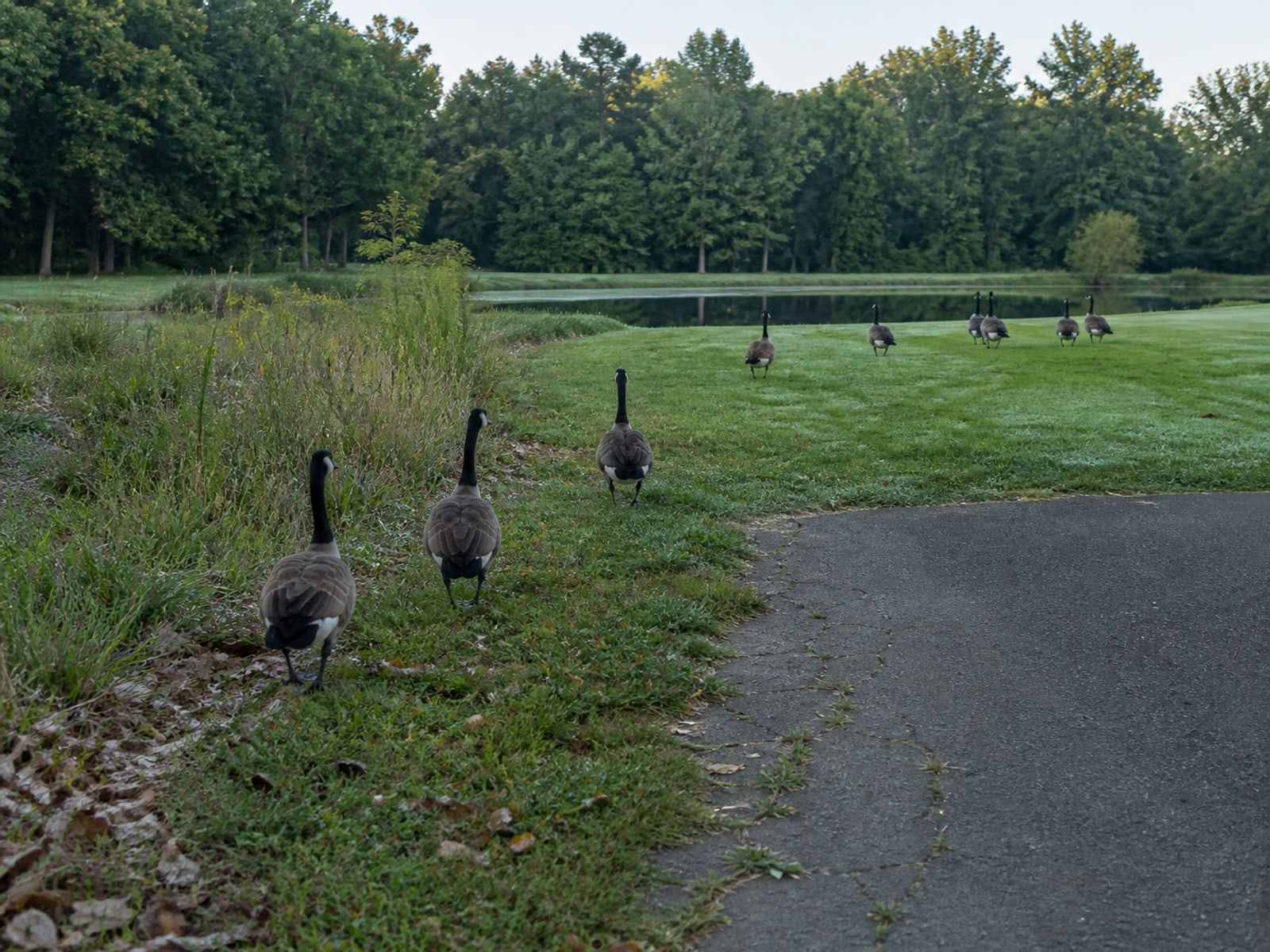
Canada goose droppings and grazed turf on maintained ground in Simsbury, CT

Where does lawn meet water in Simsbury?

The Farmington River runs the length of this town and the rest of the water is spread between town parks and state land. Where a water feature is not documented, this says so.

Meadow Pond Park and Orkil Fields

A 90 acre park surrounding Tuller Reservoir, also called Meadow Pond, on Hedgehog Lane, with a meadow and an informal playing field. Hop Brook separates the park from Orkil Fields. That is water, meadow and playing ground in one connected place, which makes it the clearest inland pairing in town.

The municipal golf course

Simsbury Farms Golf Course at 100 Old Farms Road is a municipal public 18 hole course run by the town's Culture, Parks and Recreation Department, and it is the site the town's stormwater plan names for ongoing waterfowl management under a USDA permit. Public materials do not document particular ponds or water hazards there, so specifics about the water on the course would come from the superintendent rather than from us.

The river, and the state ponds

The Farmington River bisects the town, running along the east side of the former Hartford site at 200 Hopmeadow Street and past Curtiss Park on Route 315. Stratton Brook State Park off Farms Village Road holds Massacoe Pond and a separate swimming pond, and the town says Great Pond State Park is used by waterfowl. Those state parks are CT DEEP ground rather than town ground, which changes who authorizes anything there.

The former Hartford site, and what it is now

200 Hopmeadow Street is the clearly documented institutional landscape-and-water site: town stormwater material describes the former campus development, surrounding forest, the Farmington River and Minister Brook wetlands along its north and east limits, and planned stormwater design. It should not be described as an active corporate campus, because the town's own report says the office building was demolished. No other active office or hospital campus pond in Simsbury is documented.

Who administers what, and where the river changes the answer

Simsbury's ownership map is simpler than some of its neighbors but it has one wrinkle that decides a lot of jobs.

The town's Parks and Recreation Department maintains the town parks and runs the municipal golf course, so on ordinary town ground there is one clear door. CT DEEP operates the state parks, which here means Stratton Brook and Great Pond, and those are not the town's to authorize. School property brings in its own facilities route, and the named school surfaces are among the ones Chapter 65 closes to dogs entirely.

The wrinkle is the Farmington River. It bisects the town, which means a lot of otherwise ordinary properties sit in a river corridor with floodplain, wetland and watercourse considerations attached. The former Hartford site at 200 Hopmeadow Street is the documented example: town stormwater material describes the Farmington River and Minister Brook wetlands along its north and east limits, with planned stormwater design to match.

That does not change the fieldwork. Moving birds off maintained turf with a dog is not a regulated activity anywhere. It changes what is possible at the edges, because planting a buffer, setting a barrier or altering drainage near a wetland or watercourse is a filing rather than a decision a contractor can make, and along a river that corridor is wide.

The practical consequence is worth saying plainly. On a Simsbury property the fieldwork can usually start quickly once the owner authorizes it, while the habitat half may need a season of lead time. Those are different clocks, and a plan that pretends they are the same clock will disappoint somebody.

What happens after you call about a Simsbury property?

The fieldwork is the same at a pond-side meadow, a fairway and a company lawn. Here the front end is unusually decisive, because some public surfaces are simply closed to dogs.

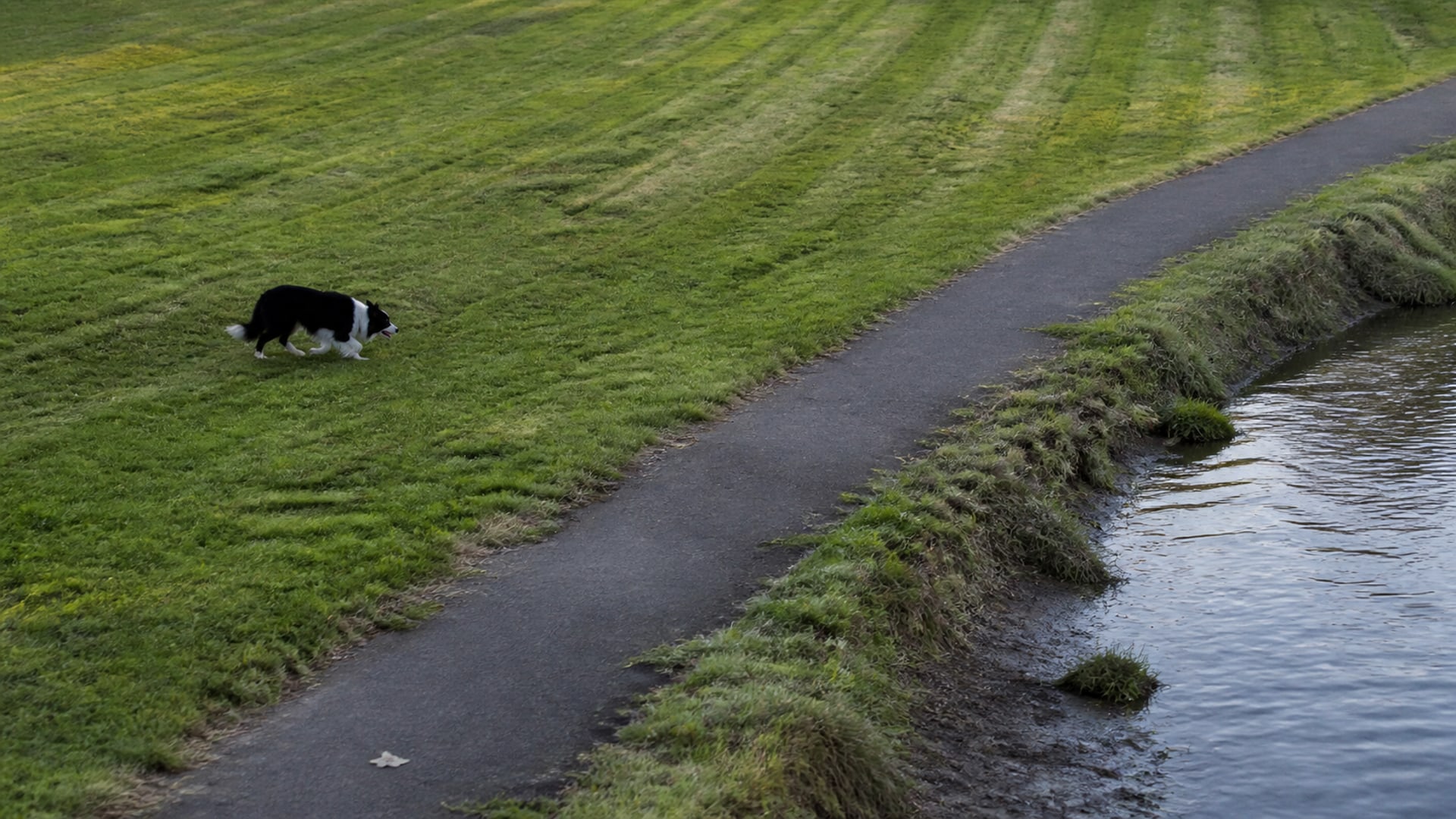
A Border Collie working a flock of Canada geese off maintained ground in Simsbury, CT
  1. 01

    We ask what the surface is

    This comes first in Simsbury rather than later. If the ground is one of the named team-use areas in Chapter 65, Article II, dogs are prohibited there whether leashed or not, and we will tell you that before quoting rather than after.

  2. 02

    We ask what you are seeing, and what has been tried

    How many birds, on which surfaces, at what times, and how close the water is. What a flock has already learned to ignore changes what is worth doing next.

  3. 03

    We establish whose ground it is

    Town park, town golf, school property, CT DEEP state park land, a private club, an association or private commercial ground. Two of those are the state's rather than the town's.

  4. 04

    We walk the ground and map the way up from the water

    Geese travel between water and turf on foot, so the useful map is where they come up, which grass they graze and where they loaf. Along a river corridor that route is longer and less obvious than beside a pond.

  5. 05

    The dogs work at times the flock cannot anticipate

    A handler works the ground with a trained Border Collie in a stalking posture. A goose responds to that as it would to a predator, by leaving, with no contact and no capture. The visits then repeat unpredictably, because a schedule the birds can learn is one they will sit out.

  6. 06

    We deal with the feeding, and we measure

    In Simsbury the feeding conversation has a 250 dollar fine behind it, which is worth knowing when a well-meaning regular is the reason the birds stay. Then counts, locations, complaints and the gap between a visit and the birds returning, which is the first honest evidence a program gives you.

What we handle, and who handles the rest

We do not operate under anybody else's permit. The USDA arrangement at Simsbury Farms is the town's, and we would not represent ourselves as working under it or as able to.

We do not apply turf repellents. They are registered pesticides, applying one to commercial turf in Connecticut is licensed work, and we hold no such certification. A licensed applicator is the right call if a repellent suits a defined surface.

We do not addle eggs or work on nests. The landowner registers with the US Fish and Wildlife Service before anything happens, Connecticut accepts that federal registration and adds a further requirement where a commercial control firm is involved, and the authorization belongs to the landowner or the town rather than to a contractor.

We do not run dogs on the town fields Chapter 65 closes to them, and we will say so at the quoting stage rather than hoping nobody checks.

And we do not promise the geese will be gone permanently. A town running a permitted program at its own course year after year is the local evidence for why.

When does acting in Simsbury cost the least?

Before nesting narrows what is lawful, and before the playing season closes off the ground.

Connecticut DEEP puts territorial defense as early as March and nesting by early April, with incubation about 28 days and hatching through to June. Up to that point a shoreline or a meadow edge is just ground. Once a pair is holding position it becomes a protected-nest problem, and beside a park path or a school field that is a safety question as well as a legal one.

The Farmington River gives this town a second rhythm on top of its resident birds. DEEP records migrants arriving in early October, movement continuing through November with another arrival peak in mid-December, and most birds leaving the state by mid-January, though mild winters hold them longer. DEEP also says migrant and resident birds overlap in those months and cannot be told apart by appearance, so a flock at Curtiss Park in November tells you little about where those birds nested.

There is a scheduling point specific to Simsbury as well. Because Chapter 65 closes named team-use fields to dogs entirely, the practical window for any dog-based work on public ground is on the surfaces that are not on that list, and working that out early is the difference between a plan and a disappointment.

Nobody publishes freeze or thaw dates for Meadow Pond or the state park waters, so we watch the water rather than the calendar.

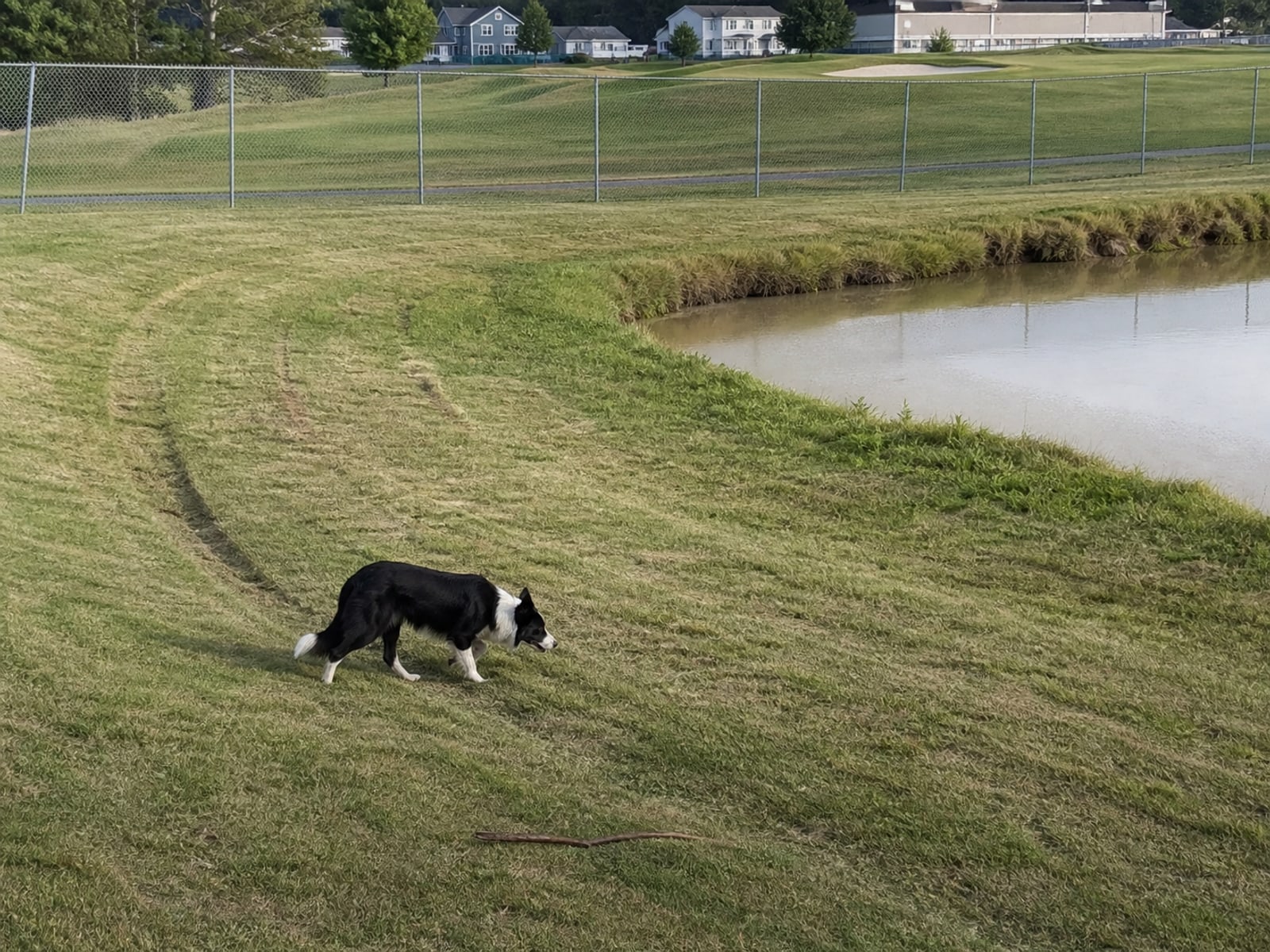
Maintained ground in Simsbury, CT holding clear of Canada geese after repeat visits

Simsbury goose control questions

Does the town already have a goose program?

At one site, yes. Its draft stormwater management plan says waterfowl management at Simsbury Farms Golf Course will continue to operate under an existing permit with the USDA. The wider plan also commits the town to identifying congregation and feeding areas, educating the public and either discouraging congregation or isolating drainage from those areas.

Can a trained dog work on Simsbury town fields?

Not on the named ones. Chapter 65, Article II prohibits dogs, restrained or unrestrained, from specified team-use areas including the Memorial Park fields, Curtiss Park athletic fields, Weatogue Park athletic fields and playscape, and the Simsbury High School track, turf, courts and fields. Service dogs are the stated exemption and there is no commercial working-dog exemption. Elsewhere on public ground it needs written, location-specific approval.

Is feeding geese against the rules here?

Yes, and firmly. Section 65-3 prohibits the intentional feeding of wildlife, defined broadly and including wild birds, with a 250 dollar fine per offense under section 65-5. That is the strongest feeding provision we have found in this service area.

Our site is beside a state park. Does that matter?

It changes who authorizes anything on the state side. Stratton Brook and Great Pond are CT DEEP ground, and the town says Great Pond is used by waterfowl. It does not stop a program on your own property; it means the neighbors' land is not yours or the town's to work.

How much does goose control cost in Simsbury?

It is quoted per site, on ground worked, bird numbers, water edge, visit frequency and what the surface is used for. There is no credible published range for this region, and a figure given before somebody has walked the property is a guess.

What if the birds are on a field where dogs are banned?

Then we say so, and we talk about what is available instead: changing the mowing line, an unmown strip or a barrier where the water meets the grass, enforcing the feeding rule, and working the adjoining ground the flock uses to reach that field. Selling you visits to a surface we cannot lawfully work would be worse than losing the job.

Is Hop Meadow a municipal course?

No. Hop Meadow Country Club at 85 Firetown Road is a private 18 hole club, while Simsbury Farms at 100 Old Farms Road is the municipal public course. That difference decides who authorizes work and how it is purchased.

Local detail

Canada geese in Simsbury, Hartford County

Simsbury is a Hartford County town of about 24,500 residents in the Farmington River valley, spread across Simsbury Center, Weatogue, West Simsbury and the borough of Tariffville rather than a single built-up core.

The goose-relevant ground is a mix of town recreation land and river valley: Simsbury Farms with its public golf and recreation complex, Meadow Pond and Tuller Reservoir on Hop Brook at Meadow Pond Park and Orkil Fields, the Farmington River itself, and state land at Great Pond and Stratton Brook. The town also has rules against intentional wildlife feeding and restrictions on dogs at athletics facilities, both of which shape how a program is scoped here.

Neighborhoods we cover in Simsbury

Parts of Simsbury where we work. Each one opens in Google Maps.

Bordering towns: Avon, Canton, Bloomfield, Granby, East Granby, Hartland. A flock does not recognize a town line, so a program sometimes has to be scoped wider than one parcel.

Getting there: Route 10, Hopmeadow Street, Route 167, Route 185, Route 315, Firetown Road, Iron Horse Boulevard.

We cover all of Simsbury and the ground around it. If your neighborhood is not listed, or you are not sure which one you are in, it is very likely we work there. Ask and we will confirm.

Talk to us about your Simsbury property

Tell us what you are dealing with: roughly how many birds, which surfaces they are fouling, how close the water is, and whether the ground is town, state, club or private.

Tri-State Geese Patrol runs humane Canada goose abatement with trained Border Collies across Connecticut, Massachusetts and New York, and we are reachable 24 hours. Call (203) 856-4889 and it goes to Bill.

And if the honest answer for your site is an unmown strip and enforcing the feeding rule rather than a contract, we will say so.