Tri-State Geese Patrol

The Canada Goose

The Canada goose, Branta canadensis, is a federally protected bird that has become a year-round resident across Connecticut, Massachusetts and New York because developed property gave it exactly what it needs: short mown grass to graze, open water a few steps away, clear sightlines, and room to land and take off. Understanding that is most of the job, because everything a property can lawfully do about a flock follows from what the bird is doing and why. Call Tri-State Geese Patrol on (203) 856-4889.

At a glance

Species

Branta canadensis

Protected by

Migratory Bird Treaty Act

Nests within

About 150 feet of water

Flightless

Roughly mid-June to late July

Why the bird chose your property

Not by accident, and not because of anything you did wrong. A Canada goose is looking for a specific combination, and a managed property supplies all of it at once.

Connecticut DEEP names the habitat directly: lawns, parks, golf courses, athletic fields, airports, agricultural fields, ponds, lakes, reservoirs, marshes and rivers. Its nuisance guidance is more precise about why. Geese need room to land and take off, and they are uncomfortable feeding where their view of a predator is poor. Cornell's guidance on urban geese adds the same three ingredients from a different direction: open view, grazing turf, and water nearby.

So a mown lawn beside a pond is not a neutral piece of ground that geese happen to visit. It is high-quality food, an escape route, a clear line of sight and a runway, arranged together. Short, fertilized, irrigated grass is genuinely better goose forage than the rough field next door.

DEEP also ties the rise in the resident population to development itself, linking it to the ponds, lakeside lawns, golf courses and athletic fields built since the 1950s. It says the birds now nest statewide, with the highest Connecticut populations in Fairfield, Hartford and New Haven counties. New York DEC counts more than 200,000 resident Canada geese statewide against a long-term goal at or below 85,000. This is a regional pattern that arrived with the way we build, not a local misfortune.

One consequence is worth stating plainly, because it changes how a property should think about the problem. Nothing on that list is a mistake to be corrected. A pond, a lawn and an open outlook are usually the things a site was designed to have, and on a golf course or a campus they are the product. The work is therefore not about undoing the property. It is about changing the parts of it the birds are reading, in the places that can afford to change.


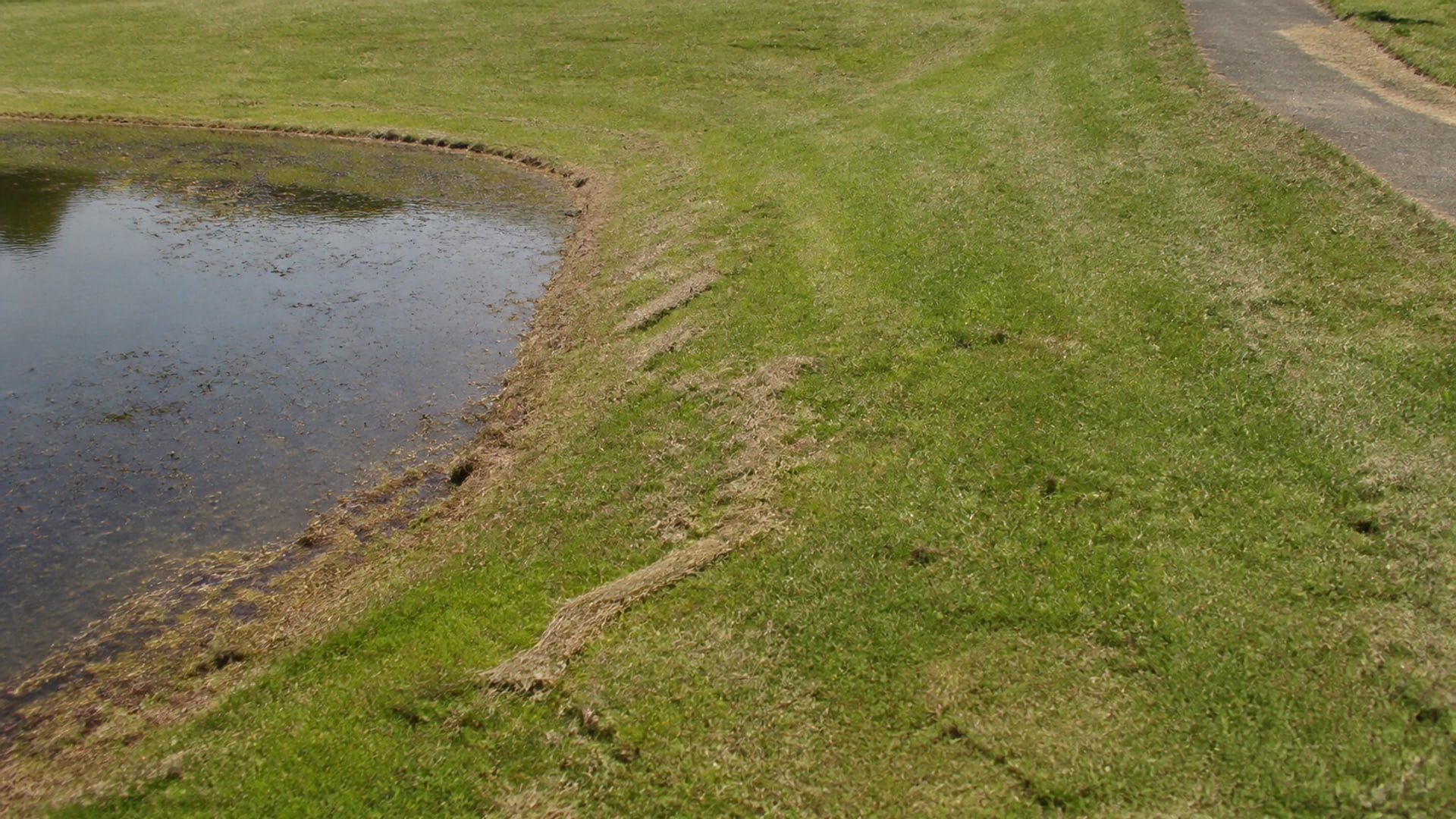
Short mown grass running down to open water with clear sightlines

Resident geese and migratory geese are not the same problem

This is the distinction that decides what a property can realistically expect, and it is the first thing worth establishing on your own site.

USDA defines resident Canada geese, for federal management purposes, as birds that nest in the lower 48 states and the District of Columbia during March through June, or that reside there during April through August. Those are your year-round birds. They treat your pond as home, they return to the same nesting spots, and their goslings become next season's resident flock. A pair that has nested beside the same green for four years is a resident problem.

Migrants are a different pressure entirely. In Connecticut they arrive in early October, movement continues through November, another peak lands in mid-December, and most have gone by mid-January, though a mild winter holds numbers later. Connecticut DEEP notes that geese concentrate in Long Island Sound bays and inlets when inland fresh water freezes, which is why a hard winter and a mild one produce different problems on the same property.

New York's Atlantic Flyway plan identifies the Hudson River Valley as an inland winter concentration area, and notes that urban areas can hold winter birds because of ice-free water, food and little hunting pressure. Practically, that means a flock arriving on your grass in November has no knowledge of anything done in June, and a program that promised otherwise was overpromising.

Both kinds respond to the same methods. They respond on different timescales, and only one of them lives with you.

Canada geese holding ground on managed turf outside migration season

The year, month by month

The bird's calendar drives everything: what it does on your property, what it will tolerate, and what anyone is lawfully allowed to do about it.

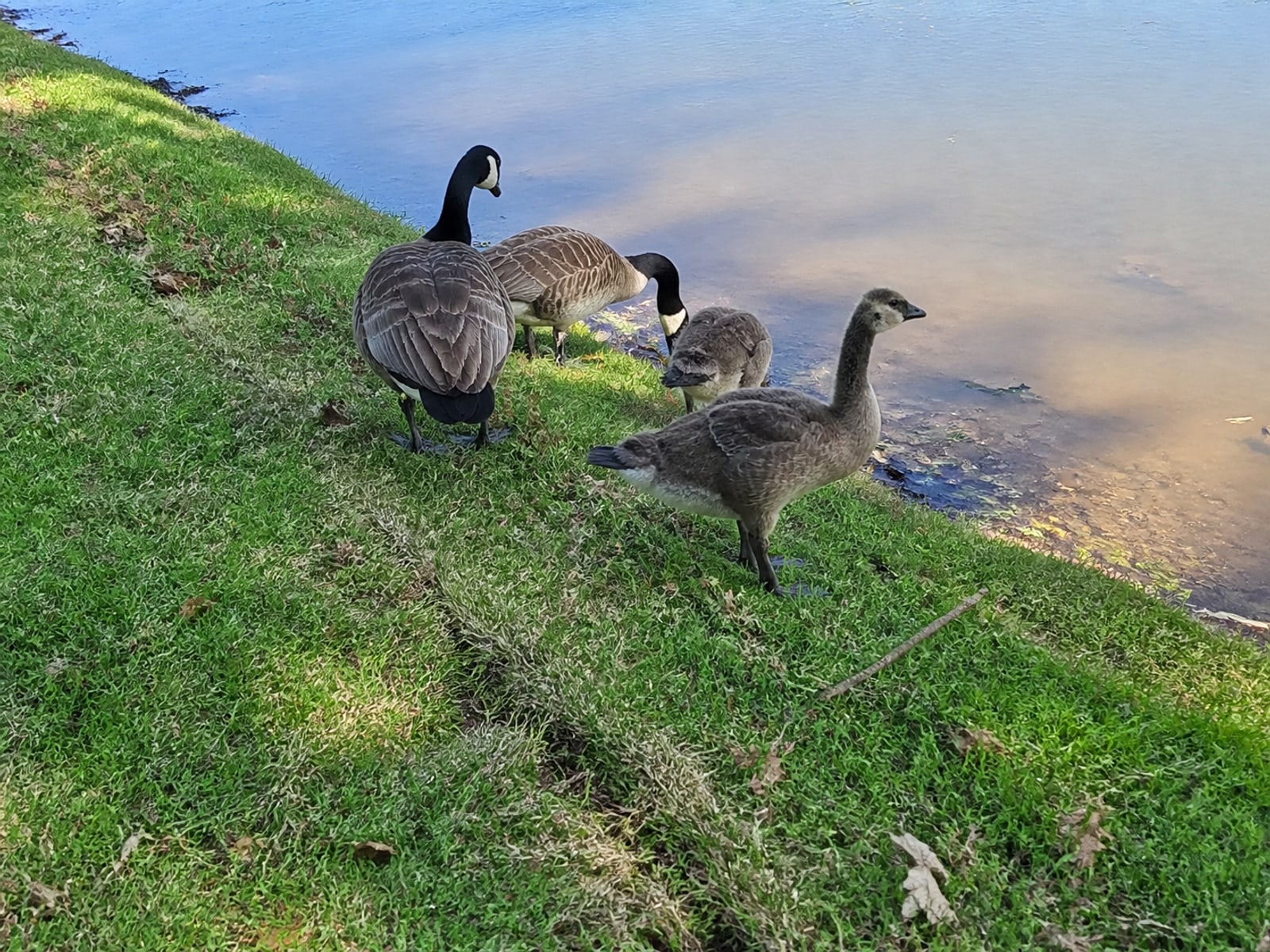
A flock of Canada geese gathered on grass beside water during the summer molt

March, pairs return and claim ground

New York DEC says adult pairs return to nesting areas in late February or March as the water opens, and Connecticut DEEP says territory defense may begin in March. This is the most valuable window for an assessment, because once a pair has committed to a site your options narrow sharply and stay narrow for months.

April into early May, nesting and hatching

Connecticut's guidance describes nesting by early April, with hatching running April through June and a peak in the first week of May. New York DEC describes egg laying and incubation extending through April with peak hatch in late April or early May depending on location. Cornell notes that urban geese usually nest within about 150 feet of water, which is why nests appear beside the paths and doorways people actually use.

May and June, goslings on the ground

Adults with goslings hold ground and behave defensively. This is when a property's complaints shift from cleanup to people being confronted, and it is covered in more detail on the nesting season aggression page.

Mid-June to late July, the flightless molt

New York DEC identifies a four to five week molt in this window with flight resuming by August, and Connecticut DEEP identifies June and July as the months the birds cannot fly. The flock is on foot, concentrated, and stuck wherever it already is. Penn State Extension advises that the birds should not be disturbed during it.

August through November, flight returns and migrants arrive

Resident birds are flying again and migrating flocks add pressure on top of them. A new flock on your grass in autumn is frequently a different set of birds from the ones that were there in spring.

December through February, winter flocks

Massachusetts notes that resident Canada geese are present year-round and gather into large flocks by fall. Whether they stay on your property through winter depends mostly on whether the water stays open.

Why they are protected, and what that rules out

Canada geese are protected migratory birds. The US Fish and Wildlife Service states that the Migratory Bird Treaty Act, 16 U.S.C. 703 to 712, and the federal regulations under it protect the birds, their nests and their eggs, and that killing or handling birds, nests or eggs requires legal authority.

That single fact rules out most of what a frustrated property owner is tempted to try first, and it is the reason this industry exists in the shape it does. The practical question is not how to remove the birds. It is how to change what the flock makes of your ground.

The regulated exceptions exist, and they are narrow and specific. New York DEC lists the federal resident-goose rules as 50 CFR 21.159 for airport and military airfield control, 21.162 for resident Canada goose nests and eggs, 21.165 for agricultural facilities and 21.168 for public health control. Each is its own authorization with its own conditions, and none of them is a general license.

Nest and egg activity is the one property owners ask about most. The Fish and Wildlife Service describes it running March 1 through June 30, requires annual registration before any activity and annual reporting afterwards, and notes that state requirements can add conditions on top. Connecticut's state-contact entry says an additional state requirement applies for commercial control firms. That path belongs to the landowner or a public body, and it is not a service Tri-State Geese Patrol performs or holds authorization for.

What is allowed without a permit is moving birds without harming them. New York DEC states that no federal or state permit is needed to scare, herd or chase geese, including with dogs or noisemakers, provided no bird is physically harmed. That is the legal foundation the whole non-lethal approach rests on.

For a property manager the practical takeaway is short. Anything that moves birds without touching them sits on one side of a bright line and needs no permit. Anything that touches a bird, a nest or an egg sits on the other side, needs a specific authorization, and belongs to you or your municipality rather than to a contractor. A provider who is vague about which side a proposed action falls on is the single clearest warning sign when you are choosing a provider.

What a resident flock actually costs a property

The bird itself is not the complaint. These are.

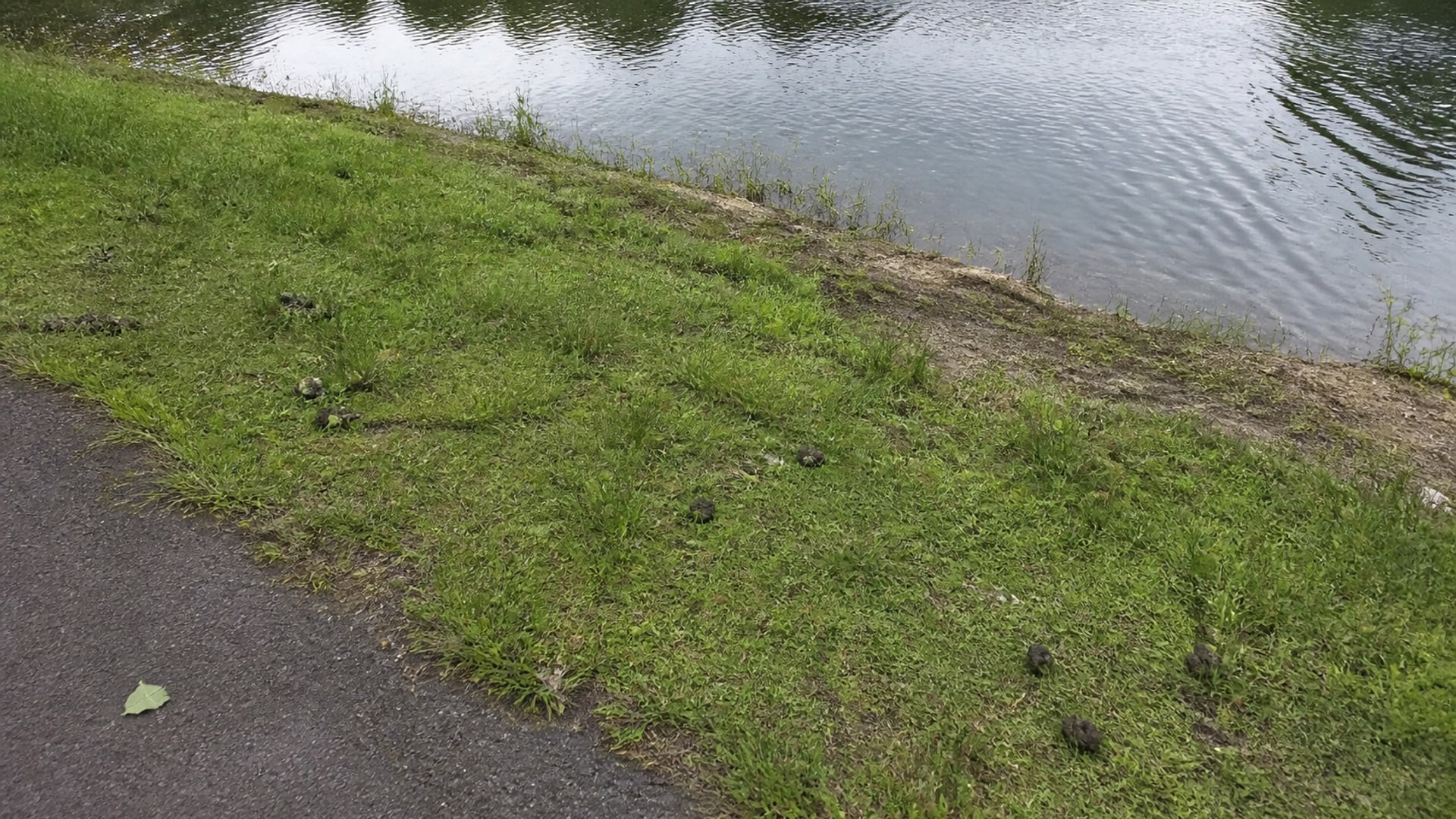
Fouled ground

USDA APHIS reports that a single Canada goose can defecate every 20 minutes and produce up to 1.5 pounds of feces per day. Connecticut DEEP identifies fecal waste on lawns, fairways, greens and parks as the most common and persistent municipal concern, and says large quantities can leave outdoor spaces unusable. More on droppings and turf damage.

Grazed and thinned turf

Geese graze the same ground repeatedly, and short fertilized grass is what they are there for. A USDA technical series notes that damage to putting greens can cost thousands of dollars to repair or replace.

Confrontations in spring

New York's Atlantic Flyway plan associates nesting-season aggression with injuries, usually resulting from falls, along with lawsuits and areas becoming inaccessible. That is a public-safety problem rather than an appearance problem.

Water quality

Connecticut's lake guidance identifies goose excrement as a source of phosphorus, nitrogen and decomposable organic matter. See water quality in ponds for what that does to a pond over a season.

Aviation risk

The Atlantic Flyway plan identifies geese near airports as a major safety issue because of their size and flocking behavior. FAA documents that wildlife strikes have caused hundreds of deaths worldwide and billions of dollars in aircraft damage. See bird-strike risk.

The measures that stopped working

Cornell's urban-goose guidance says quick fixes seldom reduce conflicts, and that scare techniques or barriers can give short-term relief at one property while moving the flock to another site. Connecticut DEEP says there is no single silver bullet and that lasting abatement takes several strategies together.

Why the bird is so hard to move, and what does work

Because a goose is doing arithmetic about safety, and most deterrents fail that arithmetic within a fortnight.

MassWildlife notes that geese adapt to loud noises. Penn State Extension says they acclimate quickly to visual deterrents. Connecticut DEEP makes the same point about devices that carry no consequence. A cannon that never hurts anything, a decoy that never moves and a flag that never changes are all, after a few days, part of the scenery. Worse than neutral, in fact, because the flock has now confirmed the ground is safe.

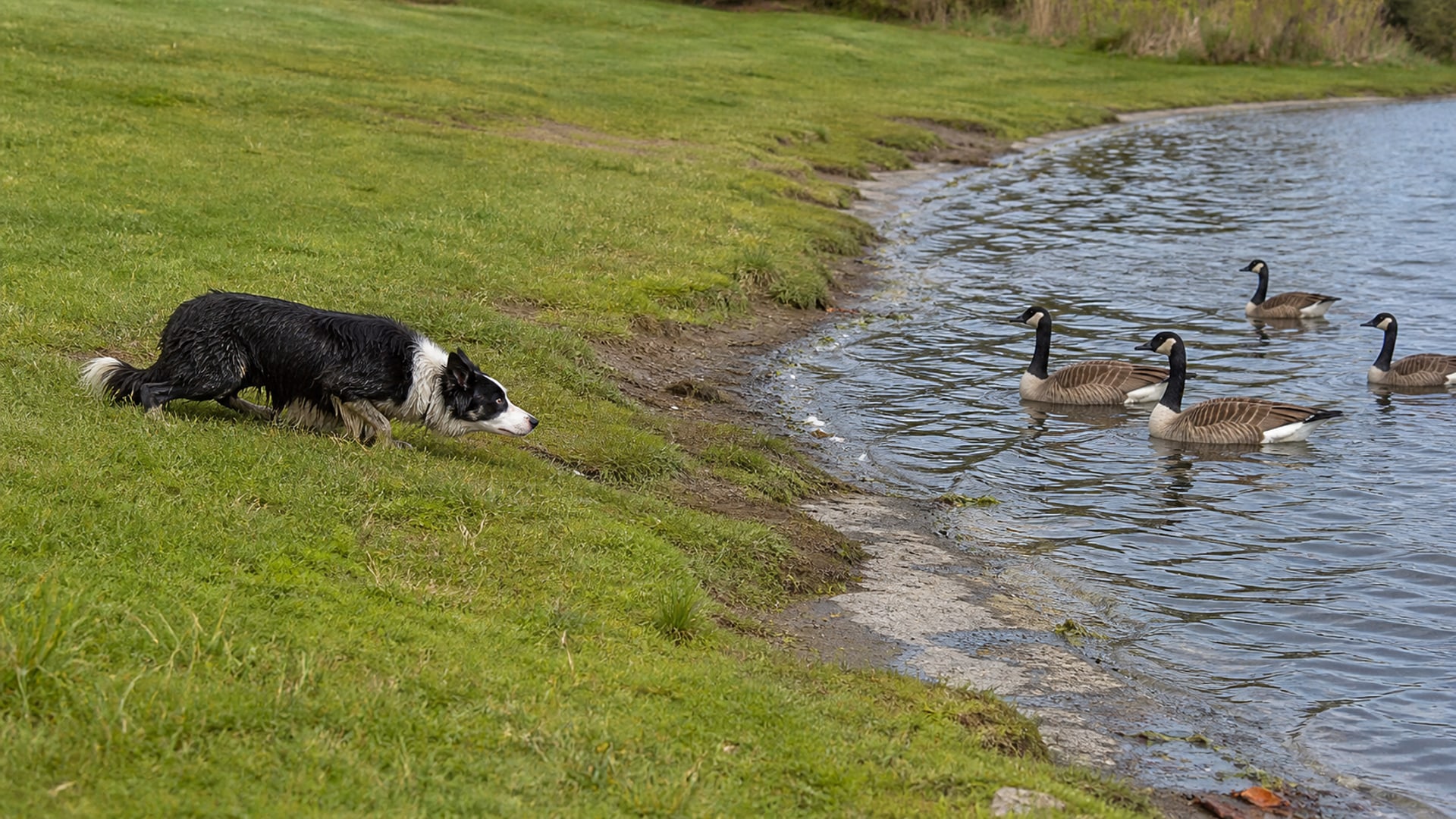
What does register is a predator. A Border Collie works a low stalking posture, and the response it triggers in a goose is instinctive rather than learned. But even that is bounded. USDA research on hazing found that geese left sites more often when hazed, returned more quickly than on days without it, and did not avoid a site for longer than 48 hours after a single event. Extension guidance says the same thing in plainer words: geese monitor preferred sites and can return once the dogs leave.

So the mechanism is not the dog. It is repetition at a cadence the flock cannot predict, sustained long enough to change where the birds think it is safe to stand. That is why Border Collie goose abatement is a program rather than a visit.

The other half is the ground itself. Connecticut DEEP calls habitat change the most effective non-lethal way to reduce conflicts, while being clear that many of the useful changes are not feasible on a working public site. New York DEC states that no single method is universally effective and that persistent use of a combination is usually necessary. Both agencies land in the same place: several things, applied at the right time of year, beat any one thing applied hard.

It is also why the honest measures of progress are behavioral rather than a headcount. Where the birds sit on the property compared with the baseline, how long the gap between visits stretches, and how quickly they lift when a dog appears all move before the raw number does. A flock that has shifted from the fairway to the far bank has already given a golf course back the ground it was paying for.

Maintained ground of the kind this page describes, on a the canada goose property

Common questions

Our pond freezes over. Why are the geese still here?

Because something else on or near the site is still supplying what they need. Connecticut DEEP notes that geese concentrate in Long Island Sound bays and inlets when inland fresh water freezes, so a hard freeze usually moves them. New York's Atlantic Flyway plan explains the other case: urban areas can hold winter birds because of ice-free water, available food and little hunting pressure. A pond kept open by an aerator or an outfall, plus mown grass and somebody feeding them, is a winter refuge.

Why do the same geese come back every year?

Resident birds return to ground they know, and they return to the same nesting spots. That site attachment is precisely why a one-time clearance does not hold and why the useful measure is how long they stay away between visits rather than whether they are present today.

How many geese is a normal number for a pond?

There is no published number that fits every property, because the number depends on ground somebody has to walk. What matters more than the count is where the birds are on the ground, how long they stay away after a disturbance, and whether that gap is lengthening.

Are geese dangerous?

Not usually, and mostly in one specific window. The Atlantic Flyway plan links nesting-season aggression to injuries that generally result from people falling while backing away, rather than from the bird itself. Outside the nesting window the practical hazard is footing on fouled surfaces.

Does feeding them make it worse?

Yes, materially. USDA APHIS says feeding encourages wildlife to congregate, reduces their fear of people and can increase aggression and disease spread. On public ground it is often the single strongest attractant, and a program that ignores it is working against itself.

Can we stop them nesting on our property?

You can make the ground less attractive before they commit, which is why a March assessment is worth more than a May one. Once a nest is active it is federally protected, and acting on it requires the registered authorization described above, which belongs to the landowner rather than to us.

Will they leave on their own eventually?

Resident birds will not, because they live there. The flock composition shifts with the seasons, but the ground stays attractive unless something about it changes.

Tell us what your property is seeing

If you recognize your site in this, the useful next step is somebody looking at the ground rather than more reading. Tell us where the birds are, what the property is used for, how close the water is and what has already been tried.

Call Tri-State Geese Patrol on (203) 856-4889, or send us a message and it goes straight to Bill.

Tell us what your property is dealing with.

Call Tri-State Geese Patrol on (203) 856-4889 and we will talk through the site, the flock and what a program would look like.