

Algae that arrives earlier each year
The timing shifting forward across seasons is often the first real signal, more telling than the amount in any single summer.
A resident flock does not only foul the grass around a pond. Connecticut's lake guidance identifies goose excrement as a source of phosphorus, nitrogen and decomposable organic matter, and the state reports that at two Connecticut lakes with large winter flocks, phosphorus from bird droppings was estimated at 50 to 70 percent of the annual watershed phosphorus input, followed by early and intense oxygen depletion in summer. That is how a goose problem turns into an algae problem, and why it often reaches two departments at once. Call Tri-State Geese Patrol on (203) 856-4889.
What goes in
Phosphorus, nitrogen, organic matter
At two CT lakes
50 to 70 percent of annual phosphorus
Shows up as
Algae, then oxygen depletion
The lever
Fewer bird-hours at the water, meaning fewer birds for fewer hours
The chain is short and it is not controversial. Nutrients go into the water, algae use them, and everything downstream of that follows.
Connecticut's guidance on caring for lakes identifies goose excrement as a source of phosphorus, nitrogen and decomposable organic matter, and notes that large flocks have caused concern at Connecticut lakes. Connecticut's stormwater manual makes the same point from the drainage side, identifying waterfowl as a significant source of nutrient and pathogen loading to surface waters.
Phosphorus is usually the one that matters in a freshwater pond, because it is the nutrient in shortest supply and therefore the one that limits how much algae can grow. Add phosphorus and you raise that ceiling.
The state's own numbers show how far that can go. Connecticut DEEP reports that at two Connecticut lakes carrying large winter flocks, phosphorus from bird droppings was estimated at 50 to 70 percent of the annual watershed phosphorus input, and that this was followed by early and intense oxygen depletion in summer. That is a location-specific finding rather than a universal rule, and it should not be read as a prediction for your pond. It does establish that on the right waterbody, birds can be the dominant nutrient source rather than a contributing one.
The delivery route matters too. Droppings on the lawn beside the water do not stay on the lawn. They wash in, which is why the fouled turf problem and the pond problem are frequently the same problem viewed from two different desks.
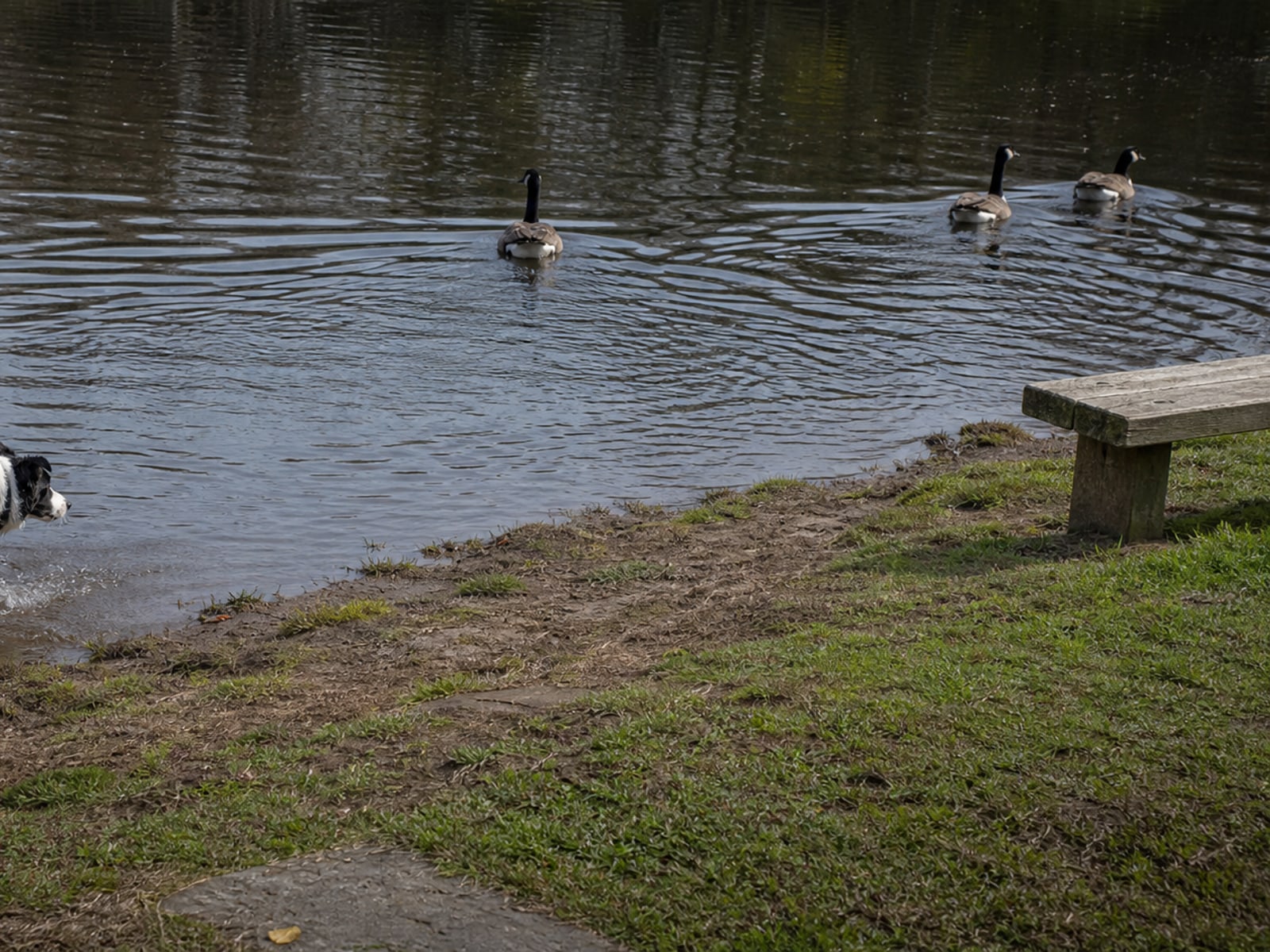
The nutrient loading is invisible. These are the symptoms that make somebody pick up the phone.
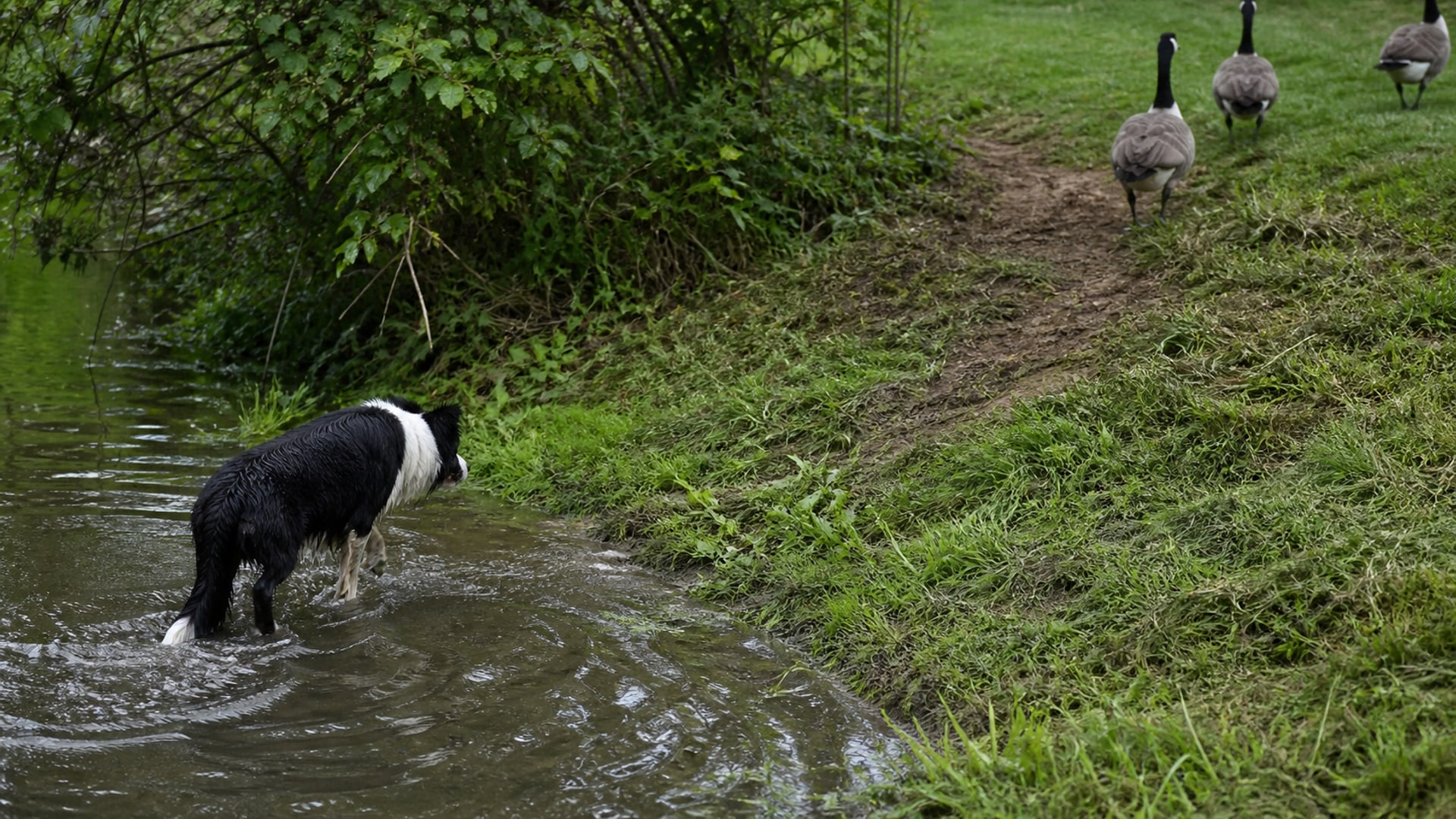
The timing shifting forward across seasons is often the first real signal, more telling than the amount in any single summer.
Concentrated droppings where the birds come out of the water and rest, which is also the ground that drains straight back in.
On a corporate campus, an HOA or a park, the pond is usually an amenity that was paid for. Residents, tenants and members notice when it stops looking like one.
The visible end of decomposable organic matter accumulating, and the version of the problem that reaches a board fastest.
Where people swim or paddle, nutrient and microbial loading becomes a use question rather than an appearance one, and that is a conversation for your local health authority rather than a contractor.
Connecticut's finding at those two lakes ran from droppings to early and intense oxygen depletion. On a managed pond that is the point where fish and aeration enter the discussion.
Because a treatment addresses what is already in the pond, and the flock is a supply line that refills it.
Most properties in this position have already spent money on the water itself: algaecide, aeration, dye, sometimes dredging. None of that is wrong and some of it is necessary. But if birds are contributing a substantial share of the annual nutrient load, then treating the symptom every summer is a subscription rather than a fix, and the cost recurs on a schedule set by somebody else.
The arithmetic on the input side is the same one as on the turf. USDA APHIS reports that a single Canada goose can defecate every 20 minutes and produce up to 1.5 pounds of feces per day, and MassWildlife's estimate runs from half a pound to a pound and a half. A resident flock spending its days on the shoreline of a small pond is a continuous, concentrated deposit into and beside the water.
So the useful question is not which treatment to buy next. It is what share of the load is coming from birds, and whether that share can be reduced. On a pond ringed by mown grass and holding a resident flock, it very often can.
It is also worth separating the two budgets this problem tends to sit in. Pond treatment usually comes out of grounds or facilities; the goose complaint often arrives through residents, members or tenants. Because they are handled by different people, the connection between them can go unexamined for years, and each side treats its own symptom. The first useful step is frequently just getting both conversations into the same room with the same bird-use record on the table.
Two of these reduce input at the source. The third catches what is already moving. Most ponds need more than one.
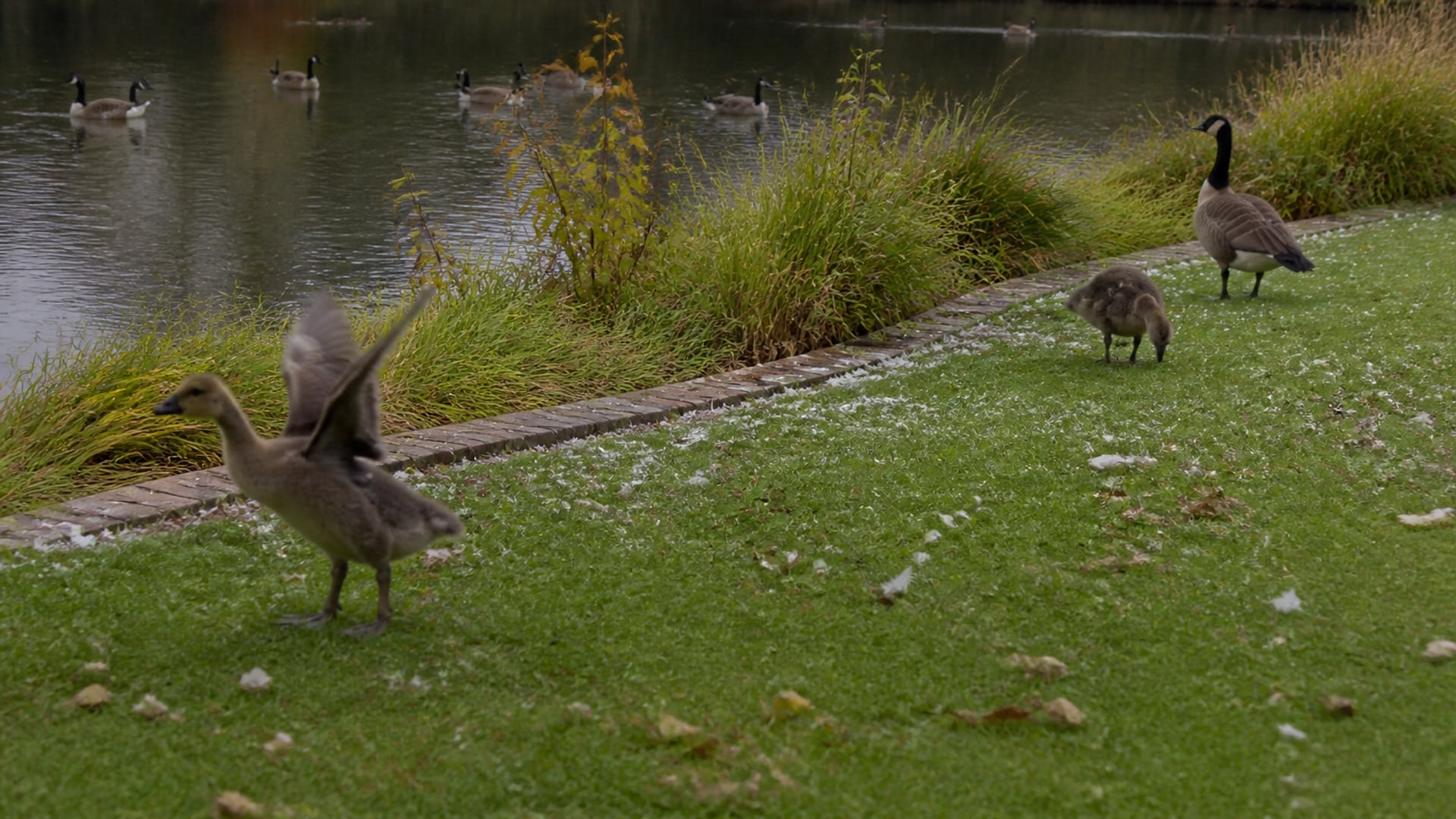
This is the direct lever on input. Trained Border Collies and handlers working the site on an unpredictable schedule cut the time the flock spends on the shoreline and the turf that drains into it. USDA research found geese returned within 48 hours of a single hazing event, which is why Border Collie goose abatement is a maintained cadence rather than a visit.
This one does two jobs at once, which is why it is the most cost-effective change available on most ponds. Massachusetts DCR treats a vegetated buffer as both a small waterfowl barrier and a strip that absorbs nutrients before they reach the water, and tells its own site managers not to mow to the water edge. MassWildlife recommends a hedge or a wide swath of uncut growth between water and mowed grass. See habitat modification.
USDA APHIS says feeding encourages wildlife to congregate, reduces their fear of people and can increase aggression and disease spread. Where the public feeds birds at a pond, it is frequently both the largest attractant and the least expensive one to remove.
Connecticut DEEP lists reduced fertilizer and watering among habitat measures for geese, and the same reduction lowers what runs off into the pond directly. Two problems, one change, which is usually an easy case to make internally.
Counts, times of use and where the flock sits, recorded on a consistent basis alongside whatever water testing already happens. Without the bird-side record, next year's algae bloom cannot be attributed to anything and the decision gets made on impressions.
A strip left to grow is a change to somebody's route, equipment and schedule, and a buffer that the grounds crew was not consulted about tends to get mown by accident in its first season. Agree where the mower stops, mark it if necessary, and write the maintenance change into the plan rather than assuming it. Connecticut DEEP notes that visual deterrents need regular maintenance and can be vandalized, and a planted or unmown strip has the same requirement in a quieter form.
Nutrient input is not spread evenly across the year, and neither is your opportunity to reduce it. Three periods do most of the work.
Mid-June to late July is the concentration window. New York DEC identifies a four to five week flightless molt in that period with flight resuming by August, and Connecticut DEEP identifies June and July as the months the birds cannot fly. A flightless flock stays on the water and the shoreline it is already using, in numbers swollen by that spring's goslings, for weeks. Everything it produces lands in one place, and that place is the pond edge.
Autumn and early winter bring the migrants on top of the residents. In Connecticut, migrants arrive in early October, movement continues through November, another peak lands in mid-December, and most have gone by mid-January. Connecticut's own finding about phosphorus dominance came from lakes carrying large winter flocks, which is a reminder that the season people pay least attention to a pond can be the season it takes the biggest load.
Then the effect surfaces the following summer, months after the input, which is the part that makes this problem so easy to misattribute. Connecticut's sequence at those two lakes ran from droppings to early and intense oxygen depletion in summer. The bloom that annoys everyone in July is drawing on nutrients that arrived while nobody was looking at the water.
Practically, that argues for two things. Keep the bird record running through the months nobody is using the pond, and judge any change over a full year rather than over a summer.
The moment a plan involves changing the shoreline rather than the birds, a different set of rules applies, and finding that out after the planting is the expensive order to do it in.
In Connecticut, activities in or affecting inland wetlands and watercourses are regulated under Connecticut General Statutes sections 22a-36 through 22a-45a, with local inland-wetlands agencies administering permits under those statutes. A project gets screened with the municipality before anything is graded, filled, obstructed or materially altered.
In Massachusetts, the Wetlands Protection Act, M.G.L. chapter 131 section 40, and 310 CMR 10.00 govern work affecting protected resource areas. Vegetation removal, regrading and construction can all be regulated, and the work area can reach into the 100-foot buffer zone where the activity may alter a protected area. The local conservation commission reviews it.
In New York, DEC administers freshwater wetlands and protection of waters permits, and whether either applies depends on the particular waterbody and the particular work.
None of this stops a project, and a modest change to a mowing pattern is a very different proposition from regrading a bank. It does mean the screen comes before the design. A provider who has never raised it is either doing very small work or is about to hand you a problem with your name on it.
There is an upside worth noticing. Where a property already carries a stormwater or pond-quality obligation, the same buffer planting can be justified against two budgets rather than one, because Massachusetts DCR explicitly treats it as serving both purposes.
This page cites state findings from specific waterbodies. None of them is a measurement of yours.
The 50 to 70 percent figure is Connecticut's finding at two particular lakes with large winter flocks, and the state's own framing is location-specific. Applying it to your pond would be inventing a number. What can be established is how much time birds spend there and where.
Nutrient and microbial loading is a risk rather than a proven health violation at any given site. If contact water, a beach or a drinking-water watershed is involved, that is a question for your local health authority or the state, not for us.
Weather, depth, flushing rate, watershed inputs and management history all drive that. Reducing the bird contribution changes one input, which is worth doing and is not a forecast.
We reduce what the flock puts in and, with habitat work, what washes in from the turf. Pond management itself, aeration, treatment, dredging and testing, is somebody else's trade and we will say so rather than take the work.
Fewer than most people expect on a small waterbody, because the input is per bird per day and it lands in a concentrated area. The state's finding at two Connecticut lakes involved large winter flocks, but a small pond has correspondingly less water to dilute anything.
Treatment and source reduction do different jobs. Treatment addresses what is in the pond now; reducing bird use lowers what arrives next season. If a treatment cycle has become annual and predictable, the input side is usually where the unexamined cost is sitting.
Both, and the grass matters more than people assume, because droppings on the turf around a pond wash in. That is exactly why a buffer strip at the water's edge earns its place: it interrupts the birds' walking route and intercepts runoff at the same time.
It helps at one time of year and not year round. Connecticut DEEP says fencing loses much of its effectiveness once the birds can fly, while MassWildlife calls a three-foot fence effective during the summer flightless molt. A barrier is a control on walking access, not a lid.
It changes who cares and which budget pays. Connecticut's stormwater manual identifies waterfowl as a significant source of nutrient and pathogen loading, so on a basin the case tends to be made on compliance and function rather than appearance.
Slower than on the turf, and that is the honest answer. Fouling on the grass responds to the first visits; a waterbody responds to a season of reduced input, filtered through weather and its own chemistry. We report on bird use because that is what we actually affect and what can be measured reliably.
That is the objection most boards raise and it is a fair one. A buffer can be a mown-edge planted band rather than an unkempt fringe, and the width and species are design decisions rather than fixed requirements. The version that gets approved and stays in place beats the version that is technically ideal and gets removed after one summer of complaints.
The useful details are how big the water is, how much mown grass runs to its edge, roughly how many birds use it and at what times of day, and whether anybody is feeding them. That is usually enough for a first conversation about whether reducing the bird contribution is worth doing on your site.
Call Tri-State Geese Patrol on (203) 856-4889, or send us a message and it goes straight to Bill.
Call Tri-State Geese Patrol on (203) 856-4889 and we will talk through the site, the flock and what a program would look like.