Tri-State Geese Patrol

About Tri-State Geese Patrol

Tri-State Geese Patrol moves Canada geese off client property without harming them, using trained Border Collies and their handlers on a recurring schedule. The company is owned by Bill Belward, works out of West Hartford, Connecticut, covers Connecticut, Massachusetts and New York, runs more than one crew, and is reachable 24 hours a day on (203) 856-4889.

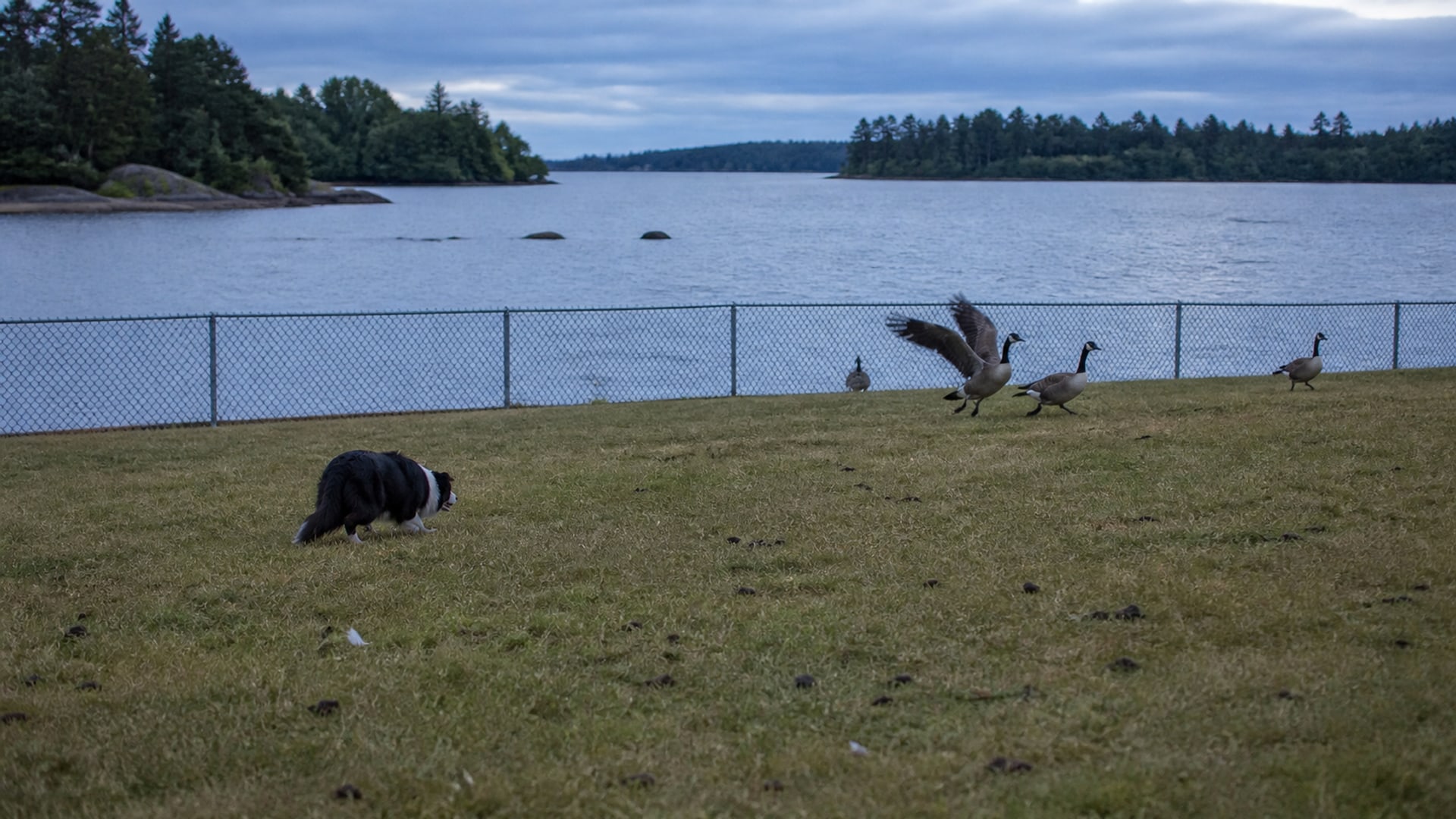
A Border Collie working a client property beside open water

At a glance

Owner

Bill Belward

Base

West Hartford, Connecticut

Working across

CT, MA and NY

Reachable

24 hours

What this company actually is

A small operation that does one thing, and does not pretend to do others. Dogs and handlers work your property on a schedule, and the geese decide the ground is not worth standing on. There is no second line of business here and no attempt to be a general wildlife contractor.

The customers are the people who own the problem rather than the people who notice it. Golf course superintendents, airport operations staff, municipal parks and public works, corporate campus facility managers, HOA and condominium boards, school and cemetery grounds staff, and homeowners with pond frontage. What they have in common is short mown grass beside open water, which is the exact combination a Canada goose is looking for.

The work is a program rather than a call-out. A single visit moves birds and changes nothing about how they read the site, which is why the visits repeat on a pattern the flock cannot predict. That is also why we would rather talk about a season than a job.

Everything else on this page follows from those two facts: it is one service done properly, and it is ongoing.

Why the method is non-lethal, and why that is not a slogan

Canada geese are protected under the Migratory Bird Treaty Act. That is the starting condition for anyone working with this species, and it rules out most of what a frustrated property owner is tempted to try first.

New York DEC states that no federal or state permit is needed to scare, herd or chase geese with dogs or noisemakers, provided the birds are not physically harmed. Read that sentence carefully, because the whole method sits inside it. The legality of what we do depends on the birds being unharmed. It is not a value we bolted on afterwards, it is the condition that makes the work lawful at all, and the moment a program crossed that line it would become a legally different activity.

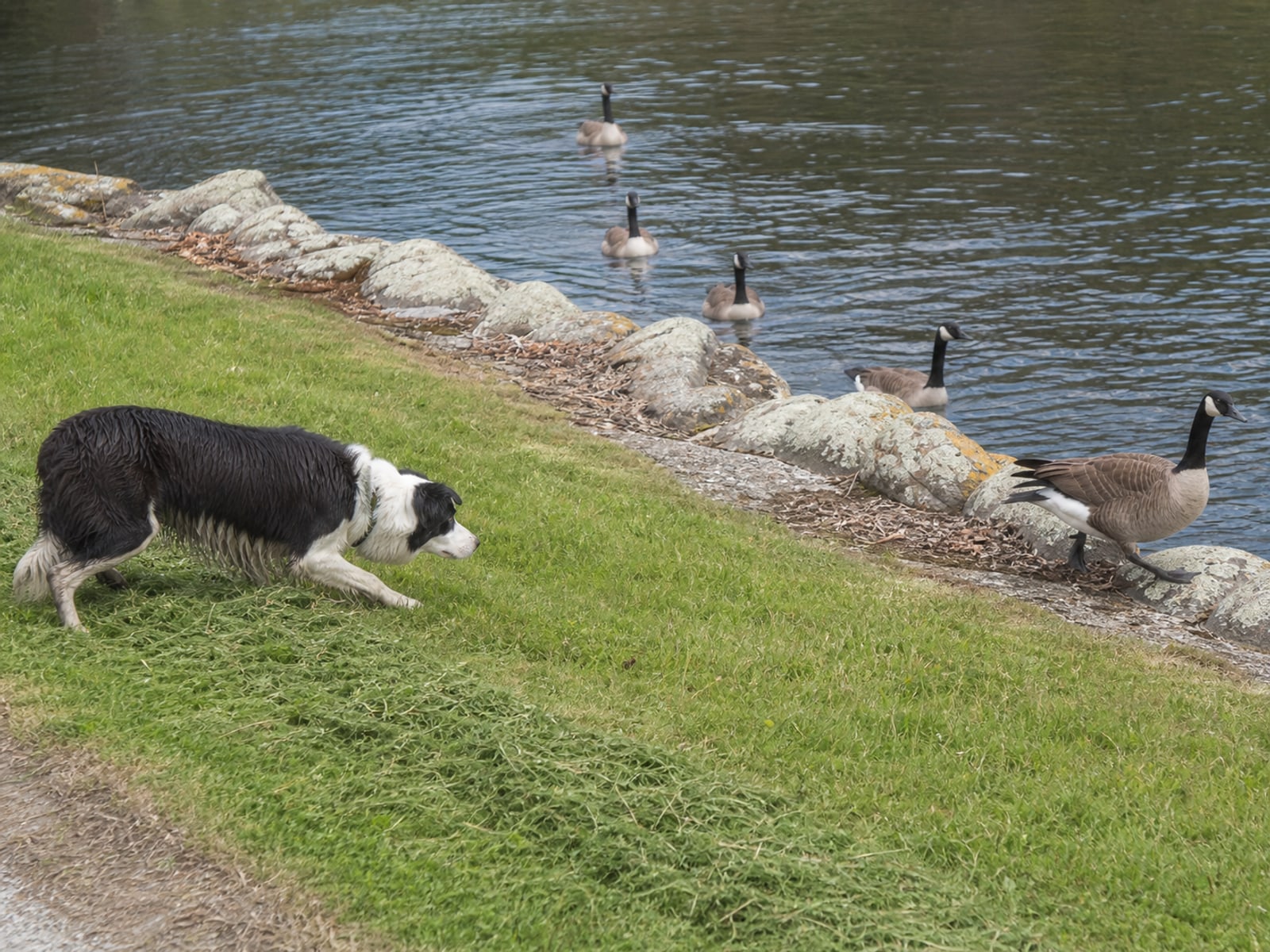
The method itself is older than the company. A Border Collie works a stalking posture, head low and shoulders down, moving in a controlled arc. To a goose that reads as a predator, and the response is instinctive rather than trained out of the bird. MassWildlife's own guidance names trained dogs as especially effective among the non-lethal options available, which is a state wildlife agency describing this as an established management category rather than a novelty.

The handler matters as much as the dog. The dog stays under control, makes no contact, and is called off before pressure turns into pursuit. On water, the dogs will go in and work birds off the surface. Nothing in that sequence requires harming a goose and nothing about it is improvised on the day.


A Border Collie in the low stalking stance that a Canada goose reads as a predator

How the work is set up

These are the operational facts about the company, and they are the ones worth knowing before you sign anything.

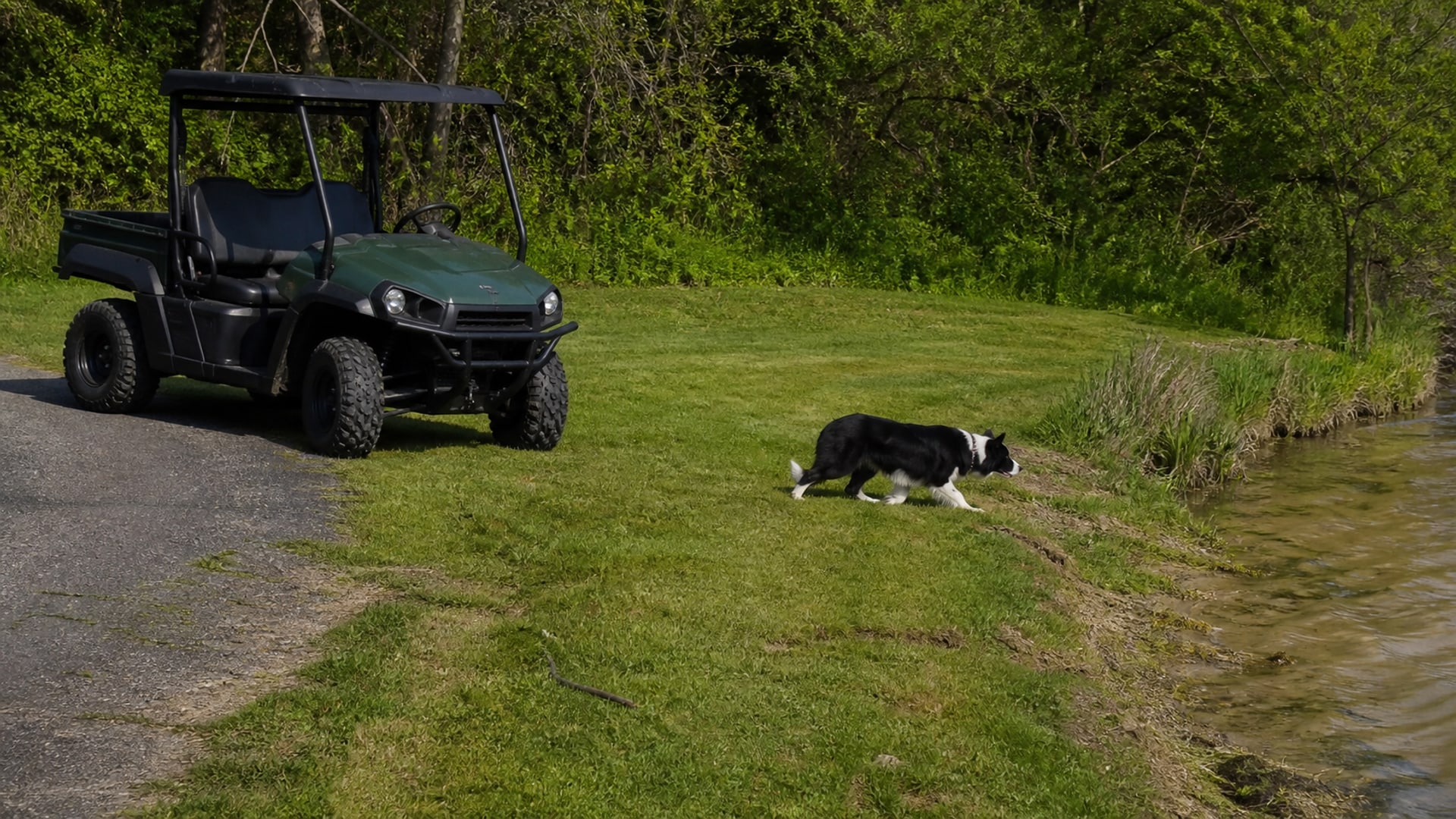
A plain utility vehicle parked at the edge of mown turf on a client property

More than one crew

The company runs more than one crew, which changes what can be promised. If a job is far, that crew takes no second job that day, or a different crew covers the other location. For a buyer running several sites, or for a municipality that cannot have a program stop because one person is unavailable, that is the difference between a service and a dependency on an individual.

Distance is scheduling, not a limit

A property ninety minutes out gets the same recurring program as one fifteen minutes away, not a reduced version of it. Where a site sits in the footprint affects how the day is planned. It does not affect what is offered.

A base in West Hartford, and three states

Crews work outward from West Hartford, Connecticut across Connecticut, Massachusetts and New York. The service areas page lists the towns covered. If a property is not on it, the answer is a phone call rather than an assumption in either direction.

Open 24 hours

The business is reachable around the clock. That matters least to a homeowner and most to airfield and municipal staff, whose own problems do not observe office hours and who need to reach somebody when a flock has arrived at the wrong moment.

A written scope, then a record

You get a scope before the work: which areas are covered, roughly how often, how visits fall through the season, and what we will and will not do. Then you get a record of what actually happened. Both exist so the program can be judged rather than believed.

The other three services exist because the dogs are not enough on their own

New York DEC's position is that no single method is universally effective and that persistent use of a combination is usually necessary. Connecticut DEEP lands in the same place from a different direction: long-term solutions are complex, there is no panacea, and several non-lethal techniques used together at the right time do better than any one of them alone.

So Border Collie goose abatement is the core, and it does one specific thing: it changes what the flock does now. Habitat modification works on the ground itself, changing the access and the sightlines the birds depend on, which is the slower and more durable half of the job. Consultation and program design is the step that decides which of those a property actually needs, which on a complicated site is the least expensive thing you can buy first.

A company that sold only the dogs would be easier to explain and would leave clients worse off.

What we put in writing

Being specific about limits is not modesty. It is the part that lets a client hold a provider to a scope a year later, and it is the fastest way to tell a serious bid from an optimistic one.

Nest and egg work belongs to the landowner

Nest and egg work on resident Canada geese is separately regulated federal activity requiring registration with the US Fish and Wildlife Service, and Massachusetts adds its own penalty for interfering with the eggs of a protected bird. That route belongs to the landowner or a public body, not to a contractor. We will tell you it exists and who administers it. We do not perform it.

Relocation is not something the agencies allow

New York DEC generally does not permit relocation of Canada geese at all, with or without a permit. Anyone offering to take your birds somewhere else is describing something other than what the agencies allow.

A maintained program rather than a one-time fix

Resident birds return to ground they know and migrating flocks arrive with no knowledge of your program. USDA research on hazing recorded geese returning within 48 hours, which is exactly why abatement is a maintenance program rather than a one-time fix. A guarantee here would be a sales tactic, not a finding.

The price comes after the site walk

Pricing is per site because the things that drive it are per site: acreage worked, how many birds, how much water, how often we visit and what the ground is used for. A number produced over the phone before an assessment is a guess that one of us pays for later.

Every number here is sourced

No fabricated visit statistics, no invented timelines, no review scores, no case studies without the client's permission. What goes on this site is either verifiable or sourced to the agency that published it.

Where our numbers come from

Everything on this page is either checkable or sourced to the agency that published it. The method and its legal basis trace to published state guidance, and the operating setup is what we actually run.

Those figures either have not been confirmed or do not exist in a form worth printing, and a number on an About page that nobody can check is worth less than no number at all. When there is a verified one to give, it will appear here with its source.

In the meantime the things that can be checked are the ones on this page: the method and its legal basis, both of which trace to published state guidance, the operating setup, and the limits above. Ask us the rest on the phone and you will get a straight answer or an honest do not know.

Who is accountable

Bill Belward owns Tri-State Geese Patrol. He is also the byline on the company's writing, which means the explanations on this site are not anonymous marketing copy produced at a distance from the work.

Practically, it means there is a person at the end of the phone who is responsible for what a crew does on your property, rather than an account manager relaying it. Messages sent through the contact page go to Bill.

It also means a complaint has somewhere to land. On a recurring program running across a season, that matters more than it sounds like it should.

How to tell whether the program is working

Are the geese gone is the wrong question, and any provider who accepts it is setting a client up to be disappointed the first week a migrating flock drops in. These are the measures we report on instead.

Where the birds are, not only whether they are there. A flock that has moved from the fairway to the far bank has already given you back the ground you were paying for, even though the count has not changed.

How long they stay away between visits. This is the number that matters most. Early in a program the return interval is short. As the site stops reading as safe, that interval stretches, and a gap that stops lengthening tells us the cadence needs to change.

How the birds respond when a dog arrives. Birds that lift immediately are behaving differently from birds that shuffle a few yards and settle. The response is itself data.

What your grounds staff say. They notice the change in cleanup before anyone in an office does, and on public ground the count of people still reporting a problem is a real measure even though it is not a biological one.

Talk to us about your property

Tell us what you are seeing, what the ground is used for, and what has already been tried. If a program makes sense for your site we will say what it would look like, and if it does not we will say that too.

Call Tri-State Geese Patrol on (203) 856-4889, or send a message and it goes straight to Bill.

Tell us what your property is dealing with.

Call Tri-State Geese Patrol on (203) 856-4889 and we will talk through the site, the flock and what a program would look like.