

Key Takeaways
01
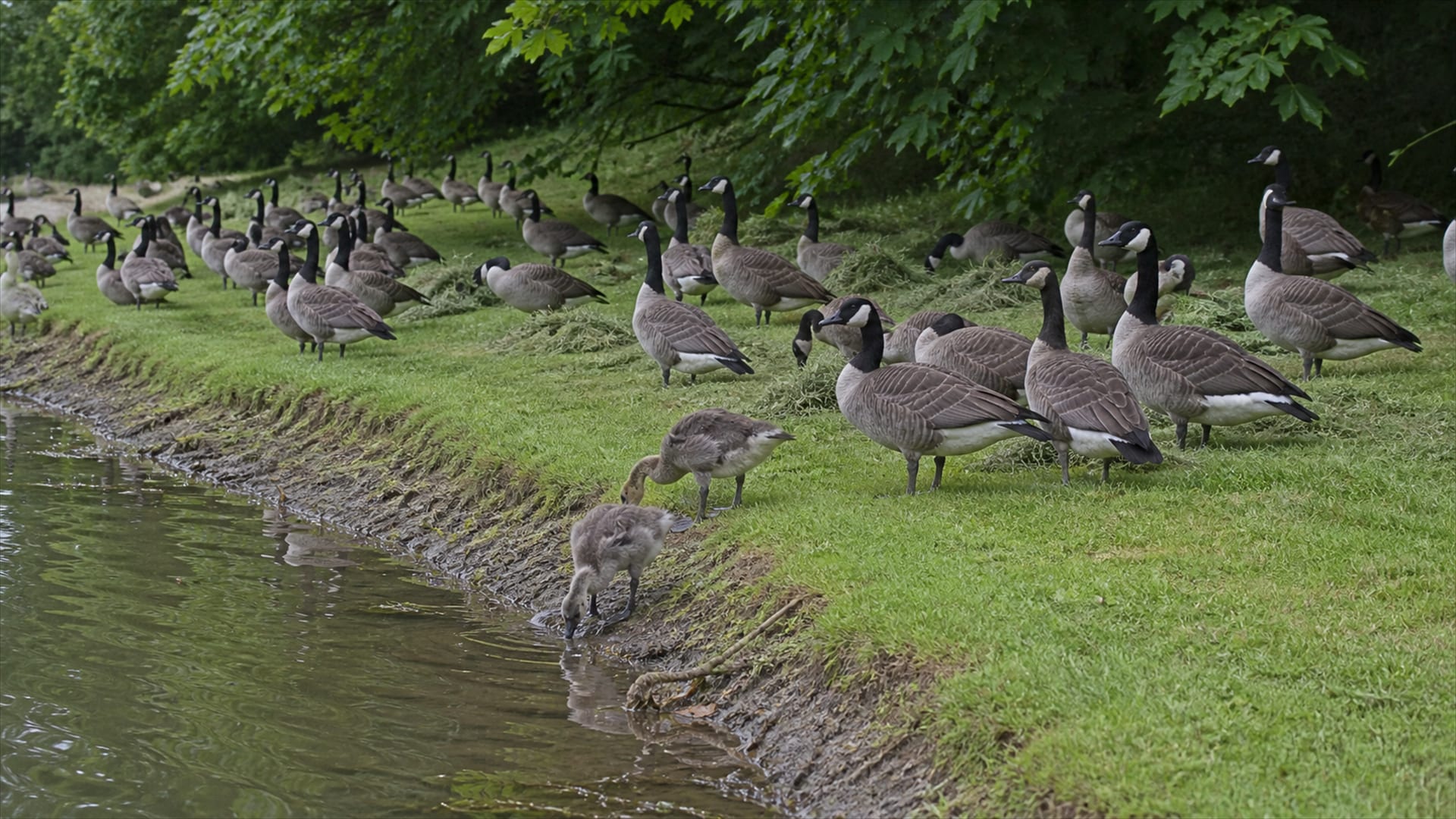
Adult Canada geese drop their flight feathers all at once and are flightless for about four to five weeks, with [New York DEC](https://dec.ny.gov/nature/animals-fish-plants/nuisance-wildlife-species/canada-geese) placing the window from mid June to late July and flight returning by August.
02
A flightless flock cannot be moved by putting it into the air, so the birds leave on foot or by water and often relocate to another part of the same property or to unmanaged ground nearby.
03
Waiting out the molt is a real option, but it is a decision with a cost: [MassWildlife](https://www.mass.gov/info-details/learn-about-canada-geese) puts one goose at roughly one half to one and a half pounds of droppings per day, and those weeks are when the flock is at its most concentrated.
Why will the geese not fly away this month?
Because they cannot. Canada geese go through a complete molt of their flight feathers once a year, and unlike many birds they lose them all at once rather than a few at a time. USDA APHIS describes molting resident birds as needing food, grass or crops, and water, and reports that both adults and goslings are flightless through the mid June to early July period.
Two groups are grounded at the same time, for different reasons. The adults have dropped their primaries. The goslings hatched earlier in the spring and have not yet grown the adult flight feathers they need to get airborne. Connecticut DEEP reports hatching from April through June with a peak in the first week of May, which is why a June flock so often contains large, almost adult-sized young birds that still cannot leave the ground.
There is a sequencing detail worth knowing if the timing on your site seems off. Indiana DNR notes that nonbreeding birds tend to molt first, in mid June, while parents molt after their goslings hatch. Individual birds do not molt in exact synchrony either, so a single flock can hold birds at slightly different stages. The practical effect is that the flightless period on a given property can look ragged at both ends rather than starting and stopping cleanly.
The molt, week by week, at this latitude
Mid June
Nonbreeding adults begin dropping flight feathers first. The flock on your water starts to look larger as birds that were ranging more widely settle onto reliable grass and water.
Late June into early July
APHIS places resident adults and goslings both flightless in this window. This is the deepest part of it, and the point at which droppings, grazing and conflict around people are most visible.
Through July
New York DEC gives the wider window as mid June through late July. Birds are still grounded but the earliest molters are beginning to regrow feathers.
August
Flight returns. New York DEC says the birds are flying again by this point, and any barrier or ground-based measure that was carrying the site suddenly stops being sufficient on its own.
How long does the flightless period actually last?
Between four and five weeks for an individual bird, and a little longer than that for the flock as a whole because the birds are not synchronized.
New York DEC is the clearest regional source on the window: molt runs from mid June to late July, birds resume flight by August, and during the flightless weeks they congregate at ponds or lakes that offer safety, food and a place to rest. A federal environmental impact statement on resident Canada geese adds the detail that adults which produced young lose their flight feathers two to three weeks after the goslings hatch, which is what ties your site's molt timing back to its nesting timing.
So if you want to predict the flightless weeks on your own ground next year, the useful thing to record this year is not the molt itself. It is when you first saw goslings.
Why does the flock look bigger than it did in May?
Partly because it is, and partly because it has stopped spreading out.
During the flightless weeks the birds are limited to what they can reach on foot or by swimming. A property with open water and mown grass next to it becomes one of a small number of viable places within walking distance, so birds concentrate there rather than distributing across the wider landscape the way they do when they can fly. New York DEC describes exactly this, with molting birds gathering at ponds and lakes that supply safety, food and rest together.
The other half of the answer is that the goslings from this spring are now nearly full sized and are on the ground with the adults. A pair that nested on your pond in April can be a family group of six or seven large birds in July, all of them grounded, all of them feeding on the same lawn.
What does a flightless flock do to a property?
The same things a flying flock does, concentrated into a shorter period and a smaller area.
The volume is the part most people underestimate. MassWildlife puts a single Canada goose at roughly one half to one and a half pounds of droppings per day. Multiply that by a family group that cannot leave, standing on the same stretch of lawn for a month, and the arithmetic explains why crews who kept up with the mess in May stop keeping up with it in July.
New York DEC lists the broader impacts that follow: overgrazed lawns, nutrient loading into ponds, public health concerns at beaches, dining areas, gathering places, health care facilities and drinking water supplies, aggressive nesting behavior, and safety hazards near roads and airports. Not all of those apply to every site, and it is worth being precise about which ones apply to yours rather than treating the list as a single problem.
On the water quality side, there is a useful worked example rather than a rule of thumb. A USGS study calculated the annual load added to one lake by 6,500 Canada geese and 4,200 mostly mallard ducks at 4,462 kilograms of carbon, 280 kilograms of nitrogen and 88 kilograms of phosphorus, mostly during migration. That is one specific site with a very large bird population, not a per goose figure you can scale to a campus pond, and it should be read as evidence that the pathway is real rather than as a number that describes your water.
What changes during the flightless weeks, and what does not
Can anything legally be done while the birds cannot fly?
Yes, and the boundary is the same one that applies for the rest of the year.
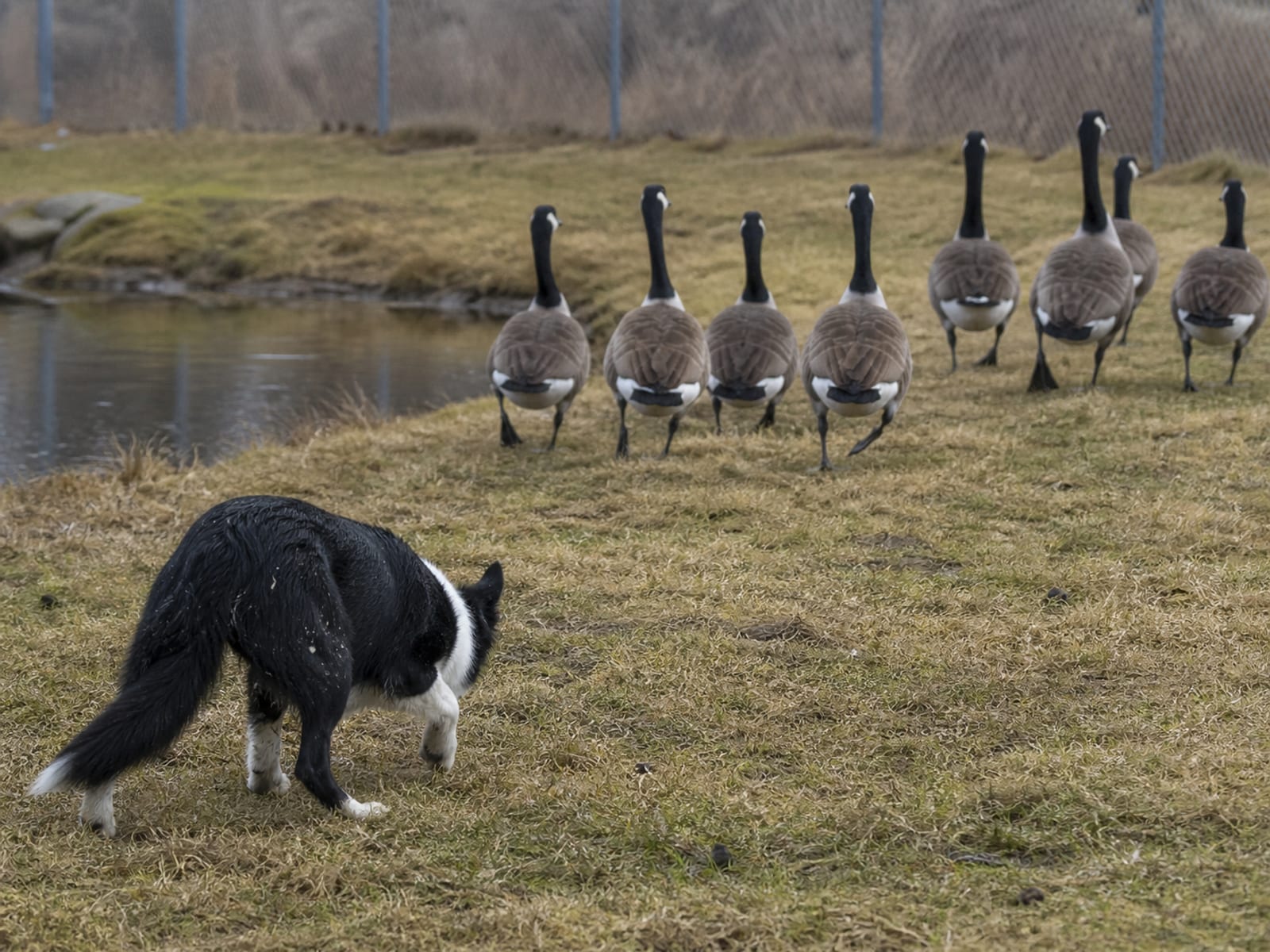
New York DEC states that no federal or state permit is needed to scare, herd or chase geese, including with dogs, as long as no bird is physically harmed. Rutgers says the same thing and adds the part that matters operationally: the handler remains liable if a dog harms a bird. That is a real constraint during the molt, because the birds cannot escape upward and a poorly controlled dog has a much greater chance of making contact than it would in May.
Anything beyond non-injurious dispersal is a different matter. Nest and egg work runs through an annual registration held by the landowner with the US Fish and Wildlife Service, with reporting obligations attached. It is regulated and permit gated, and it is not something we perform. Capture, relocation and take are separate again, and generally require authority that a property owner does not have by default.
The honest summary is that the molt does not open a legal window and it does not close one. It changes the physics of the situation, not the law.
What is allowed during the flightless weeks?
Pick an answer to see how you did
1. The flock on your pond cannot fly. Which of these needs no permit?
2. Why does handler control matter more during the molt than in May?
Nothing answered yet.
Is waiting it out a reasonable plan?
Sometimes, and it deserves a straight answer rather than a sales one.
If your site has a small family group, limited public traffic and no water quality or safety exposure, the birds will be flying again in August and the problem may genuinely subside on its own. Nobody needs to sell you a program for that.
The case against waiting is about what the flock learns. Geese have strong site fidelity, and a month of undisturbed use on your lawn during the most concentrated period of their year is a month of the property confirming itself as safe. Rutgers makes the timing point directly: active deterrents tend to work better than passive ones, and they work best when begun as geese arrive rather than after a flock is entrenched. A site that waits until August is starting from a worse position than a site that worked through July.
There is also a second, quieter cost. The weeks the birds cannot leave are the weeks the droppings accumulate fastest on the ground people actually use. Whether that matters depends entirely on whether your walkways, playing surfaces, swimming area or entry lawn are in the affected zone.
What does a program actually look like during the molt?
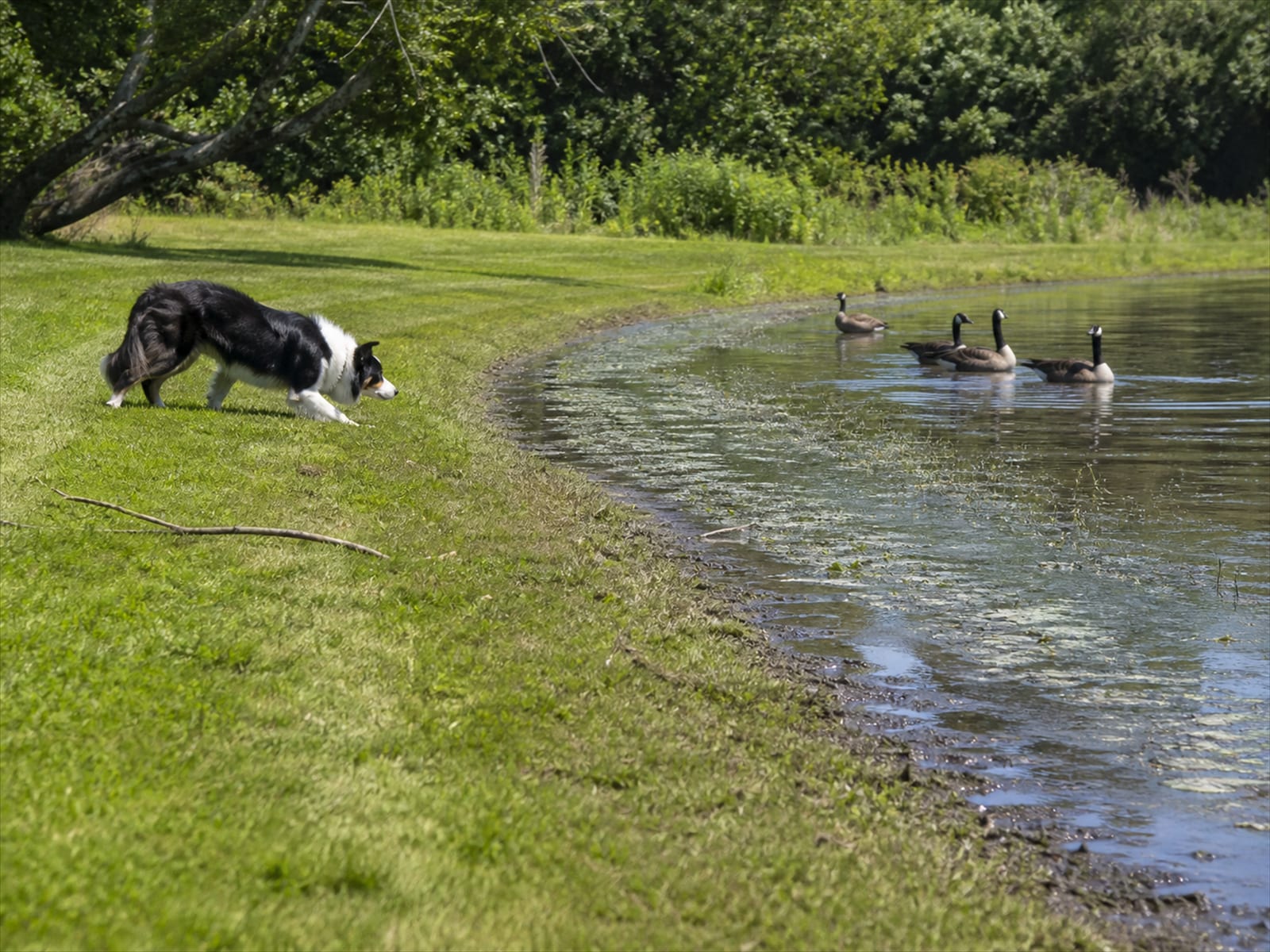
Different from the rest of the year, in one specific way: the birds cannot be put into the air, so they are moved on the ground and on the water, and they will often go somewhere else on the same property rather than off it.
That is not a failure of the method, it is the situation. A published New York study of integrated non-lethal management found that collared birds frequently used unmanaged locations around treatment sites, and that flocks were repeatedly worked after earlier dispersal. Rutgers puts it plainly as well: active dispersal is often temporary and geographically limited, and birds may return after the disturbance or move the issue elsewhere.
So the working shape during these weeks is repetition and observation rather than a single decisive clearance. New York DEC states that persistent combination methods are normally necessary and that no single technique is universally effective and socially acceptable. Where the property allows it, work on the water matters more during the molt than at any other point in the year, because the water is where a grounded flock retreats to.
Working a flightless flock, in order
01
Confirm the birds are actually in molt
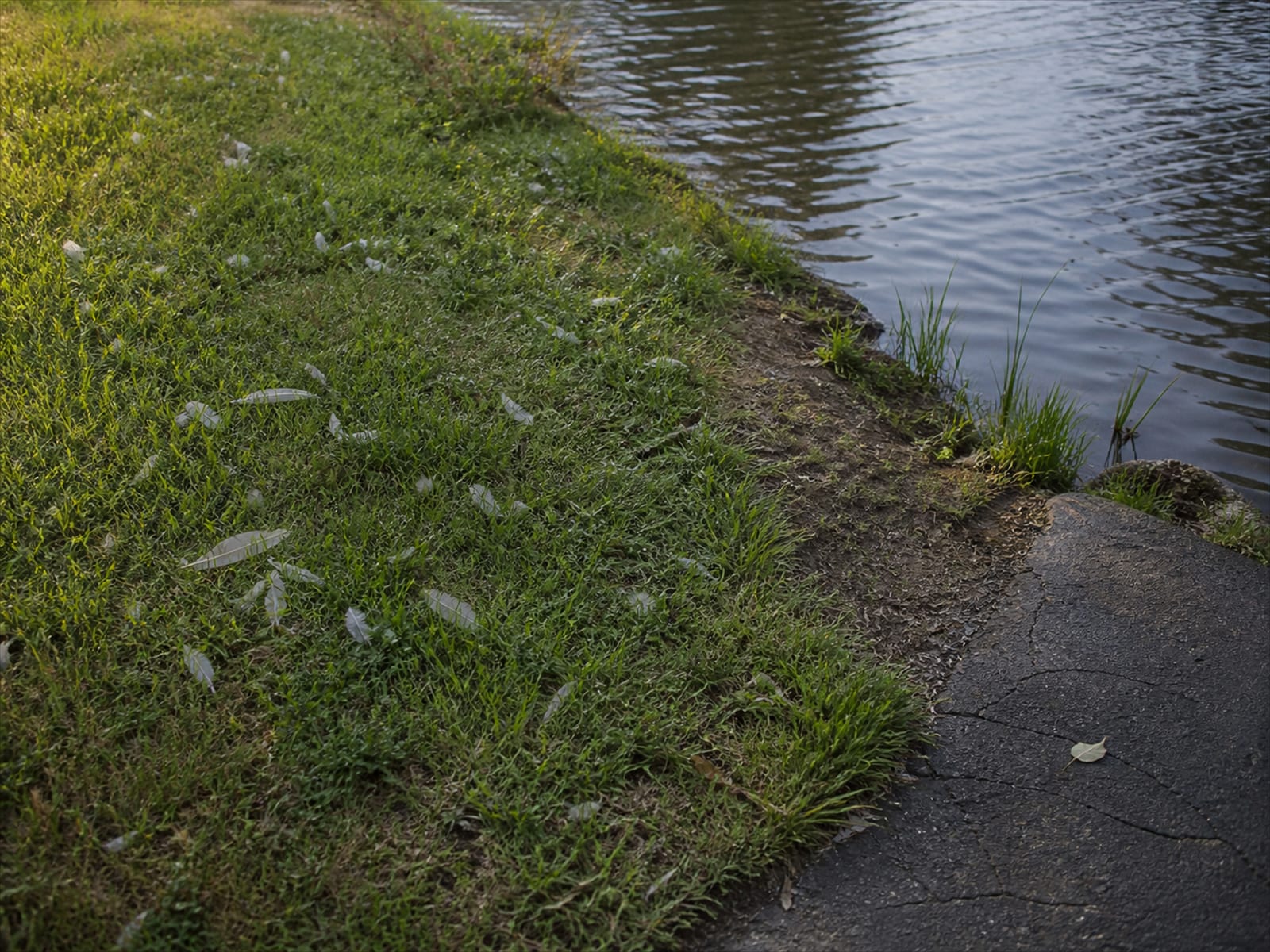
Dropped flight feathers around the water's edge, birds running or swimming rather than lifting, goslings the same size as adults and equally grounded.
02
Check for anything still active
Establish whether any nest remains in use anywhere on the property before working near shoreline cover, and do not disturb one.
03
Remove what is holding them
Intentional feeding is the single largest factor a property controls. APHIS is unambiguous that feeding wildlife concentrates animals and creates problems.
04
Work the water as well as the grass
A grounded flock pushed off the lawn goes to the pond. A program that cannot reach the water moves the birds thirty feet and no further.
05
Repeat, and record what changes
Return interval between visits is a better measure than a bird count on any single day.
06
Plan for August
The moment flight returns, ground-based measures stop being sufficient on their own and fly-in access becomes the question again.
What does this cost, and what drives the number?
We quote per site after seeing the ground, and there is a reason this page carries no price. No credible published rate exists for non-lethal Canada goose management during the molt in Connecticut, Massachusetts or the Hudson Valley and Capital District, and a figure invented to look competitive is a figure somebody pays for later.
What can be said honestly is what moves the number: the size and layout of the property, how many separate water and grass areas it holds, how often visits are needed and for how long, whether the water can be safely reached, whether work has to continue right through the flightless interval, and whether anything physical is being added at the water and grass edge.
For scale rather than for pricing, the New York research program mentioned above recorded its own study inputs across five sites in 2004 to 2006: $7,500 in materials including a trained Border Collie, two remote controlled boats, batteries, a charger, a kayak, life vests and miscellaneous items, plus $32,000 for one person's salary running visits three times a day, five days a week for eight months. Those are twenty year old research inputs at an intensity no ordinary property needs, published for a study rather than quoted to a customer. They are not a rate card and should not be read as one.
Terms you will hear this month
Tap a term to see what it means
Molt. The annual replacement of feathers. In Canada geese the flight feathers are lost all at once, which is why the birds are grounded rather than simply flying less.
What should you do this week?
Three things, none of which require hiring anybody.
Stop any feeding, including the well meant kind. APHIS is direct about feeding concentrating wildlife and creating exactly the conditions a property is then trying to undo, and during the flightless weeks a food source is the strongest possible reason for a flock that cannot leave to stay precisely where it is.
Write down what you are actually seeing: how many birds, where they feed, where they enter and leave the water, which surfaces are being fouled, and what time of day the concentration is worst. That record is worth more than a single headcount, and it is the input any honest assessment starts from.
Then decide what the affected ground has to keep doing for the rest of the summer. A back lawn nobody uses and a swimming area under weekly testing are the same biological problem and completely different operational ones.
What This Means for You
The behavior that prompted this search has an explanation and a date range. Your geese are not defying you and your earlier attempts did not fail because the property is hopeless; the birds are grounded, they will be grounded until roughly late July, and they will be flying again in August. That is worth knowing before you spend anything.
What you decide from there is a judgment about your own ground. Waiting is legitimate on a quiet site with no exposure. On a property where people walk, play, swim or work on the affected surfaces, the flightless weeks are the ones that do the most visible damage, and they are also the weeks when consistent, non-injurious work has the clearest effect on where the flock chooses to settle next.
If you want somebody to look at it, call Tri-State Geese Patrol on (203) 856-4889. We work out of West Hartford across Connecticut, Massachusetts and New York, we run more than one crew so a property ninety minutes out gets the same schedule as one down the road, and we will tell you on the first call if we think your site is one that can reasonably wait until August. Our Border Collie goose abatement is the recurring work described above, and where the answer is the ground rather than the birds, habitat modification is the longer term change at the water and grass edge. You can also send us a message with the details.
Keyword: canada geese molting season