

Key Takeaways
01
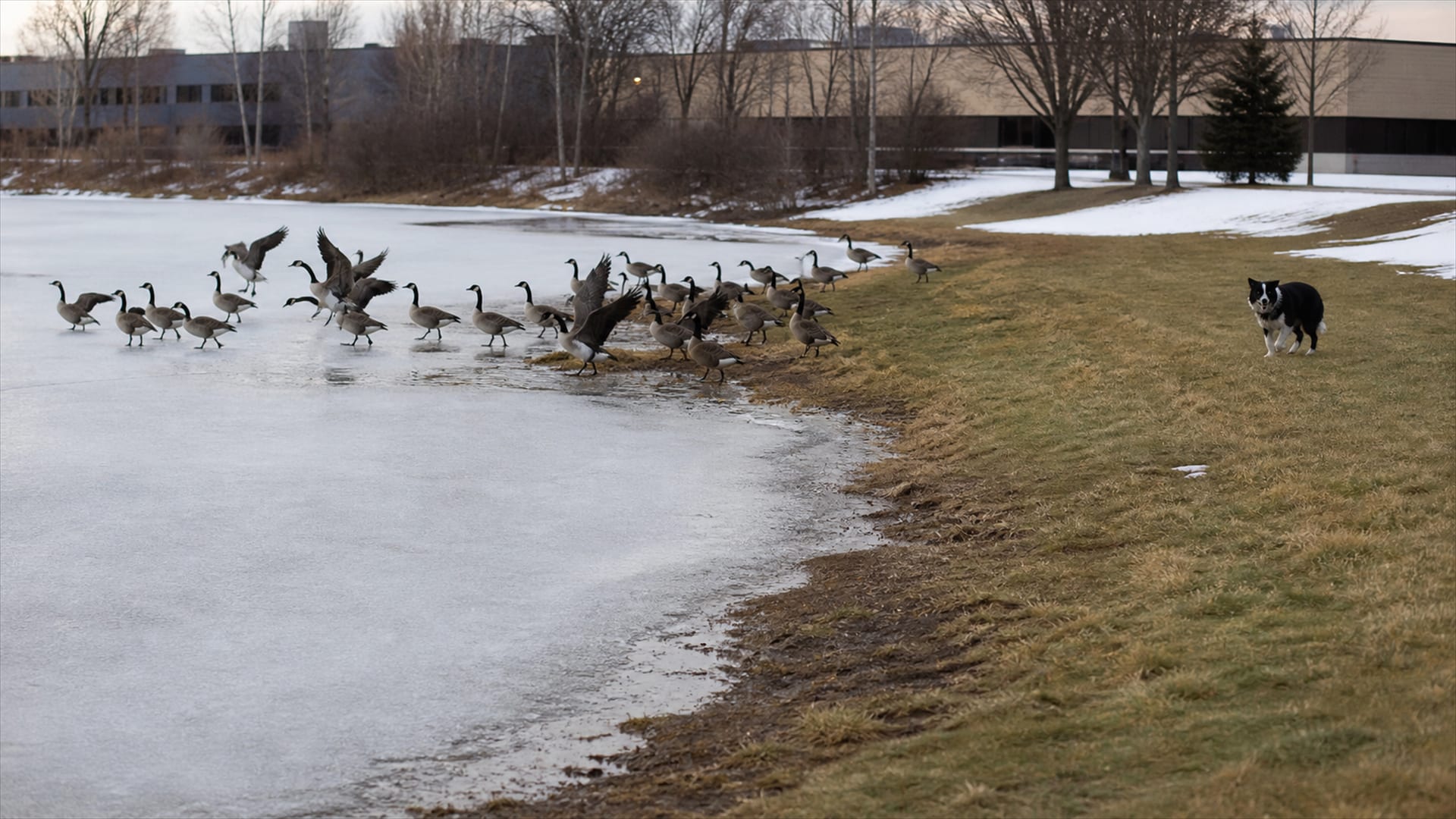
Migrant and resident Canada geese overlap here through fall and winter, and [Connecticut DEEP](https://portal.ct.gov/deep/wildlife/fact-sheets/canada-goose) says they cannot be told apart by appearance, so a December count cannot tell you which birds will leave.
02
A mild winter can leave substantial numbers of migrants in Connecticut all season, which means "they will move on" is a hope rather than a plan.
03
The winter problem is usually a roost problem: birds concentrate on whatever open water remains, so the ground that matters is the water rather than the lawn.
Do Canada geese actually migrate anymore?
Some do, some do not, and both are on your property at once. That is the part that makes winter confusing.
Resident geese nest and live here year round. Migrants breed further north and move through or settle for the season. Connecticut DEEP is direct that the two overlap in fall and winter and cannot be distinguished by appearance, which is why counting birds in December tells you how many you have and nothing about how many will still be there in March.
The federal environmental impact statement on resident Canada geese covers the same ground in more depth. The species is listed among protected migratory birds at 50 CFR 10.13, and that protection applies to every bird on your pond whether it was hatched three miles away or six hundred.
The practical consequence is worth stating plainly. Nobody, including us, can look at your December flock and tell you which birds are temporary.
Why your winter flock got bigger
Why is your pond suddenly the popular one?
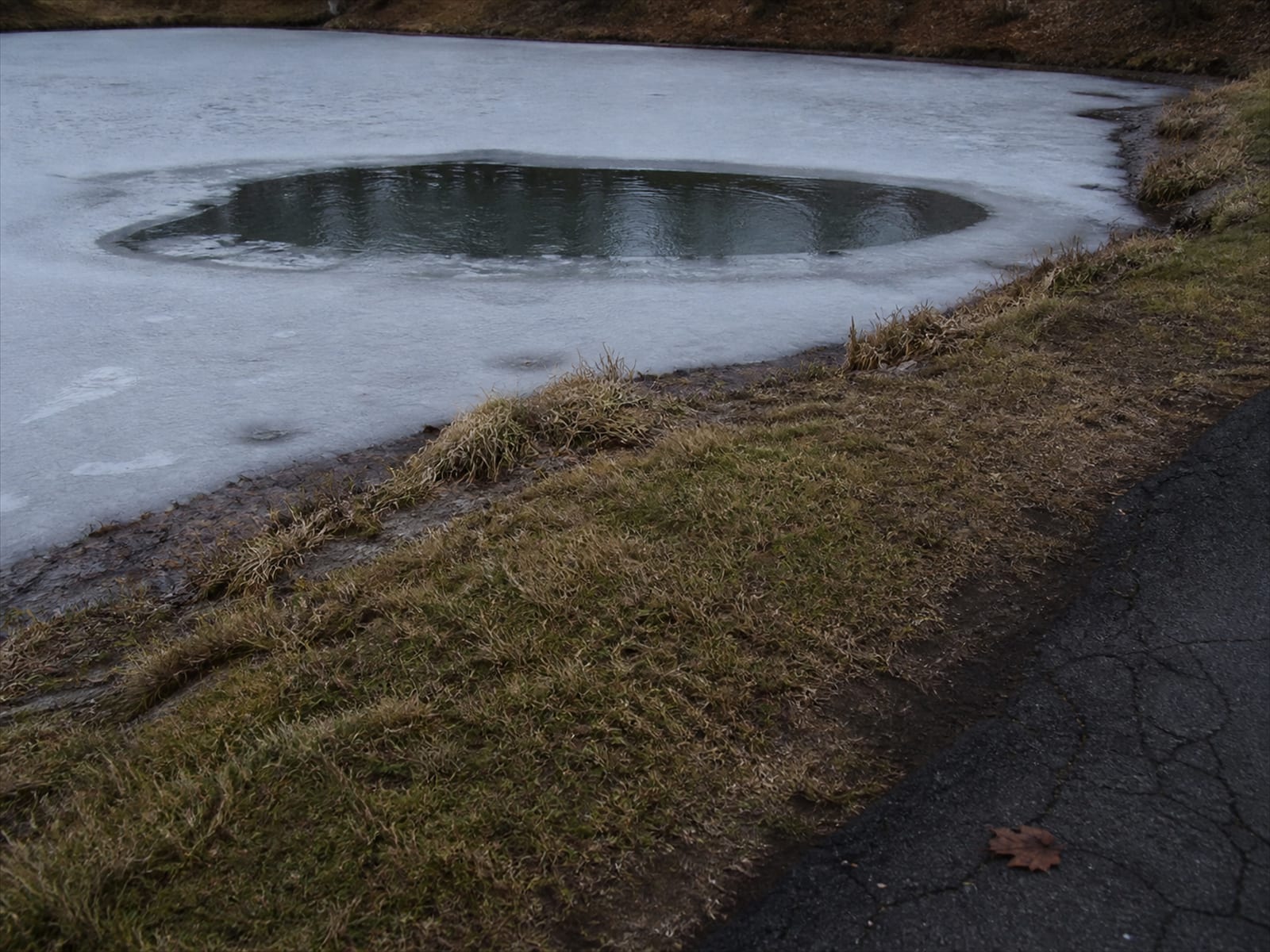
Because in a cold snap the number of options collapses, and open water is what a goose needs at night.
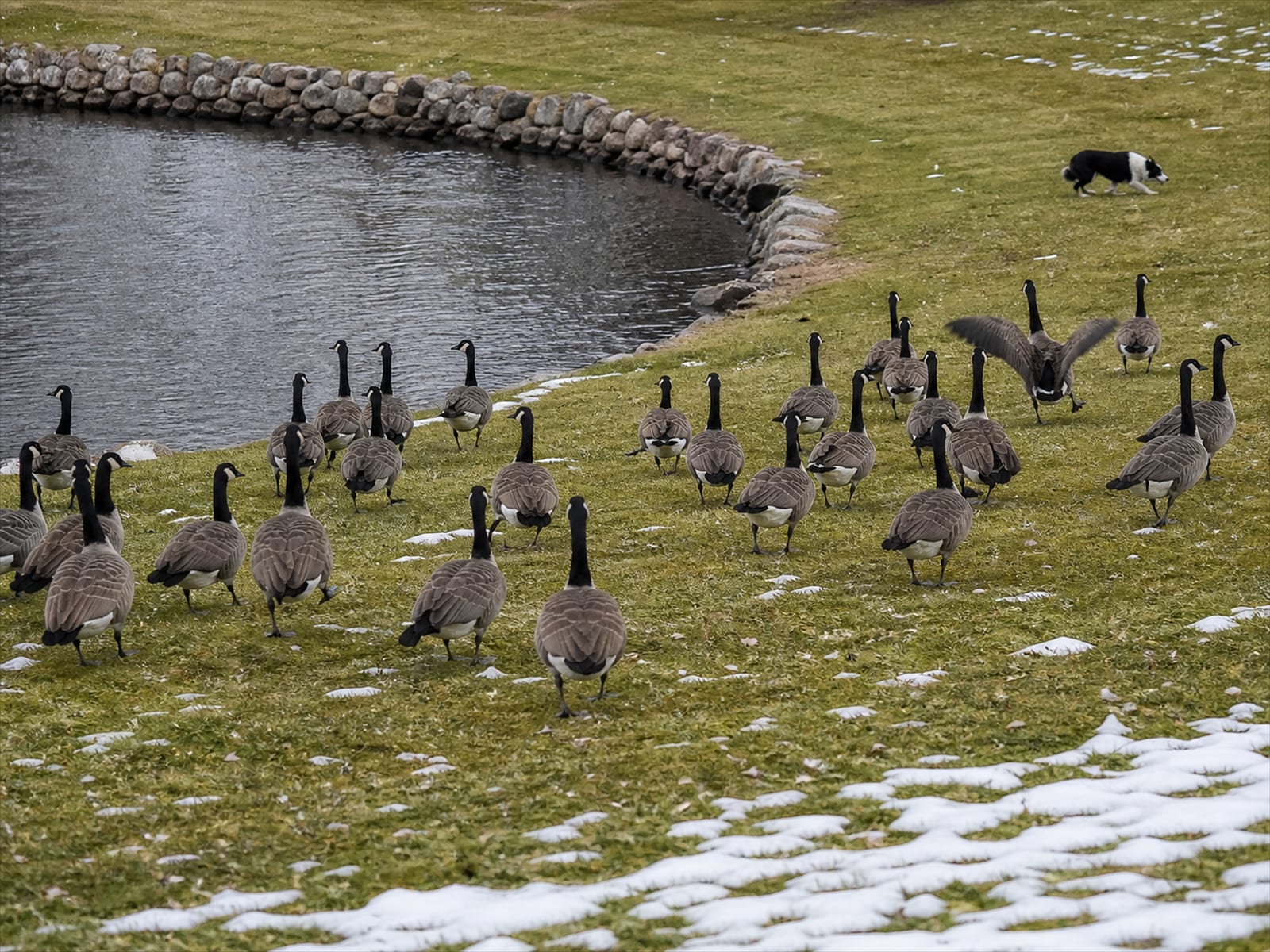
Geese roost on water. It is safety from ground predators, and in winter it is also thermally sensible. When surrounding ponds freeze, the birds redistribute onto whatever remains unfrozen, which can be a pond with aeration, moving water, a warm outflow, or simply enough depth and use to stay open. A property that had a proportionate share of the local flock in October can be holding an unreasonable share of it in January purely because the neighbors froze.
Connecticut DEEP describes the habitat combination the birds seek, and in winter the balance within that combination shifts. Lawns, waste grain, athletic fields, parks and golf courses supply the feeding, and low-disturbance open water supplies the roost. The birds will commute between the two.
That commute is the most useful thing to understand about your winter problem, because it means the ground doing the damage and the ground holding the birds may be two different places, possibly on two different properties.
Is the winter mess actually worse, or does it just look worse?
Both, for different reasons.
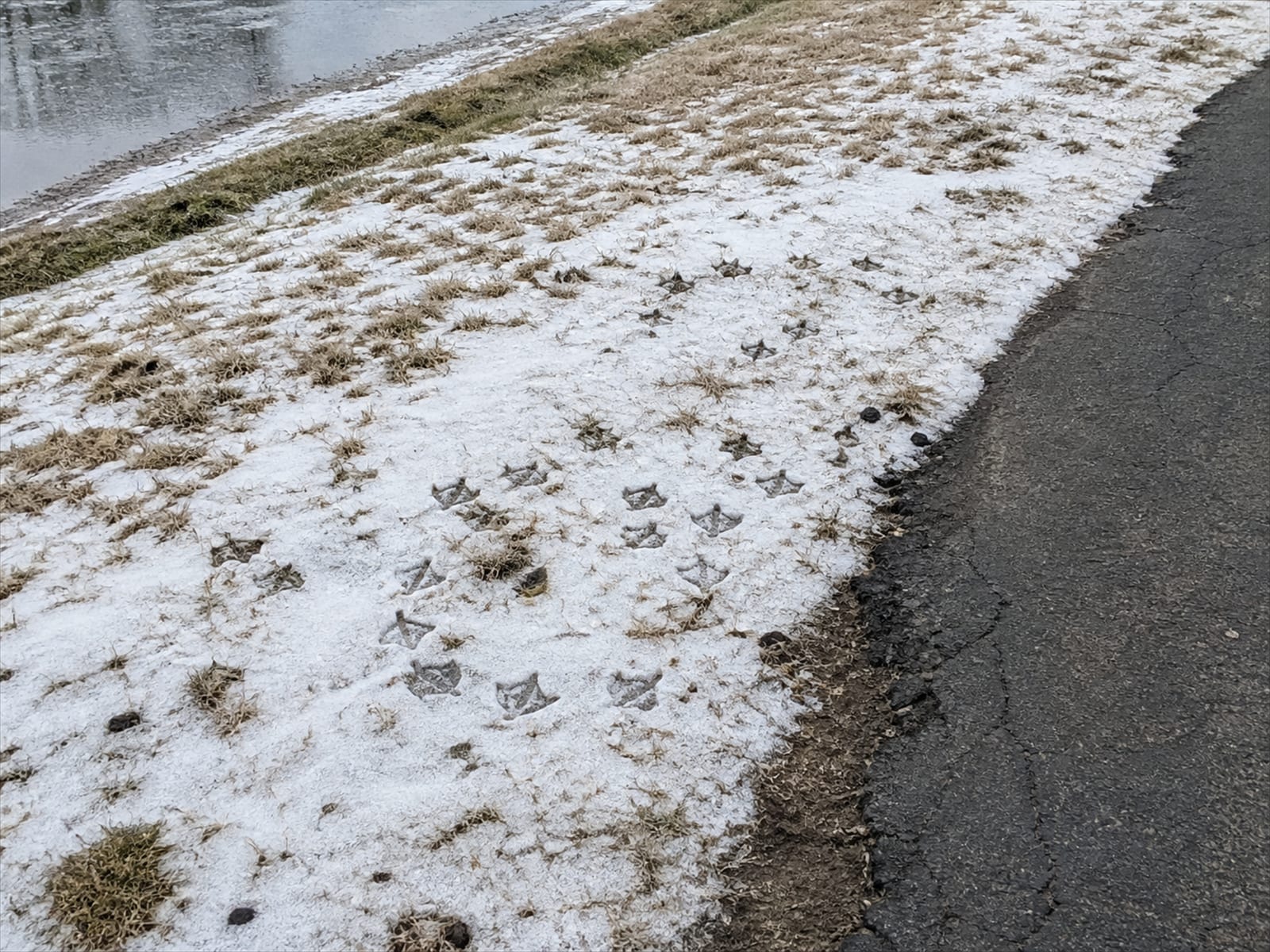
The volume is real. MassWildlife puts a single Canada goose at roughly one half to one and a half pounds of droppings per day, so tripling the flock triples the daily load on whatever surfaces they use. Nothing about winter reduces that.
What winter adds is that the surfaces recover more slowly and the cleanup options narrow. Frozen ground does not absorb, dormant turf does not grow through damage, and pressure washing a walkway is a different proposition in January than in July. Grazing pressure on dormant grass also does damage that will not be visible until spring green-up, which is why some properties get a nasty surprise in April.
There is a water quality dimension as well. USGS documents Canada geese contributing fecal contamination to water bodies, and a concentrated winter roost on a small pond is exactly the loading scenario that produces.
The winter, as your property experiences it
Fall
MassWildlife describes broods gathering into large flocks by fall. Your count starts climbing before any migrant arrives.
Early October into November
CT DEEP describes migrant arrival beginning and continuing through the period. The flock composition changes without looking any different.
December and January
Surrounding water freezes and birds concentrate on whatever stays open. This is usually when the complaints peak, and when staffing is thinnest.
Through a mild winter
CT notes substantial migrant numbers can remain all season. Waiting for departure is not a reliable plan in a warm year.
Late February into March
Territorial behavior resumes and pairs begin defending nesting areas. The winter problem hands directly into the spring one.
What actually works in cold weather?
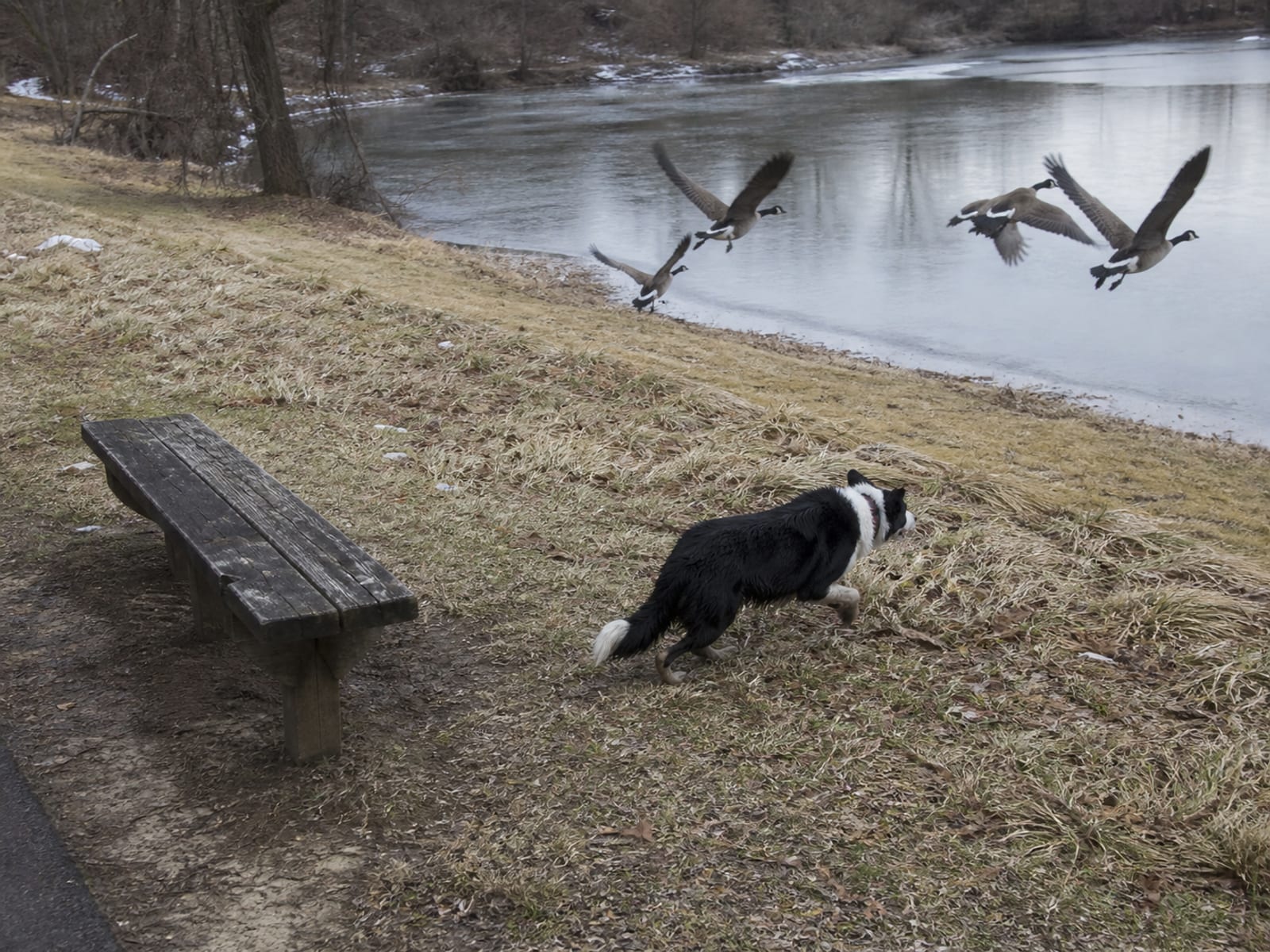
The same principle as the rest of the year, applied to the roost rather than the lawn, and with a couple of practical differences.
The principle is repetition. New York DEC says persistent combination methods are normally necessary and that no single technique is universally effective. CT DEEP says geese adapt to noise and that the desired effect is not achieved without reinforcement. Neither of those statements has a seasonal exemption.
The differences are practical. Daylight is short, which compresses the window when work can happen. Ice changes what is safe to approach and can put part of a pond out of reach entirely. And the birds are working harder to meet their energy needs, which means a site offering reliable food is harder to give up than the same site would be in September.
The most important adjustment is target selection. If the birds are roosting on your water and feeding somewhere else, working the lawn accomplishes little. If they are feeding on your turf and roosting elsewhere, the reverse is true. Establishing which one you are is the first job, and it takes observation at more than one time of day.
Working out what you have, before spending anything
01
Count at dawn and at midday
A roost count and a feeding count are different numbers. The gap between them tells you what role your property is playing.
02
Find the open water
In a freeze, whatever stays unfrozen locally is the anchor. It may not be on your parcel.
03
Map the commute
Where do they arrive from and leave toward. The flight line often crosses a boundary, which changes who you need to talk to.
04
Identify the food
Turf, waste grain, or somebody feeding them. APHIS treats artificial feeding as a core factor, and winter is when it does the most work.
05
Record what surfaces suffer
Walkways, entries, playing surfaces, pond banks. This is what you will be judged on in spring.
06
Check what will show in April
Grazing damage on dormant turf is invisible now and obvious at green-up. Note where it is heaviest.
What can you measure through the winter?
More than you would think, and the measurements you take now are the argument for next year's budget.
The load is quantifiable at site level. MassWildlife puts one bird at about one half to one and a half pounds of droppings a day, and identifies goose use of lawns, golf courses, gardens, beaches and water supplies. From that, a property can track droppings removal weight or the labor hours spent on it, the extent of grazing damage, and the number of days a surface was effectively unusable. New York DEC lists overgrazed lawns and nutrient loading to ponds among the recognized conflicts, which are the two that show up later.
No universal dollar loss exists in the published record, so do not go looking for a figure to borrow. Your own labor hours are the honest number, and they are more persuasive to a budget holder than somebody else's average would be.
The measurement worth adding, because almost nobody does it: mark where grazing is heaviest while the birds are actually on the ground. Dormant turf hides the damage until green-up, and a property that photographed the affected areas in January can explain the bare patches in April instead of guessing at them.
Where the birds are, across this region
Winter concentrates a regional pattern onto a few sites, so it helps to know what the pattern is.
Connecticut DEEP identifies the settings where geese concentrate: lakes, marshes, ponds, reservoirs and rivers, alongside lawns, parks, golf courses, athletic fields, agricultural fields and airports, plus the bays and inlets of Long Island Sound. It reports the highest resident populations in Fairfield, Hartford and New Haven counties.
Read that list as a winter survey checklist rather than as background. The combination that matters in January is short turf next to water that stays open, and in our service area that describes a great many corporate campuses, municipal parks and golf courses within a short flight of each other.
It also explains why a single property rarely solves a winter problem alone. If your pond is the only open water for a mile, you are hosting the neighborhood, and the useful conversation may be with the neighbors rather than only with a contractor.
What does the law allow in winter?
Exactly what it allows in summer. There is no seasonal relaxation, and there is a specific trap worth knowing about.
Non-injurious dispersal remains available. New York DEC states no federal or state permit is needed to scare, herd or chase geese, including with dogs, so long as no bird is physically harmed. That is the lane we work in, in January as in June.
The trap is hunting season. Waterfowl hunting is a regulated activity with its own seasons, licenses and rules, administered by the states, and Connecticut's provisions sit in chapter 490 of the general statutes. The existence of an open season somewhere does not create any authority for a property owner or a contractor to take a bird on a commercial property. Those are entirely separate things, and conflating them is how people get into trouble.
Nest and egg work does not apply in winter, since there are no nests, but for completeness it runs through 50 CFR 21.162 and an annual registration held by the landowner. And the general prohibition at 16 U.S.C. 703 applies year round to every bird on the property.
Winter rules, quickly
Pick an answer to see how you did
1. Waterfowl season is open in your state. Does that change what your grounds crew may do about the flock on the campus pond?
2. You count 60 birds in December where you had 20 in August. What does that tell you?
3. The pond is partly frozen and birds are packed onto the open section. What is the most useful thing to establish?
Nothing answered yet.
Should you wait until spring?
Only if you are comfortable with what waiting costs, and you should decide that deliberately rather than by default.
The case for waiting is that some of these birds are migrants and some will move on as water opens up elsewhere. That is true.
The case against has three parts. A mild winter may not deliver the departure you are counting on. The daily fecal load does not pause, so the surfaces people use keep accumulating for months. And the winter flock hands straight into the spring one: by late February, CT DEEP describes territorial behavior beginning, which means the birds that stayed are the birds that start looking for nest sites on your ground.
That last point is the one most properties miss. A site that let a large flock settle undisturbed through the winter has spent four months confirming itself as a good place to be, immediately before the season when the birds decide where to nest.
Winter terms worth knowing
Tap a term to see what it means
Resident geese. Birds that nest and live locally year round. Present in December, and the ones most likely to nest on your ground in April.
What This Means for You
The number on your pond went up for reasons that are mostly not about your property. Migrants arrived, this spring's young joined the flock, and surrounding water froze, and the result concentrated on whatever stayed open. None of that is a failure of anything you did in the summer.
What is within your control is narrower and more useful. You can establish whether your ground is the roost or the restaurant, because the answer determines whether anything you do will work. You can stop any feeding. You can keep a record of which surfaces are taking the damage, which is what you will need in spring. And you can decide, with the costs in view, whether letting a large flock settle in undisturbed until March is a choice you want to make right before nesting season.
If you want somebody to walk it with you while the pattern is visible, call Tri-State Geese Patrol on (203) 856-4889. Winter is genuinely a good time to look, because a freeze shows you exactly where the birds are anchored in a way that summer never does. We work out of West Hartford across Connecticut, Massachusetts and New York, and we run more than one crew, so a property ninety minutes out gets the same schedule as one nearby. Our Border Collie goose abatement supplies the repetition the agencies say a single measure lacks, and habitat modification is where we look at why the site is worth commuting to in the first place. You can also send us a message with the details.
Keyword: canada geese in winter