Tri-State Geese Patrol

Goose Control in Berlin, CT

Humane Canada goose abatement for Berlin properties, using trained Border Collies that move birds without touching them. Berlin has more named water than most towns its size, and more owners holding pieces of it.

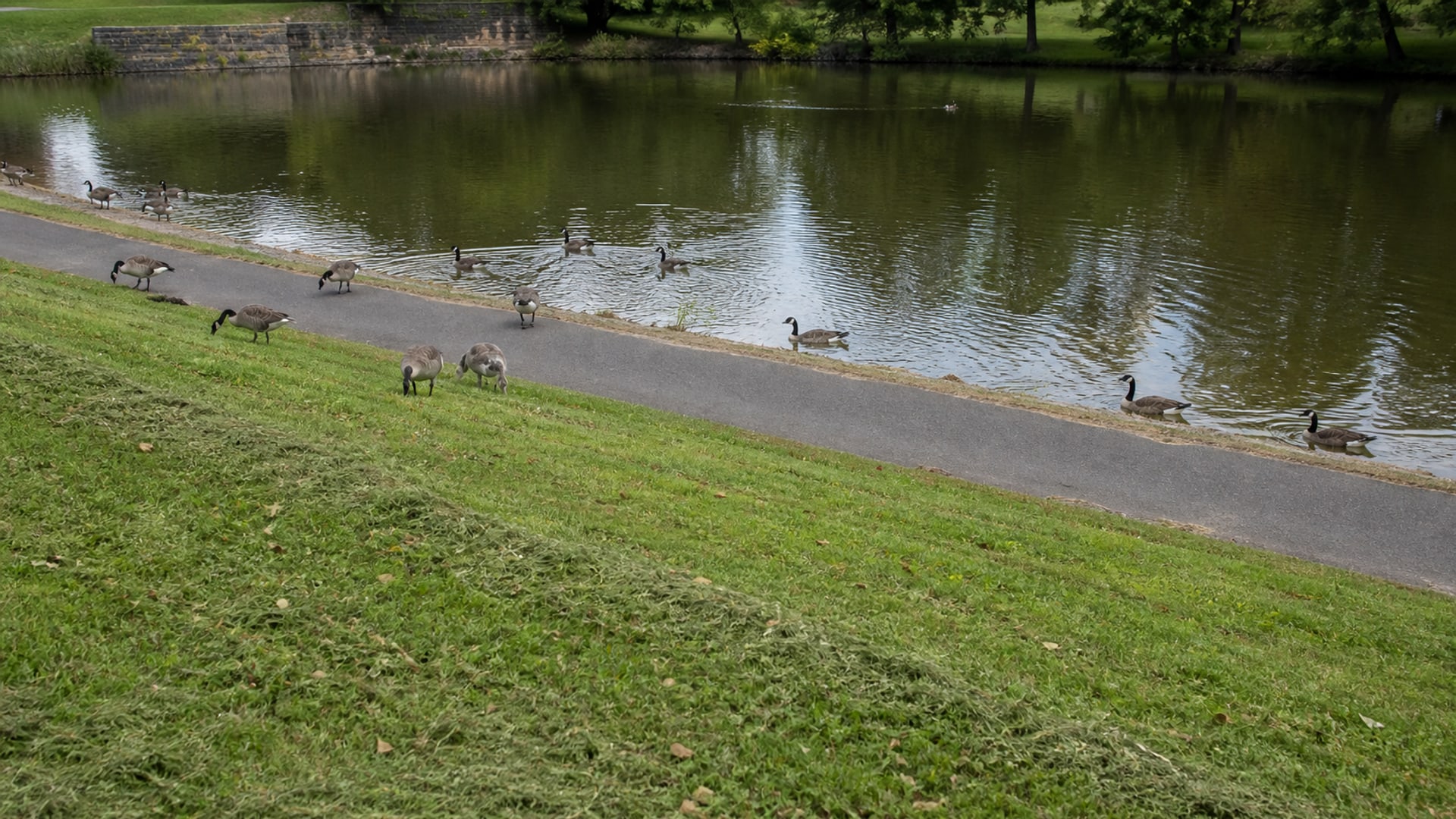
Open mown grass beside water of the kind Canada geese settle on in Berlin, CT

At a glance

Town

Berlin, Connecticut, including Kensington and East Berlin

Method

Non-lethal herding by trained Border Collies, no contact with any bird

Permit needed to move geese this way

None, provided no bird is harmed

The local complication

Several different owners hold Berlin's water and turf

Why does Berlin have so much goose ground for its size?

Because the town is unusually well watered, and because a lot of that water sits next to mown grass that people use.

Berlin's adopted 2023 Plan of Conservation and Development names the Mattabessett River, Belcher Brook, Crooked Brook, Hatchery Brook, Spruce Brook, Webster Brook and Willow Brook as the major watercourses. On the still water side it names Silver Lake, Upper and Lower Hart Pond, Paper Goods Pond, Railroad Pond, and the Hallmere, Merimere and Kenmere reservoirs. That is a long list for one town.

The same plan counts 628 acres of recreation facilities, split as 474.3 active acres and 120.4 passive, and that figure excludes conservation land. Add 348.3 acres at Timberlin Park and 77 acres at Sage Park and the shape of the problem becomes clear: a lot of maintained turf, a lot of water, and in several places the two are adjacent.

That adjacency is the whole thing. Connecticut DEEP describes the habitat that holds resident Canada geese as lawn beside water. Short irrigated grass is better food than anything in a hedgerow, the open sightlines let a bird see what is coming, and water a few steps away is an escape route. A goose does not need a property to be neglected. It needs it to be exactly what a playing field or a golf course is.

What Berlin does not have, on the record, is a documented town goose program, complaint file or news report to point at. We would rather say that than borrow a statewide fact and dress it up as a Berlin incident.


Where does lawn meet water in Berlin?

These are the documented Berlin settings where the pattern exists. Where the town's own record stops short of confirming a water feature, this says so rather than filling the gap, and none of these are named as customers.

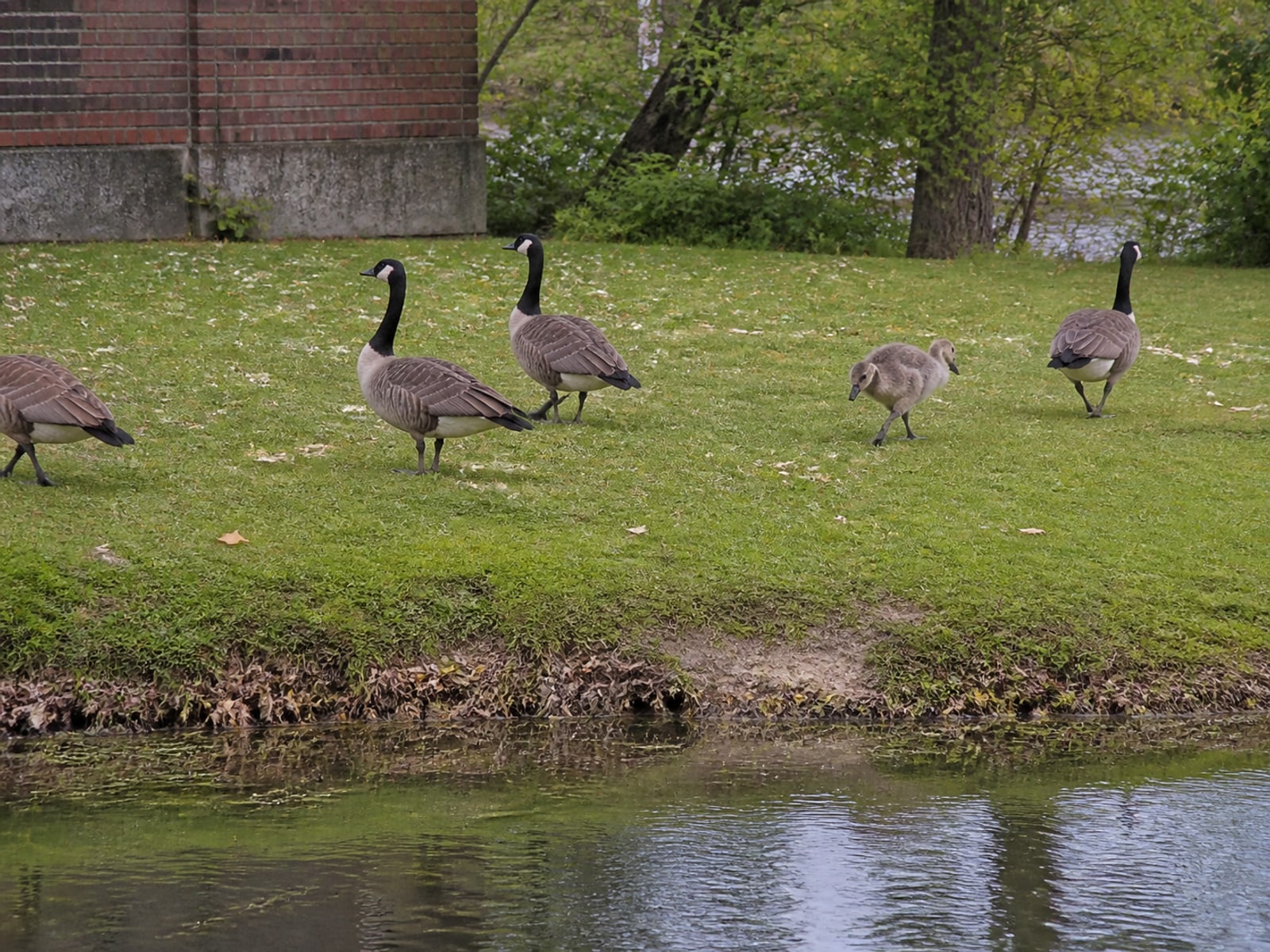
Canada goose droppings and grazed turf on maintained ground in Berlin, CT

Willard Pond and the fields around it

A 9.8 acre site at 1020 Norton Road that includes Dennehy Field and Smith Field, with Emma Hart Willard School and its youth soccer field next door at 1088 Norton Road, and Catherine M. McGee School at 899 Norton Road described as within walking distance. That is a named pond with school and town fields packed around it, which is the clearest lawn-beside-water cluster in the town record. Parks and Grounds is the function that determines safe ice conditions there, which tells you who already has a stake in the pond.

Railroad Pond, which has two names and a dam

Town recreation material says Railroad Pond is really Marjorie Moore Pond and dam, entered beside the Berlin Community Center and the Arthur B. Powers Municipal Complex on Kensington Road. The Kensington Dam impounds the Mattabessett River to form the 12 acre pond, its repair and fishway installation were completed in 2019, and the Paper Goods Dam sits immediately upstream. The town describes it as conservation land with a wooded trail rather than open mown turf, which changes what is worth doing there.

Timberlin, a town-owned golf course

An 18 hole municipal course at 330 Southington Road, at the base of Ragged Mountain, owned by the Town and run with its own Golf Course Commission, Golf Director and Grounds Maintenance contact. That governance is genuinely different from a private club, because the decision and the budget sit in different places. The town's own record does not document ponds or streams on the course, so we will not claim any until somebody walks it.

Sage Park, and what is actually established

Berlin's 77 acre athletic complex, home to Berlin High School's Scalise Field at 238 Kensington Road. It is a large maintained turf site and it belongs on any list of Berlin ground worth looking at. What the record does not show is an adjacent named water body, so a page that gave it pond frontage would be inventing one. Large open turf can hold geese on its own, particularly with water nearby, but that is a question for a site walk rather than a claim.

In Berlin, who actually owns the water?

This is the Berlin question, and it catches out anybody working from a map. A pond inside the town line is not automatically town property.

Connecticut DEEP's water diversion notice for this area joins the New Britain Water Department, the Kensington Fire District and the Worthington Fire District together in Berlin, and names White Bridge Pond, Wasel Reservoir, the Hart Ponds and the Mattabessett River. Berlin also has its own Water Control Commission with authority over the town's water and sewer systems. So three utility-type entities plus a town commission can all have an interest in water within the same municipal boundary.

The land side is layered too. Parks and Recreation administers the recreation facilities. Parks and Grounds handles grounds work and the ice determination at Willard Pond. Public Works is separate again. Timberlin has a Golf Course Commission, a Golf Director and a Grounds Maintenance contact of its own. Berlin Public Schools holds the school athletic land. Which of those you are talking to changes with the parcel, not with the problem.

This is why the first hour of a Berlin job is spent on ownership rather than on birds. It is not bureaucracy for its own sake. A program that starts before the right person has approved it is a program that gets stopped halfway through the season, and on shared water it can be stopped by somebody who was never asked.

Where activity might affect a wetland or watercourse, the Inland Wetlands and Watercourses Commission is the body, and it publishes regulations covering application requirements, procedures, hearings, decisions, enforcement and fees. Moving birds off turf with a dog is not the same as work in a regulated area, so it would be wrong to say every Berlin visit needs a wetlands permit. Planting or building at a pond edge is a different matter, and the commission decides that, not us. The town does not publish a typical review time, so nobody should be promising you one.

What does Berlin's dog rule mean for a dog-based program?

It means the permission conversation happens before the scheduling conversation, and in Berlin that rule is stricter than in most neighboring towns.

The town's enforcement notice says the December 2021 leash ordinance requires dogs to be on leashes on public property, including town parks and public sidewalks, citing Town Code Chapter 3, Section 3-10. Berlin's park rules go further: dogs are not allowed on playing fields, playgrounds, golf courses, tracks or outdoor courts at all.

Read that against the list of sites above and the significance is obvious. Playing fields and golf courses are precisely the surfaces geese use, and they are precisely the surfaces the park rules name. No exemption for commercial or working dogs appears anywhere in the town material we can find.

So on municipal turf in Berlin, a dog-based program needs town approval as a first step, in writing, from whoever holds that site. Any company that tells you it can simply arrive and work a Berlin field is describing something the published rules do not currently allow, and that is worth knowing before you sign rather than after somebody complains.

On private ground, a course under private ownership, an association's common land, a company's own lawn, the rule does not apply in the same way and the path is shorter. The Berlin complication is specifically a municipal one.

What happens after you call about a Berlin property?

The fieldwork is the same everywhere. In Berlin the front end is longer, because the ownership map is.

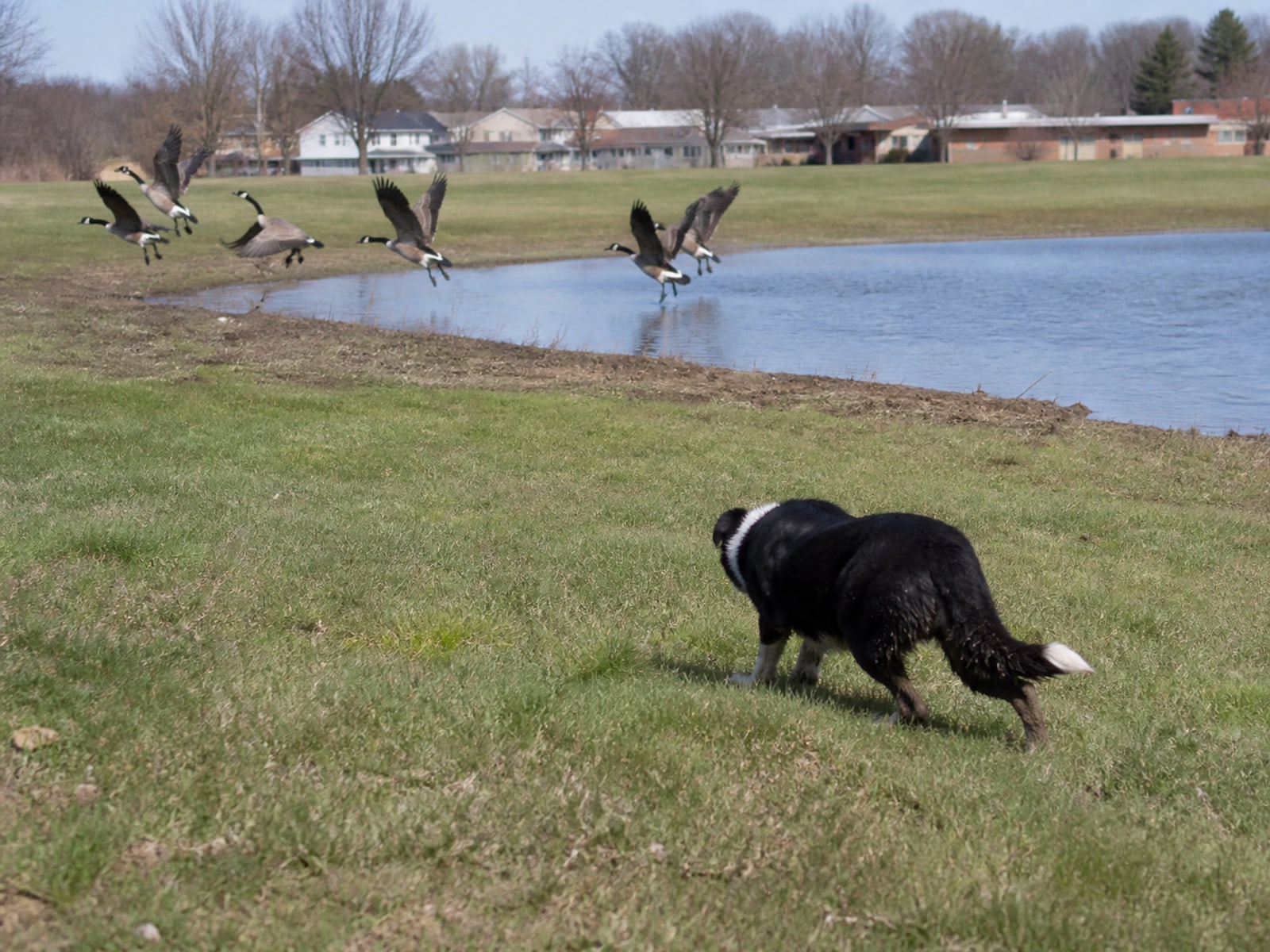
A Border Collie working a flock of Canada geese off maintained ground in Berlin, CT
  1. 01

    We establish who holds the site

    Town park, school athletic land, Timberlin, Water Control, a fire district, a water department or private ground. This is not a formality here. It decides who approves the work, who pays for it and which rules apply to the dogs.

  2. 02

    We ask what you are seeing

    How many birds, on which surfaces, at what times, how close the nearest water is, and what has already been tried. A method the flock has already learned to ignore changes what to do next, so previous attempts are useful information rather than an embarrassment.

  3. 03

    We walk the ground and map the route in

    Geese walk between water and turf, so the useful map is where they come up from the water, which grass they graze, where they loaf, and which of that you control. On a site like Willard Pond, with two schools and town fields around one 9.8 acre parcel, several people control a piece of it.

  4. 04

    We get the permissions before anything is scheduled

    On municipal turf that means written approval given Berlin's leash ordinance and park rules, and it means asking the Inland Wetlands and Watercourses Commission before anything that could count as a regulated activity near a pond edge or watercourse.

  5. 05

    The dogs work on a schedule the flock cannot predict

    A handler works the ground with a trained Border Collie. The dog holds a stalking posture, head low and eyes locked, and a goose responds to that the way it responds to a predator, by leaving. There is no contact and no capture. The visits then repeat at times the flock cannot anticipate, because a schedule birds can learn is a schedule they will wait out.

  6. 06

    We tell you what to change about the ground, and keep a record

    Where mowing stops, whether an unmown strip or a barrier can go between water and turf, and where feeding is happening. Then counts, locations, how long the birds take to come back after each visit, and complaints. That return interval stretching is the earliest honest sign the ground is changing meaning to the flock.

What we do not do, and why we say it up front

Two techniques come up in most Berlin conversations and neither is ours.

We do not apply turf repellents. They are registered pesticides, applying one to commercial turf in Connecticut is licensed work, and we hold no such certification. If a repellent suits a defined surface on your property, a licensed applicator is the person to call.

We do not addle eggs or work on nests. That is regulated activity, and in Connecticut the landowner registers with the US Fish and Wildlife Service before anything happens, with the state accepting that federal registration and adding a further requirement where a commercial control firm is involved. It is not something a contractor can simply offer. DEEP is the authority to ask about the current route before anything happens, and the authorization sits with the landowner, the association or the town, not with a vendor. If somebody offers to handle a nest on Berlin ground, the right question is who is authorized for this site.

We also do not promise the geese will be gone and stay gone. Connecticut DEEP's own guidance is that non-lethal methods other than habitat work tend to be transitory when used alone, and that lasting abatement takes several strategies together. A guarantee of permanence from fieldwork alone contradicts the state that regulates the species.

Berlin goose control questions

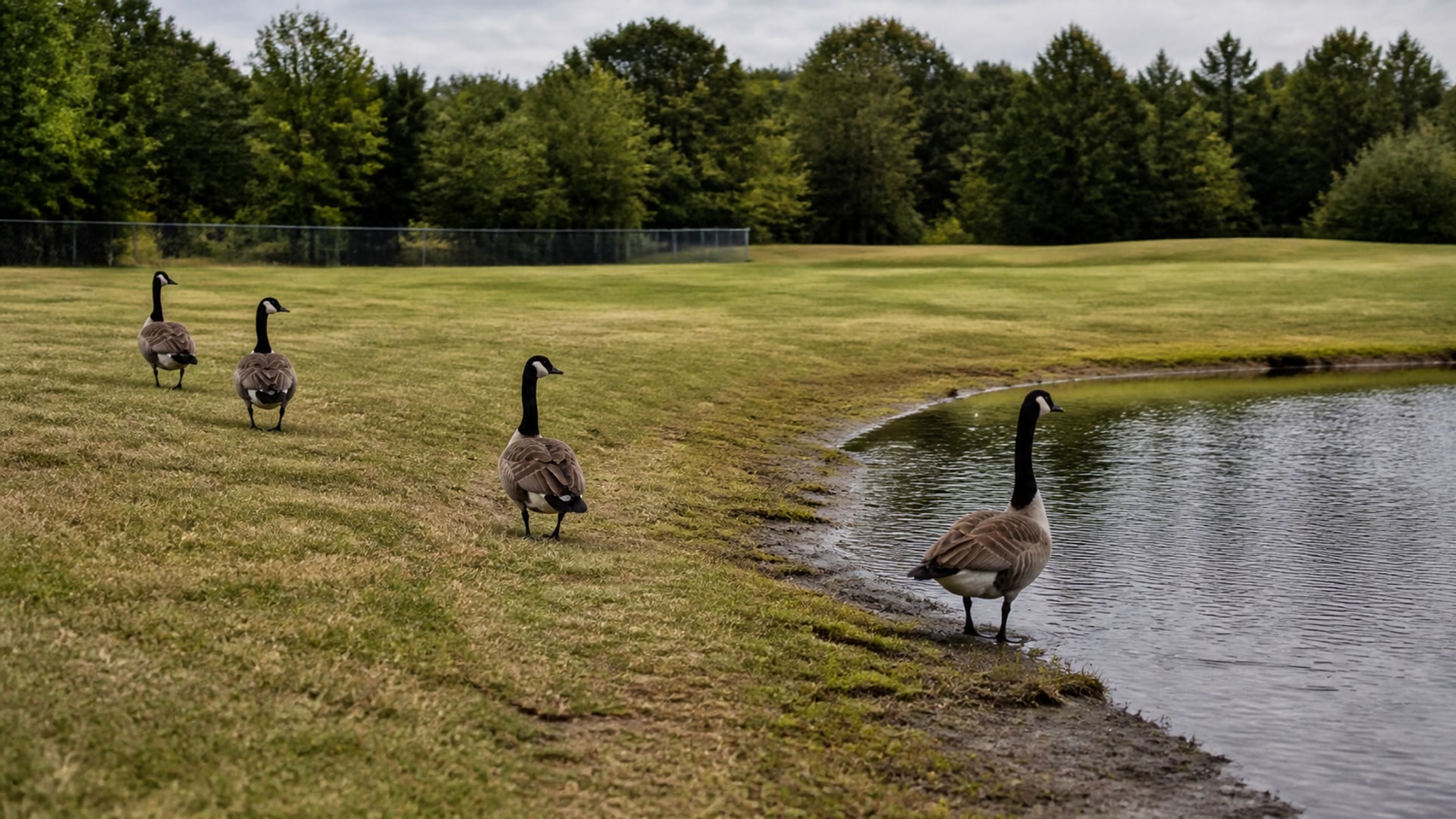
Maintained ground in Berlin, CT holding clear of Canada geese after repeat visits
Can a trained dog work on a Berlin town field?

Not without town approval. Berlin's December 2021 leash ordinance requires leashes on public property, and the park rules say dogs are not allowed on playing fields, playgrounds, golf courses, tracks or outdoor courts. No working-dog exemption appears in the published town material, so written permission from the site's owner comes first.

Is Willard Pond a town problem or a school problem?

In practice it is both, which is why it is worth sorting out early. The 9.8 acre site carries Dennehy Field and Smith Field, Emma Hart Willard School sits alongside at 1088 Norton Road, McGee School is within walking distance, and Parks and Grounds makes the ice safety call there. Several parties have a stake in the same water.

Do we need a wetlands permit for goose work near a Berlin pond?

Not for moving birds off turf with a dog. Berlin's Inland Wetlands and Watercourses Commission regulates activity in or affecting wetlands and watercourses, so shoreline planting or a barrier at a pond edge is a question for them. Its regulations cover applications, procedures, hearings, decisions and fees, and the town publishes no typical review time, so treat any promised approval date with suspicion.

How much does goose control cost in Berlin?

It is quoted per site. The drivers are how much ground is worked, how many birds, how much water edge, how often we visit and what the ground is used for. No credible published range exists for this work in the region. For a municipal buyer there is a second question, because Berlin's currently adopted bid threshold was not something we could confirm from published material, so check that with Purchasing before treating any quote as procurement ready.

Will the geese come back?

If nothing about the ground changes, yes. Connecticut DEEP says non-lethal methods other than habitat modification are transitory when used alone. That is why the fieldwork and the grounds changes belong in the same plan rather than in different years, and why we would rather talk about mowing lines than sell you visits.

Does Timberlin get treated like a private course?

The turf problem is similar, the decision path is not. Timberlin is town owned, at 330 Southington Road, with its own Golf Course Commission, Golf Director and Grounds Maintenance contact, so approval and budget do not sit in one office. The town record also does not document ponds there, so anything about water on the course would come from a site walk rather than from us assuming it.

How quickly can you get to a Berlin property?

Berlin addresses vary a lot, from Kensington to Norton Road to Southington Road, so a townwide drive time would be wrong for most of them. Tell us the address and the time of day you want us there and we will give you a real answer instead of a number that flatters us.

Local detail

Canada geese in Berlin, Hartford County

Berlin is a Hartford County town of about 20,000 residents whose three hamlets, Berlin, East Berlin and Kensington, each carry their own local identity and their own water.

For a town this size the water inventory is unusually long. The 2023 plan of conservation and development names the Mattabessett River and seven brooks, along with Silver Lake, the Hart Ponds, Paper Goods Pond, Railroad Pond and three reservoirs. That water is held by several different bodies, including the town's own Water Control Commission, the New Britain Water Department and two local fire districts, so the first question on any Berlin site is who actually owns the pond.

Neighborhoods we cover in Berlin

Parts of Berlin where we work. Each one opens in Google Maps.

Bordering towns: New Britain, Newington, Rocky Hill, Southington, Cromwell, Meriden, Middletown. A flock does not recognize a town line, so a program sometimes has to be scoped wider than one parcel.

Getting there: Route 9, Kensington Road, Norton Road, Southington Road, Route 372, Route 15.

We cover all of Berlin and the ground around it. If your neighborhood is not listed, or you are not sure which one you are in, it is very likely we work there. Ask and we will confirm.

Talk to us about your Berlin property

Tell us what you are looking at: roughly how many birds, which surfaces they are fouling, how close the water is, and who owns the parcel. If you are not sure of that last one in Berlin, you are in good company, and it is the first thing we will help you work out.

Tri-State Geese Patrol runs humane Canada goose abatement with trained Border Collies across Connecticut, Massachusetts and New York, and we are reachable 24 hours. Call (203) 856-4889 and it goes to Bill.

If what your Berlin site actually needs is an unmown strip and a no-feeding sign rather than a contract, that is what we will tell you.